



SOUTH PORTLAND – The moment when Grade 5 from South Portland’s Dora L. Small Elementary School arrived in Guptill Hall, the basement dining room at the First Congregational Church on Meeting House Hill, was pure pandemonium, as might be expected when 72 schoolchildren land anywhere in unison.
But the chaos lasted only a moment as the students raced to their places and took a seat. Then came a moment of quiet expectation, as the school’s older students waited to be served. After all, it was just one year ago when the tables were turned, and they were tasked with preparing a meal made from fruits, vegetables and herbs grown in the school’s own garden.
Would this year’s spread be as good as the one they’d prepared the year before? Did this year’s fourth-graders do a good job raising the seeds Grade 5 planted the previous spring? With 20 fewer students in this year’s fourth grade, could the young chefs possibly hope to put on as good a feast? It didn’t take long to get an answer.
“They did awesome,” said Truly Franciose-Chillemi. “I’m going to have seconds.”
The annual Harvest Feast, now in its ninth year, is a high point for students at Small Elementary, almost as eagerly anticipated as prom is for high school students. Each year, fourth-graders start nurturing seedlings in their classrooms as early as February. By spring, the plants
are transplanted to the school’s garden, which was augmented this past year with six new raised beds and a donated irrigation system.
During the summer, the garden is tended by parents and volunteers. Then, in the fall, the new fourth-grade class takes over, spending 60-90 minutes in the garden every Thursday, raking, weeding, watering and, ultimately, harvesting.
It all culminates in a two-day event each fall when fourth- graders use the food they’ve grown to put on a meal for the students who planted the seeds the previous year. With teachers, parents and local dignitaries such as the superintendent of schools and the city’s mayor on the guest list, the students can feed as many as 150 people each season.
“It’s sort of amazing that the seeds we planted made this big meal,” marveled Franciose-Chillemi, as she savored fresh kale cut from the school garden that very morning.
“It means a lot to us,” said her friend and fellow environmental club member, Zoe Collins. “It just feels really good to be eating stuff that we planted.”
“If you just go to the store and buy tomatoes, that’s one thing, but when you grow them yourself and then cook them, it makes them taste so much better,” said fifth-grader Digby Roberts. “I appreciate my food a lot more now knowing how much work goes into growing it.”
That, feast organizers say, is the whole point of the annual exercise.
“It’s a great way to integrate our kids into the community, but it’s more than that,” said the head of this year’s event, Margaret Donahue. “In a classroom, you’re doing reading, writing and arithmetic, and that’s important, but when we’re in the garden I hear things from kids like, ‘This is the best part of my day. I love this so much. Do we have to go inside?’”
Although most of the students say they’d like other South Portland schools to create gardens as extensive as theirs and put on their own harvest meals, Superintendent Suzanne Godin said this event will likely remain exclusive to the Willard neighborhood school.
“I think every school finds its passion and its focus, and this seems to be Small school’s,” she said. “But it was a fabulous meal. It’s exciting to see the kids harvest what they planted during the year and to share with each other their harvest.”
“My daughter absolutely loves being out in the garden,” said Jessica Williams. “Every time she comes home from school on Thursday, she’s always very excited and energized by it, and wants to talk about her day.”
“I’ve been involved in every aspect of volunteering at our school, and I think the reason the kids like this so much is that they do it,” said Donahue, “Whether it’s making butter or cutting carrots, it’s more about the process than the product.”
But it can also be about opening young eyes to new foods, such as when Donahue and other parents brought a cook stove out to the garden this fall, so students could sample fresh-steamed edamame sprinkled with sea salt.
“There are so many kids that eat different ways based on how their families eat and don’t try a lot of food,” said Donahue. “It’s cool for these kids to kind of reach outside their comfort zone and try different things.”
The harvest feast itself, on the other hand, can be outside everyone’s comfort zone – a two-day frenzy fueled by countless hours of preparation that never seem like enough.
“Every year it’s like, ‘How is this going to happen?’ and every year it does. It’s so special and reflects South Portland as a special community,” said Donahue.
For some, this year’s meal was particularly special, given the rancorous tar-sands debate that has split the city along sharp political lines.
“Some of us who are handling the feast are on opposite sides of the tar-sands issue, but the interesting thing is, here we are coming together to do this for the kids,” said parent and event volunteer, Julia Selser. “It hasn’t interfered at all, because we’re all there for the kids. It’s definitely providing some common ground during the tension of the election.”
“Politics doesn’t come into this in any way, not even a millionth of a percent,” agreed Donahue.
“I’m totally blown away by how amazing this all is, how hard the parents worked, but also the kids, preparing all the food,” said Williams, a freshman volunteer. “It’s great, and they’re really excited.”
For Nora Caouette, the high point of the feast was learning to make butter from cream supplied by Westbrook’s Smiling Hill Farm.
“You get to shake the cream while you’re dancing to music,” she said, with a laugh.
“It was really fun to do it with friends and interesting to learn what we would be making,” said her classmate, Alex Cook, who enjoyed learning to use a grinder, and peeling eggplant to make baba ganoush.
Both also say they’ve learned lessons about the value of composting food scraps.
“It helps our environment a lot, and it’s really good for your plants so you can grow great stuff,” said Collins, who is one of four Small students leading a new composting initiative that is expected, by year’s end, to move from the classroom to the cafeteria.
“It’s a full cycle,” she said. “It’s basically turning food into compost and then the compost becomes soil that helps grow more food.”
“This is an absolutely wonderful event,” said Mayor Tom Blake, who attended the feast with his wife, Dee Dee.
“A popular movement in American cities today is urban homesteading,” he said. “It’s all about growing your own food, having your own chickens, having bees in your backward. This is just what we’re trying to promote here in South Portland, to be sustainable.”
“To be a part of their feast and to take part in the fruits of their labor, it’s absolutely wonderful” said Blake. “You can’t beat it.”
Still, it’s not all fun and games. In many ways, large and small, Small school has used its garden project to lead what has since become a citywide focus on project-based leading.
“I think it’s a huge, huge positive part of our fourth-grade curriculum,” said teacher Becky Dadmun. “It helps students connect what we are doing in class to a real-life situation that matters to them. It is a tradition that they definitely look forward to.”
“It’s really the culmination of a lot of work they put into it,” said PTA Co-President Erin O’Conner-Jones. “I think it’s a great parent-school partnership that really supports project-based learning, with real, practical lessons on how to apply math and science skills.”
“Through the garden we’re able to connect math to real-life situations,” said Dadmun. “For instance, when we created new garden beds, the children worked with calculating perimeter and area. Also, just planning the garden, figuring out how to lay it out, means calculating things like how many inches each plant needs. The garden also gives us an opportunity to tie in our science curriculum as well, with study on the water cycle, landforms, weathering, erosion, and what’s in the soil that helps plants grow.”
The school funds the garden and the annual feast with the sale of seeds it gets from Fedco in the spring, along with the wintertime sale of poinsettias. The latter represents what school officials call a “symbiotic” relationship with the Morrison Center for the developmentally disabled in Scarborough. Residents there grow the plants, which the students then sell.
This year’s feast also was supported by a donation of 100 pounds of tomatoes by Jordan’s Farm in Cape Elizabeth and a $1,200 grant from Portland Trails, which put Small Elementary on its annual garden tour.
“Really, I think this is an amazing undertaking,” said Adam Perron, the father of fourth-grade twins. “For the kids to understand where their food comes from, and that they can do it themselves, to work together toward a common goal to grow the food and prepare their meals, it’s a great lesson for everybody.”
“I just love working in the garden with the kids. They’re so enthusiastic,” said Stephanie Cook, who volunteers even though her oldest child is only in second grade. “It’s fantastic for the kids to get a sense from the cycle of the seasons. It’s really the best learning. There are life skills kids need to know and what better skill than to learn how to grow your own food?”
“It’s kind of like the senior prom,” said Julia Selser. “The kids are coming though the grades, watching it happen each year. It’s become such a big part of the culture at the school. It’s one of those things where you can’t let the ball drop. Even though it’s all parent and volunteer driven, it’s got to happen.”
“It’s absolutely worth it,” said Jeffrey Selser, who spent this year’s Oct. 25 feast behind an apron washing dishes. “You have people from all different walks of life, with all different skill sets, who come together to make a pretty fabulous school garden and then a fantastic meal. Anything that brings people together, especially now, is fantastic. Any time we have a chance to sit down with our neighbors, break bread, and enjoy delicious food, who could pass that up?”
 South Portland Mayor Tom Blake enjoys a moment with Small Elementary School students, from left, Dylan Winship, Ethan Willette, Katharine Bennett, Samantha Hillier, giving a thumbs up to the school’s annual Harvest Feast.
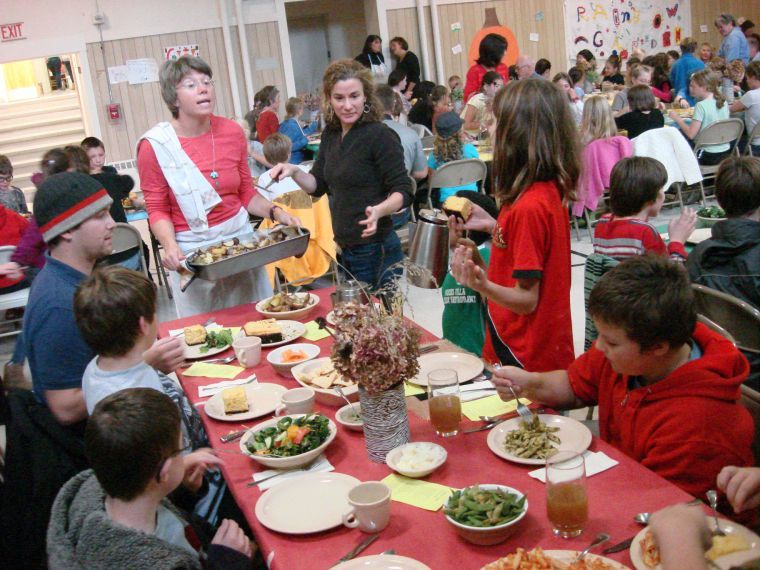 Stephanie Cooke, left, and Julie Selser serve up garden delights at last week’s Harvest Feast.
Send questions/comments to the editors.
