



An environmental group that speaks out throughout New England on pollution issues has come out against Sappi’s plan to burn construction waste, naming the company to its “Dirty Dozen” list.
Will Everitt, associate director of the Toxics Action Center, went to the Sappi mill in Westbrook Nov. 28 to present the company with its “Dirty Dozen” Award. Everitt explained the group annually issues a list spotlighting 12 facilities around New England that the group feels present a significant threat to public health and the environment and need immediate action by industry and government officials.
Sappi was nominated for the list by the members of Westbrook for Clean Air, a citizen’s group formed to block Sappi’s proposal to burn construction waste. “We recognize the threat both to public safety and the health of local residents and neighboring communities,” said Robert Foley, a member of Westbrook for Clean Air. “Our group felt Sappi could be a potential candidate for this unfortunate award.”
Sappi has filed an application with the Maine Department of Environmental Protection for a permit to burn the debris. The material, which would consist of old lumber and construction debris that has been processed and chipped into small fuel chips, would be used to fuel one of the mill’s boilers. As part of the application process, the company held a test burn of some of the material in March. Both the company, and the Maine Department of Environmental Protection, which monitored the test, said the results showed no danger from the material.
The Department of Environmental Protection plans to hold a public hearing on the Sappi application sometime in late January. While a date for the meeting hasn’t been set, the meeting will be held in Westbrook.
In advance of the state’s public hearing, Westbrook for Clean Air held an informational meeting at the Walker Memorial Library on Dec. 1 regarding the Sappi application.
About 25 people attended the meeting, the majority of whom spoke out against the Sappi proposal. Bill Brown of Colony Road said Sappi was a large corporation that didn’t care about the health and welfare of residents.
“We must be aware that they could care less about us,” he said. “They care about the bottom line.”
Bob Morrill of Conant Street said he remembered the days when the mill was at full operation and the resulting smell that emanated from the plant. “My father-in-law said ‘that’s the smell of money,'” he said.
Morrill pointed out property values in the city have gone up since the mill downsized and the smell went away. He said he would like to see the mill remain in operation and continue to provide jobs, but in an environmentally friendly way.
“I have no desire to be the dumping ground and take us back to the way we used to be,” he said. “We don’t want our city and our children to be harmed.”
While the mood at the meeting was overwhelmingly against the Sappi proposal, one resident defended the company. Ray Pepin, a Westbrook resident who retired as the environmental manager for the Sappi mill in 1999, said the mill takes great strides to protect the environment.
Pepin said while he no longer works at the mill, he is still familiar with the way it is run and he said Sappi takes extreme caution to ensure the mill is well within state pollution standards. “I live here,” he said. “I have no fear.”
Everitt said while the company has said there is no danger he is not convinced. “It poses a significant health threat not only to the people in Westbrook but to people throughout Maine,” he said. “They’re planning on burning construction and demolition waste in the largest community in Maine, the greater Portland community. If they burn this waste here, they’ll release dioxin, arsenic, mercury into the air here.”
Sappi Spokesman Jeffrey Pina said there is no truth to the allegations leveled by the Toxics Action Center. “I think we’re disturbed by the lack of facts and understanding,” Pina said. “I think they’re being extremely misleading when they say it’s harmful to the environment. That’s not the case.”
Randy McMullin, an environmental specialist with the Department of Environmental Protection, who is handling the Sappi application, said the results of the test burn were well within standards allowed by the state, and he didn’t see a problem with burning the material.
He said all of the material comes from processors who specialize in processing construction debris for fuel. He said the processed material is examined by an inspector to ensure the material is safe to burn. “We’re not going to let anything happen that’s dangerous to anybody,” McMullin said.
Pina said the company plans to purchase most of the construction debris from a processor based in Maine. He said all of the material would be screened by the processor for hazardous material before it is burned.
“They have regulations and standards they have to follow,” he said. “It’s not a free for all.”
McMullin said the state was satisfied with the results of the March burn. “It showed just what we thought it would show,” he said. “This is no problem.”
Foley said he still wasn’t convinced. He said he didn’t think there were enough controls on the material being burned, and he felt the mill did not have up-to-date anti-pollution equipment. “We’re talking about a facility here that does not have the technology, and it does not have the air scrubbers (necessary to ensure safety),” Foley said.
Pina said that allegation was absolutely untrue. “The mill has some of the most advanced air scrubbers,” he said. “Sappi values and is very committed to the environment. We have zero tolerance for environmental issues. We’re going to do everything we can to be in compliance with state and federal regulations.”
At the meeting at the library, Pepin also took issue with the contention the mill was lacking the latest pollution controls. “You don’t know what you’re talking about when you say it doesn’t have controls,” he said.
Pina said Sappi would be holding an informational meeting at the mill on Dec. 15. Pina said the time of that meeting has not been set. Check the American Journal’s Web site at www.keepmecurrent.com for details.
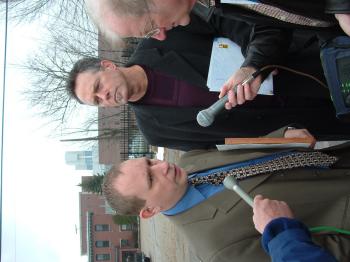 Will Everitt, associate director of the Toxics Action Center (left) and Robert Foley of Westbrook for Clean Air (right) speak to reporters outside the Sappi mill on Monday.
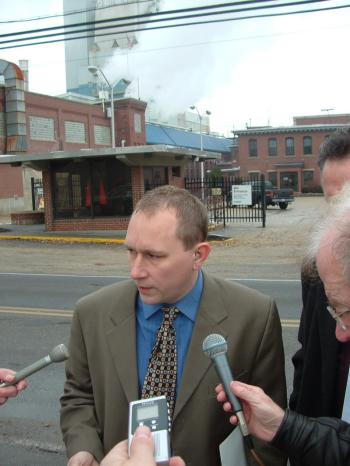 sappi 1 Will Everitt, associate director of the Toxics Action Center, discusses the cernter’s decision to name Sappi to its annual “Dirty Dozen” list outside the mill Monday morning.
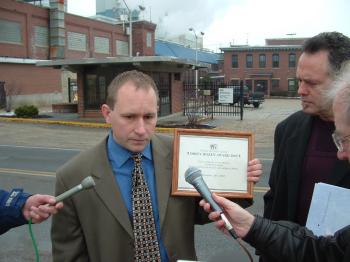 Sappi 3 Joined by Robert Foley of Westbrook for Clean Air (right) Will Everitt of the Toxics Action Center displays the “Dirty Dozen” awared he was presenting to Sappi outside the mill Monday monring.
Send questions/comments to the editors.
