



Once a month two Cape Elizabeth Public Works employees spend a full day flushing out the sewers in the Elizabeth Park neighborhood, to prevent backups that could flood the basements of nearby homes.
“This sewer system is a ticking time bomb,” said Jim Green, public works supervisor, about Elizabeth Park.
At a public hearing on Monday, April 11, the Town Council will hear residents’ comments on a $5.4 million sewer rehabilitation proposal.
Based on a report prepared by OEST Associates of South Portland, in conjunction with the town, the plan calls for 17 separate projects spread throughout the town that were deemed priorities.
Kevin and Rachel Davis live in Elizabeth Park and were present at a neighborhood meeting on March 31, organized to inform residents who would be affected by the project. The 60-year-old clay tile pipes in the Davises’ neighborhood are decrepit with age and move with the earth, causing the pipe sections to shift apart, creating a situation ripe for sewer blockage.
The couple experienced the result of a deteriorating sewer system last year, when one day they found their basement had been flooded from a sewer backup.
It turned out the couple had to replace the sewer line linking their home with the main line in the street. They hired a contractor for a half-day job to dig a trench in the yard and replace the pipe.
But the town does not have detailed maps of the system for many of the older neighborhoods, and gave the contractor the wrong information about where the house pipe met up with the main line. The half-day job turned into a three-day effort, with the Davises’ entire lawn ripped up to find the line.
The sewer rehabilitation is “desperately needed,” the couple said after the meeting Thursday evening. A second neighborhood meeting for residents in the northerly section of town will be held Thursday evening, April 7, at 7:30 p.m. in Town Hall.
One worry the couple has is that Cape residents who do not live in neighborhoods affected by the dilapidated sewers will not support the expensive rehabilitation plan.
“I hope people have a wider community view,” said Town Manager Mike McGovern in a telephone interview. “I have every confidence that support is at about 80 percent.”
McGovern said the project will not increase sewer fees or taxes for Cape residents, because the town has retired old debt.
“We’ve been waiting for other debt to be retired, and we’re taking advantage of this window,” McGovern said.
The Town Council does not need to send it to referendum, but if the council votes against the plan, the town would continue doing the projects piecemeal, though “in the long run that just ends up costing more money,” Rachel Davis said.
The price tag for the rehabilitation is $4.85 million, but the total to be borrowed is $5.4 million, which includes several costs not directly associated with the construction. These include paying a bonding counsel, a financial planner, bonding fees, calculated inflation and a cushion for unintended costs, McGovern said.
“The price tag is very expensive,” said Bob Malley, director of Public Works, at the meeting. But, he said, “we need to take care of our infrastructure.”
That infrastructure, according to the report, consists of approximately 43 miles of sewer pipe, 900 manhole structures and 26 pump stations that collect and convey wastewater to two treatment plants.
With funding from the town the Portland Water District maintains the pump stations and the treatment plant on Spurwink Avenue, while Cape Elizabeth is responsible for the 43-mile web of subsurface pipes. Sewage from the neighborhoods in the northern section of town is pumped to a treatment plant in South Portland.
“The portion of the sewer collection system that the town maintains currently has numerous deficiencies,” the report states. Some of these are deteriorating clay tile pipes, which are more than 60 years old, defective manholes, lack of easements and root infiltration that leads to significant inflows of groundwater.
But, Malley said, “it’s not all a sewer problem.” He said some neighborhoods have roads that were built before any standards for road construction existed.
The $4.85 million cost estimate also includes drainage, curbing and full depth reconstruction for some of the roadways planned for improvements. The report estimates that the cost to rehabilitate only the sewer elements is roughly 65 percent of the total cost.
Neighborhoods such as Elizabeth Park and Winding Way-Running Tide Road were earmarked for major, full-depth reconstruction, which means that both sewers and roads would be completely redone with proper drainage and paving.
Malley said the Public Works Department has been doing about one project a year, progressively upgrading sections of the town’s sewer system.
“But, that’s just not enough,” Malley said.
By far, the most expensive aspect of the plan is the sewer rehabilitation, full-depth road reconstruction and curbing of Elizabeth Park, at an estimated cost of $1.8 million.
Green said the plan is a good one. Instead of upgrading the dilapidated sewer system piecemeal it makes much more sense to “bite the bullet … do it right,” he said. Rehabilitating the sewer and fixing the old roads makes sense and saves money at the same time, he said.
The cost of full-depth reconstruction for the Running Tide Road-Winding Way-Masefield Terrace neighborhood would cost $749,000. Other roads that would have portions completely overhauled include Surf Road, Woodland Road, Charles Road, Bay View Road, Ocean View Road and Wood Road.
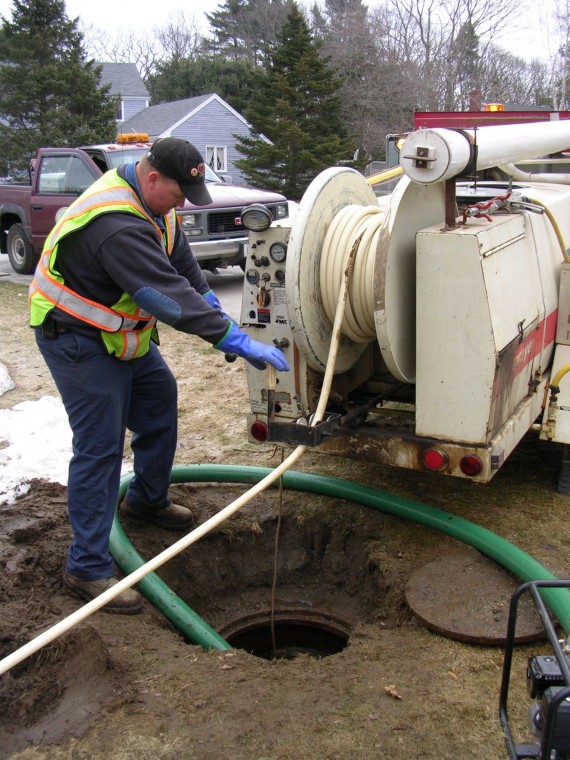 Cape Elizabeth Public Works employee Ronnie O
Send questions/comments to the editors.
