



The historic house at 92 Cumberland Street known simply as “The Elms” has been sold to a Portland commercial real estate and business broker for use as his private residence.
For almost a century and a quarter, the Elms has been associated with the S.D. Warren and Sappi mills, serving as a residence, guest house and in later years, for mill functions.
New Westbrook resident Scott Balfour closed on the home on March 21 and moved in right away. A life-long Cape Elizabeth resident who works in Portland, he said he has no plans for any major renovations of the 8,400 square-foot home. “It’s in wonderful shape,” he said.
According to Sappi spokeswoman Brooke Carey, the company decided to sell the property because it was no longer using it as a guesthouse for clients as it had for over a century. With changes to the mill reducing its size and any need for entertaining clients on the scale it used to, it didn’t make sense for the company to hold onto it any longer, she said.
“It had a long history as a guesthouse, but around 1999 it was no longer used in that manner,” she said, adding the house was only accommodating one or two clients per year at that point. “The company would use it for functions and meetings but not enough to justify its expense.”
The city, along with the Cornelia Warren Association and Westbrook Historical Society, looked into purchasing the property for use by the city in some capacity, but in the end the approximately $800,000 list price, along with the maintenance costs proved to be too much.
Long-time Sappi employee Bill Currier said the residence is relatively expensive to maintain. In the 1980s, Currier oversaw the house as quality manager for the mill. He said through that period the house employed a manager, a chef, and a housekeeper, as well as a driver for the large Cadillacs the company used to transport guests mostly from Boston to the mill.
Currier said several months ago, after the mill decided to sell, the Cornelia Warren Association, of which he is a member, approached the Westbrook Historical Society to see if the society wanted to use the house as a base for its operations. Currier said the foundation offered to purchase the house and donate it to the historical society.
“If it had use for the historical society and we could protect the Warren name, we were interested,” he said.
Westbrook Historical Society President Rob Smith said the society met with Mayor Bruce Chuluda, City Administrator Jerre Bryant, and the Cornelia Warren Association and also toured the home. In the end, though, he said even if the society was “basically given” the property, it would be hard-pressed to maintain it on its own.
“As for the historical society going it alone, that probably wasn’t happening,” he said. “It would be a lot of work to maintain.” He also said there were other issues such as limited parking for society meetings.
“It’s a challenging location from a community standpoint because of the parking,” said Bryant, who said the city looked at various uses for the home.
The home was built in 1882 as the residence for S.D. Warren Mill Agent William L. Longley, who lived in the home for only two years before dying in 1884. Thereafter, the home was used by the mill as a guesthouse, according to Elms tour information from 1979.
During the mill’s heyday, some guests wrote of the elegance of the Elms.
“Describing the Elms is like painting the lily,” wrote a former guest, Mr. F.L. Miller in the May 1920 issue of “Warren Monthly.” “It’s not a club, (though) it possesses all the advantages of one; not a hotel, though it radiates all the hospitality and cheer which poets tell us about in describing some famous olde inn of other days; not a home, because no one complained if you dropped ashes on the rug. Perhaps it might be called an blend of all three.”
The house was designed and built by architect John Calvin Stevens, one of the most prolific and well-known architects in Greater Portland history. Stevens greatly influenced the face of Portland after the 1866 fire that leveled much of the town. He designed hundreds of homes in Portland as well as commercial buildings in the Old Port area downtown.
On May 2, 1974, the Elms was included in the National Register of Historic Places as part of the Cumberland Mills Historic District.
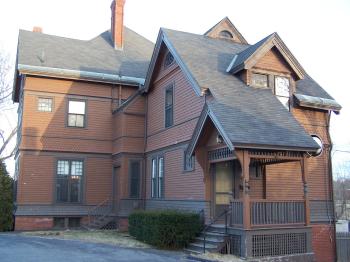 The historic Cumberland Mills home known as “the Elms” was recently sold to a Cape Elizabeth man who plans to use it as a private residence.
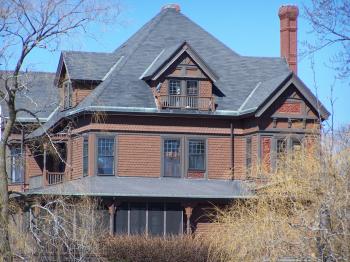 Long used as a guesthouse for clients of the S.D. Warren mill, the Elms was recently sold for use as a private residence.
Send questions/comments to the editors.
