



POWNAL – Two families forge a friendship over maple syrup.
POWNAL – Longtime Pownal residents Brewster Staples and his wife Judy remember meeting the five members of Dawson family on Halloween night four years ago.
“I was struck by how nice and wholesome they were,” said Brewster Staples, 74. “It was just great to see a family that really seemed to enjoy each other’s company.”
A year after their first meeting, John Dawson called the Staples and asked if they would let his family tap a few of the Staples’ maple trees that dot their yard on Allen Road. Without hesitation, the Staples agreed, and both a friendship and tradition launched.
Brewster Staples, a Pownal resident for 40 years, had been tapping a few of his trees regularly up until a few years ago. He was even the subject of an article written by the late newspaper columnist Hasty Thompson for his accidental discovery of what happens to frozen sap.
“So Thompson called and looked at our procedure. It was simply old metal taps in trees and you fill up the little milk jugs,” said Brewster Staples. “Not too exotic.”
After inspecting a half-frozen milk jug, he made an interesting discovery.
“I thought it was ruined. It dawned on me that water, when filled with impurities, freezes first and the impurities – maple molecules – go elsewhere if possible. In this case, all the impurities went to the center of the jug, which was still more liquid than the outer,” he said. “I hit it with a half-inch dowel and tasted it. Very flavorful.”
After tinkering with different methods and times for freezing the sap, Staples said he nailed the process.
“We figured it took about 8 hours in the freezer that we had to achieve the perfect level,” he said. “The ice would start on the outside and push the maple molecules to the center, then you just tap it and pour it off into a clean jug. Now you’ve reduced 2 to 1 the effort. The ease of this process meant you could take 50 gallons of sap and reduce it to 12 really quickly.”
Judy Staples said many people tap maple trees along the Allen Road, an informal Pownal tradition that has grown in recent years as more and more people develop a taste for real maple syrup.
Maine’s maple bounty will be celebrated this weekend at the annual Maine Maple Sunday. Maine has estimated 200 syrup producers according to the trade group Maine Maple Producers Association and can lay partial claim to the sweet treats origin.
According to a history of maple sugar written by the Maine Maple Producers, Native Americans indigenous to New England developed the process of making sugar and syrup from the sap of the maple tree. The resulting syrup was widely used by Native Americans and so valuable it was used as currency. European settlers quickly became fond of this abundant natural resource and brought an important new tool for its production-the iron kettle. Up until the introduction of the fireproof kettle, Native Americans had been boiling the syrup by dropping hot stones into thick wooden containers full of sap.
Maple sugar was much cheaper and easier to get than imported cane sugar. Furthermore, cane sugar was part of the chain of slavery, and maple sugar, made by free men, was better suited to the Yankee temperament. Thomas Jefferson tried several times to establish a “sugar bush” at Monticello, and there were even a few attempts to start a maple industry in Europe. Both ventures were doomed by climate, as sugar in maple sap only appears where warm, sunny days and below-average freezing nights follow each other for days on end, a weather pattern common during Maine’s spring.
In addition to their trees, Brewster and Judy Staples are lending their collective maple sugaring wisdom to the Dawsons.
“You could not ask for a nicer couple,” said Kathryn Dawson, mother of the three Dawson kids, Owen, 5; Alexander, 8; and Jane, 10. “This is our third year using their trees and we feel like we’re part of their family.”
The Dawson clan typically produces a modest amount of syrup – four or five gallons – that they share with the Staples.
“It’s great. I cook with it and the kids love to pour the syrup on the snow for a treat,” said Kathryn Dawson.
Like the Stapleses before them, the Dawsons use an age-old method to make the sweet treat. Despite being bestowed the nickname of “liquid gold” for its high retail price, the methodology used to create maple syrup is rustic.
Trees are tapped using a drill to make a small hole. A spike is inserted into the hole and, if conditions are right, the sap drips into a bucket. It can take anywhere from 35-50 gallons of sap to make 1 gallon of maple syrup, said Brewster Staples.
Commercial maple syrup operations will feed the sap into a large holding tank and then into a “sugarhouse,” where specially designed maple sugar evaporators turn the resulting concoction into syrup.
Kathryn Dawson said the real gift of the arrangement was making new friends and becoming part of a centuries-old tradition in Pownal.
“Brewster and Judy made me feel like I’ve known them my whole life,” she said. “For our family, that’s equally as sweet.”
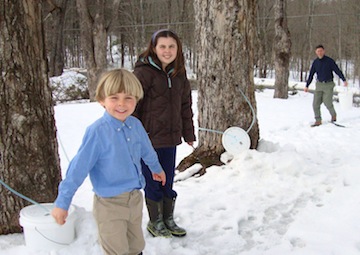 The Dawson kids, from left, Jane, Owen and Alexander, with mother Kathryn, stand next to a maple tree in the yard of Brewster and Judy Staples in Pownal. The Dawsons have been tapping maple trees on the Staples property for the last three years, continuing a tradition. “They are just great people,” said Kathryn Dawson.Staff photos by Matthew Stilphen
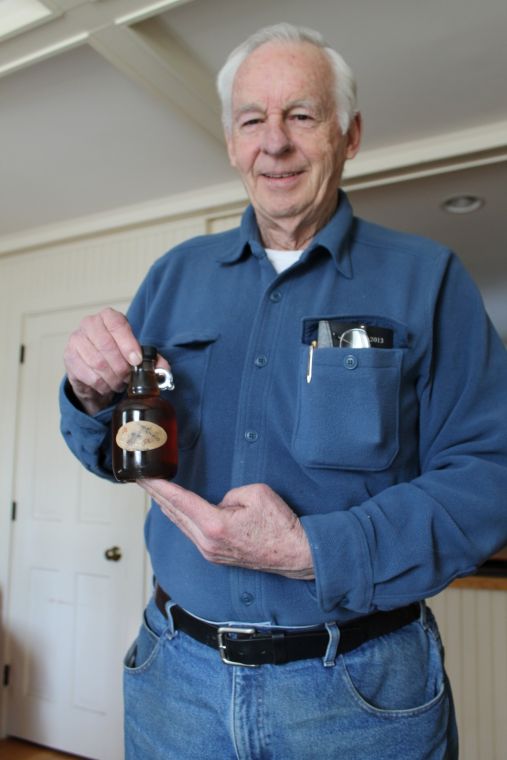 Brewster Staples with a handle of maple syrup made by the Dawson family from maple trees on his yard.
Send questions/comments to the editors.
