



Summer is here, and with it the increasing problem of underage drinking as minors attempt to illegally purchase alcohol from local bars and restaurants.
Store owners not only face a $1,500 fine for selling alcohol to minors, but they also face stiff punitive damages-up to $250,000-if the minors to whom they illegally sell alcohol wind up hurting, or even killing, themselves or others as a result of the purchase.
“We definitely notice an increase of incidents involving underage drinking during the summer,” said Kevin Joyce, chief deputy of the Cumberland County Sheriff’s Office. “A lot of camp councilors and vacationers try to purchase alcohol illegally.”
As a result of the growing problem of underage drinking, the Raymond Mentoring Partnership, an organization funded through the Maine Office of Substance Abuse that offers mentoring programs for students during the school year, hosted a seminar for local businesses on Tuesday night in Raymond on the subject of fraudulent ID detection and Maine liquor laws. The seminar was sponsored by the Cumberland County Sheriff’s Office.
“We want to place a greater emphasis on substance abuse,” said Christina Lamarre, director of the partnership.
Lamarre said the overall purpose of the seminar was to inform local licensees and those who sell alcohol of the issues of underage drinking, making them more aware of what to look for in terms of fake drivers’ licenses and the severity of the repercussions of selling alcohol to minors.
“The seminar really complemented what we’re already doing. We’re taking it one step further by trying to change the environment. If there’s less access to alcohol for minors, there will be less underage drinking,” Lamarre said.
Frank Lyons, a retired captain who was in charge of criminal investigation with the Cumberland County Sheriff’s Office, spoke at the meeting on Tuesday night.
“If you sell alcohol,” he said, “you will sell to a minor. Period.”
Since the state of Maine disbanded its Bureau of Liquor Enforcement in June 2003 and shifted the burden of enforcement onto local municipalities, the problem with underage and at-risk drinking has grown dramatically, Lyons said.
“No one is going out and supervising and overseeing the sale of liquor,” he said. “People are concerned by the lack of enforcement, and we have to rely on self-compliance. All you need to do is open your eyes…kids are doing things that we used to discourage through liquor enforcement.”
The co-owner of Sunset Variety in Raymond, Don McClellan, said he had recently caught a minor using a fake New York driver’s license, and then called the convenience store next door to warn the clerks that he might try his luck there. The minor did attempt to buy alcohol there, too, and his ID was detained and the police were called. The minor left before police arrived.
As another example of local efforts to stem underage drinking, Lyons has helped local summer camps develop policies for their councilors.
“I’ve given them guidelines as to what might be acceptable and how they are accountable,” he said.
Sarah Seaward, director of Camp Nashoba North in Raymond, has benefited from Lyons’ expertise. She said the camp has a “progressive” policy in place where councilors are educated on the issues of alcohol use.
“We have a curfew and a non-drinking, non-smoking policy inside the camp,” she said. “A majority of the councilors are over 21 and well-educated.”
In an effort to reach out to local vendors who sell alcohol, Seaward says that she has given proprietors a list of councilors who are 21 and over so there is no question as to their age. Many of the councilors have out-of-state licenses or passports, which may cause problems for local businesses to verify their age.
Facing sobering fines for the illegal sale of alcohol to minors, some local bars and taverns have a policy in place to deny patrons who only provide out-of-state licenses and passports. Kim Laughlin, manager at the North Shore Tavern in Raymond, said that a large number of patrons are in fact summer camp councilors, and denying these patrons because they don’t have a Maine State ID can hurt business.
“My biggest concern is that these kids have one night out a week. If they don’t have a Maine ID, then we turn them away. And if they don’t have residency, they can’t get an ID. I would like to see if maybe they can get temporary residency status and then get a temporary license,” she suggested.
A huge concern for those in the Lakes Region who sell alcohol is the detection of fake identification. Although Lyons had suggested that the quality of the licenses has lessened over the years because of new security features, constant updates and the fact that teenagers may not have the money to buy top-of-the-line fraudulent identification, the tell-tale signs of forgeries can still elude vendors.
Here are some tips for Fraudulent ID detection, according to Lyons:
1. Studiously compare the physical characteristics of the person standing before you to the picture on the ID. Oftentimes older siblings bequeath their licenses to younger brothers or sisters whom they closely resemble.
2. Check for disclaimers or rhetorical lines on the back of the license. “Not an actual state license” should certainly tip you off.
3. Look for the issuing agency on the card. If the card is issued by anyone other than the state, it’s a fake.
4. Closely examine the holographic image on the ID. Most times, the image is three-dimensional. A good rule of thumb, says Lyons, is that if the image is two dimensional and does not stand out if the card is examined from the side, it is more than likely fraudulent.
5. Check for odd typeset, color and consistency. The misalignment of text can often reveal a fakery.
6. Look for pixilated signatures as a result of reproductions created by a computer.
Another trick, Lyons said, is simply to ask for a backup ID. “If the kid’s a minor, chances are, he’s doesn’t have one.” In fact, up to 80 percent of violations cited, the minor did not have a second form of identification.
As a safeguard, state law requires vendors to ask for identification if the purchaser appears at least under 27.
As the populations of towns around the Lakes Region explode this summer with vacationers, those who sell liquor at bars, restaurants and outdoor festivals need to keep in mind that they are all liable for the sale of alcohol to minors.
Lyons sympathizes with the liquor industry and the camp directors who are responsible to prevent the sale, possession and consumption of alcohol by minors. “My hat goes off to them, because it is a growing problem,” he said.
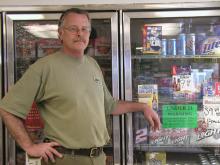 DonMcClellan1: Don McClellan, co-owner of Sunset Variety in Raymond, guards the beer coolers. McClellan recently caught a minor using fake identification to buy alcohol, and then warned the clerks at the Big Apple next door in case the minor decided to try his luck there. He did, and was caught.
Send questions/comments to the editors.
