



The sixth-grade students of Heather Russell and Paula Ross are learning about food production in a project under way at Gorham Middle School.
Russell wants her students to know that “food doesn’t magically” appear on shelves. For the third year in a row, students are working in a garden after school with produce helping the needy.
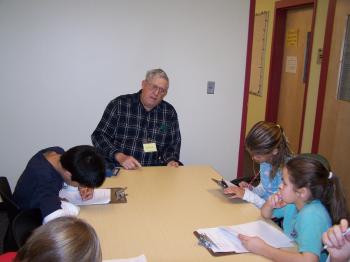
Monday, students interviewed several farmers to learn first hand about everyday challenges and the changing roles of farmers over the past century.
Students heard about the long hours and hard work of farming. But farm life intrigued some. “I would like to live on a farm,” said student Justin Reyes.
The students have already studied the history of Gorham agriculture and read a diary by Sadie Richardson, a member of a Gorham farm family a century ago. For the interviews, students were divided into seven groups.
Albert E. Mosher talked with one of the groups. Asked about the history of his farm, Mosher said forbears had bought the land in the 1770s. “In olden days, everyone was connected to a farm in some way,” Mosher told the students.
Now, few people are close to farming. He attributed declining farm numbers to an increase in efficiency, raising foods more cheaply in larger quantities. “It’s a great life, but not enough demand for farms so everyone can do it,” he said. “It’s great to support your local farmers.”
Mosher said he delivered milk in Portland as a youth in 1940. Later, the farm shipped milk wholesale to a dairy. A typical 12-hour workday began at 5 a.m., and he tended and fed his 70 milk cows before eating his breakfast at 8 a.m.
He sold the dairy herd in 1986 because of problems with his knees. “I had to quit or I would have been a cripple,” he said.
Reyes asked about changes in dairying over the years. Mosher recalled milking 12 to 14 cows by hand when he was young. He said technology was a big change. Before he sold his cattle, milk flowed through a pipeline from the cow to a bulk tank cooler.
This year, he harvested 9,000 bales of hay to sell. The farm once produced several varieties of sweet corn for a farm stand. He said Gorham once had shops that canned corn, allowing local farmers an opportunity to increase revenue. But the corn shops have long disappeared.
Jackson Marshall asked Mosher if he ever made ice cream. He said they made it for their family only, but the farm long ago churned butter and made cheese to sell.
Matt Campbell asked Mosher how he became interested in farming. Mosher explained that he was born into it and told about trials of farm life, like doctoring a sick cow. He said farmers have to know how to care for animals, raise crops and be a weatherman. “It has a lot of challenges that I enjoyed,” Mosher told the six students in his group.
He described driving farm equipment to fields and coping with traffic. “Some people do crazy things when you’re driving a tractor,” Mosher said.
The project has been a learning experience for Russell right along with her students. “This is stuff I never learned in schools,” Russell said.
Russell, who had a hand Monday from parent volunteers Janice Pompeo and Cindy Lambert, said the project teaches “real life skills” like interviewing, listening and note taking besides learning about the importance of food production. The students also visited a shelter in Portland where students heard about hunger and homelessness.
She instituted the middle school’s organic vegetable garden in which 48 students work after school hours. Produce benefits the Gorham Food Pantry. “It promotes citizenship and community,” she said about the school’s garden.
The project at the Gorham Middle School is in conjunction with a nonprofit organization, Cultivating Community. Craig Lapine, executive director and founder of Cultivating Community, said Gorham Middle School is one of three his group is working with. He said the program teaches giving back, where food comes from and you can make a difference.
The students’ study found that more than 3,000 acres of farmland was lost in Cumberland County between 1997 and 2002, according to a U.S. Department of Agriculture survey.
 Cutline (GMS 1)
 Send questions/comments to the editors.
