



On Tuesday, Sen. Bill Diamond, D-Windham, urged Maine senators to back LD 2028, a bill that would help the state’s Computer Crimes Task Force fight Internet child pornography.
Diamond, who chairs the Criminal Justice and Public Safety Committee, said the unit, a division of the state Department of Public Safety, was understaffed and unable to keep up with retrieving evidence from the growing number of confiscated hard drives.
“Child pornography is the fastest growing business on the Internet,” Diamond said in a recent interview. “This task force deals with all pre-pubescent images – these kids are infants to six-year olds.”
When Diamond visited the Unit to learn more about its members’ overwhelming task, he was sickened by the heinous nature of the images these men and women had to view as a part of their job. Right now, there are only two investigators in the unit, with a third position open. LD 2028 would allow the unit two additional investigators to help with the pile of more than 100 hard drives awaiting inspection.
In an interview on Thursday, Sergeant Glenn Lang, who heads up the task force, said about two-thirds of the computer crimes they investigate concern child exploitation. They use EnCase forensic software to recover files and pictures and then run “scripts” to look for more information.
Their search could pull up half a million images, with only a portion related to child pornography. But it is because of the sheer volume and multiple steps that the investigation of each hard drive takes so long.
Often, children in these images are told to smile because the resulting images add to viewers’ gratification. Other pictures are darker, depicting acts of bondage or physical abuse.
While the unit provides no outside counseling for its investigators, it recognizes the negative effects of viewing these images.
“Our support right now is internal,” Lang said. “We keep an eye on each other; we work out together every day – that’s the only way we can survive. It’s traumatic for people to see the sexual assault of an infant. At the rate we’re going and the volume we’re seeing, we’ll probably get there (to needing outside counseling).”
When investigators uncover evidence, the images are sent to the National Center for Missing and Exploited Children. Sometimes, the center is able to identify a child by a face or by something in the background.
It’s extremely hard for investigators to track down the original source of these pictures. And, while the unit has had cases in Maine where people have been charged with creating these images, Lang doesn’t believe that is a huge problem for the state.
But those who view the images can be found everywhere, and Maine is no exception. With 405 peer to peer occurrences in 2005 in the Lakes Region alone, and with 17 Maine towns reporting more than 100 in the same year, the problem is serious – and growing.
And those figures represent only a small part of the total. They have been obtained by tracing and recording hits on “known pieces of porn.” That doesn’t even take into account the millions of pieces that have not yet been tagged.
Not only is Internet child pornography a serious crime because of its exploitation of children, but it has been proven to incite its viewers to perpetuate these despicable acts as well. According to a study done by the United States Postal Service, 80 percent of those who view child pornography go on to sexually molest children.
Lang wasn’t surprised by the study.
“If they’re interested in seeing some of the stuff we see here, they’re probably interested in doing it themselves and at some point will take it to the next level,” he said.
In addition, while Lang says that the demographics of those who view child porn cross socio-economic lines, it’s more prevalent in the middle to upper-middle class.
Technology is already available to identify those who view child pornography over the Internet. But the key, according to Diamond, is to have the human resources – the investigators – to keep up with the growing pile of evidence.
To keep children safe from viewing these images, Lang says having the computer where parents can monitor its use is not enough. He recommends installing monitoring software. He also discourages the use of Webcams, citing many instances where children have been coerced into recording “semi-risquA?© behavior” on camera and later being blackmailed by the video to perform more depraved acts.
LD 2028 had its second reading and was passed to be engrossed in the Senate. The bill will now be integrated with its final amendments and be presented for a final vote in the House and Senate before the session ends in mid-April.
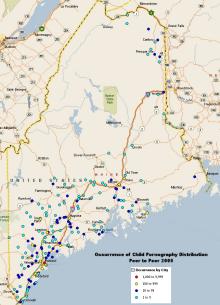 This map pinpoints areas of reported peer to peer child pornography computer access occurrences in 2005.
Send questions/comments to the editors.
