



WESTBROOK – In his more than two decades on the Westbrook police force, Officer Philip Hebert was known in the city for his work with police dogs. He was one of the department’s K-9 program handlers.
Hebert recently retired from the police force, but now is putting his skills with animals and law enforcement to use in a different way. He just started a new job as the city’s parking and animal control officer. It’s a civilian job, but under the auspices of the police department, Hebert said.
As of July 6, he’s been working to enforce parking laws and help residents who’ve called him with concerns about animals that range from dogs and cats to foxes and possums. He’s even fielded calls about insects such as bees and bedbugs.
Hebert, a Westbrook native who is married with two daughters, said his retired K-9, Samson, continues to be a part of their family.
This week he answered some questions from the American Journal about the varied aspects of his new job.
Q: Let’s start with your new job. Your title is parking and animal control officer. Are your parking-related duties separate from your animal control duties, or are they somehow related? Approximately how many hours per week do you spend on each aspect of your job?
A: Parking enforcement was added to the animal control position several years ago. Each municipality in the state is required to employ an animal control officer, and the city combined the functions to be more efficient. Police Chief (William) Baker is looking for a balance between parking and animal control duties; some weeks one may be heavier than the other depending on events and calls for service. So far, I have been very busy.
Q: Can you describe the basic duties of the parking control officer in Westbrook? Also, from your perspective, why does the city need to have an officer to monitor parking?
A: My duties include enforcing the laws of the city in relation to parking. For example, parking facing the wrong direction on the street seems like a minor infraction, but the safety issue created when that vehicle pulls out could be significant. The city has parking rules to create equity for customers visiting downtown businesses and to create safe neighborhoods. Some areas will need situational enforcement when there are large events at the schools or the Little League complex, for example.
Q: What’s the hardest thing about being a parking control officer so far? The most enjoyable thing?
A: The job isn’t hard; it is enjoyable to be out in the community. I have built and maintained relationships with many citizens and business owners and feel that I can be an asset to the city. It is great to be out on foot.
Q: OK, now the animal control part of your job. What are the basic duties of that part of your job?
A: My duties include ensuring the licensing of dogs and the welfare of animals in the city. Safety is a priority, so I also deal with domestic and wild animals that are considered a danger to others. I clean up dead animals in roadways, answer nuisance complaints and animal welfare concerns. So far, in 10 days, I have dealt with calls for dogs, possums, raccoons, cats, a fox, bees and bedbugs. I did explain to the folks concerned about bees and bed begs that we didn’t handle them and gave them another resource!
Q: Does Westbrook have problems with wildlife? If so, what kind?
A: Maine communities have abundant wildlife. I don’t think it is a problem, but it can be a nuisance to residents. As I learn more about the job, it will be easier for me to advise residents about what the city is responsible for and when they need to contact a specialist. I hope snakes require a specialist – I am not a fan.
Q: What type of animal is the most troublesome in Westbrook from an animal control officer’s perspective? Is there anything we humans can do to keep this animal from being a nuisance?
A: I think the answer might be surprising. What I hear from citizens are complaints about people walking pets and not being considerate. Just because your dog has a long leash doesn’t mean it should be allowed to go ten feet onto someone else’s property. Also, everyone appreciates a considerate scooper. When you go for a walk with your dog – be prepared, (and) remember to always carry a bag.
Q: Before you retired from the police force, you were involved with the K-9 program and were a dog handler. Do you find your experience working with police dogs useful in your new job? If so, in what way?
A: My dogs were well trained and I knew what to expect when I asked them to do something. A dog is only as obedient as its owner has taught it to be. When dogs are misbehaving, it is most frequently the owner’s responsibility and not the dog’s.
Q: Animal control officers used to be called “dogcatchers” and people sometimes assume they don’t like animals. From your past experience, it’s pretty clear you like animals. How does that fit with being an animal control officer?
A: I think dogcatchers might have been necessary before leash laws, when numerous dogs were at large. Today, it is more rare to see a dog without its owner. My favorite animal is still my dog Samson.
Q: So far, what do you think is the most difficult thing about being an animal control officer? What’s the most rewarding aspect of the job?
A: I am only 11 days into my new position. I am still learning.
Q: Do you have any animals in your own life? If you do, please tell us about them.
A: Samson, my retired K-9, will continue to live with us.
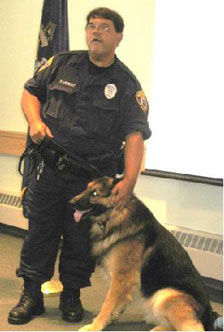 Phil Hebert has retired from the Westbrook police force, as has his dog Samson. But he remains involved in city matters as the new parking and animal control officer. Courtesy photo
Send questions/comments to the editors.
