



In preparation for a public hearing on July 26, the Windham Town Council discussed proposed amendments to the town’s land-use ordinance at Tuesday night’s workshop.
If adopted, the land use ordinance modifications, also known as design standards or guidelines, would have an effect on the direction and appearance of future commercial growth in town.
These design guidelines stem from a study done by the Windham District Development Advisory Committee (WDDAC) in the late 1990s. That study featured picture examples and outlined ways in which the commercial sector could improve overall ascetics and address parking and pedestrian issues.
“This is the result of several years worth of work, not only by staff and consultants, but by a (Town) Council-appointed citizen committee,” Town Manager Anthony Plante said. “This is a direct outgrowth of input that we were hearing from the public. The way commercial development, particularly in and around North Windham, looks, the way it works, has not been very green and has not been very pedestrian friendly. There was a sense that there ought to be some way to address that.”
From the study, Councilors David Tobin and Michael Shaugnessy developed a list of “objectives” which Town Attorney Kenneth Cole III drafted into the proposed design guidelines. Cole said he was careful to use specific wording – “should” opposed to “must” – that would present the objectives as guidelines and not standards.
“There are a series of guidelines that get basically into what is less engineering and more subjective data so that the Planning Board, when dealing with site plans, can require a developer to address these,” Cole said. “They are not, again, black and white standards that say: ‘you have to have a (roof) pitch of 2:1 or 3:1’, but rather they say: ‘as to roof pitches we want it to fit into the area, tell us how you are going to make it look right?’ So that in each instance the board can require (the developer) to address these various things.”
If the design objectives were adopted as standards, Cole said they would restrict the Planning Board’s ability to cooperate with the developer and force the developer to get a site plan variance in order to build in any other fashion than that dictated by the standards. As guidelines, Cole said, the Planning Board would be able to negotiate commercial design with the developer, using the objectives outlined and the WDDAC study as a reference.
Councilor John MacKinnon made the argument however that having “loose” guidelines might make it more difficult for the developer and the Planning Board to decide on commercial design because of the guidelines’ ambiguity.
“I don’t have the benefit of experience with the evolution of this thing, but I think I have the benefit of having fresh eyes,” MacKinnon said. “From the applicant’s perspective, looking through the proposed amendment, I got the sense that: yes, this is nice, but give me some real direction? What do I have to satisfy here?”
Councilor Lloyd Bennett then asked Cole if these guidelines would have “enough teeth” to require the developer to address the guidelines.
“By doing it this way, the intent was to give the Planning Board flexibility to try to come up with the best design,” Cole said. “It’s a negotiating process…Most developers would rather have an approval than be tabled or denied.”
Councilor Carol Waig asked whether any neighboring communities had adopted design standards instead of guidelines. Cole said that he did not know of any who did, however he did know of some communities who adopted engineering standards into their land-use ordinance. Cole explained that he had gone through a similar process with the Portland City Council who decided in the end to adopt engineering standards, but kept the design criteria as guidelines.
Keith Luke, head of Windham’s Economic Development Office, elaborated on this to say that none of the towns who had adopted similar design guidelines (towns such as Yarmouth, Freeport and Scarborough) had retracted the guidelines from their ordinance later on.
“It’s difficult to say what the result will be,” Cole said. “All I can say is: as it is, it isn’t working. So we’re hoping this is a step in the right direction.”
A public hearing on design guidelines and other amendments to the land-use ordinance will take place at the Town Council meeting of Tuesday, July 26 at 7 p.m.
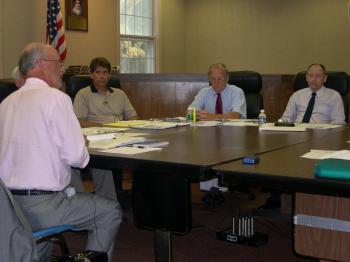 Town Councilors John MacKinnon, David Tobin and Robert Muir discuss design guidelines with Town Attorney Kenneth Cole III, left, at a workshop Tuesday. The guidelines, if approved as an amendment to the land-use ordinance, would direct the appearance and overall design of future commercial development in Windham.
Send questions/comments to the editors.
