



The natural disasters over the past few years, like Hurricane Katrina, have put pet owners on alert – even the most responsible ones can be separated from their dogs and cats.
Though collars and dog tags are important, they are not enough, according to Andrew Ferreira, executive director of the Animal Refuge League.
“One of the first things that happens is that collars tend to fall off,” Ferreira said about when pets get lost.
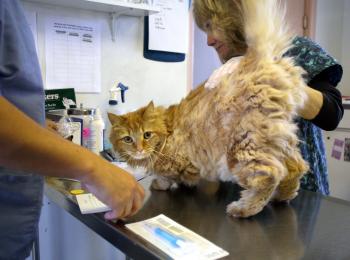
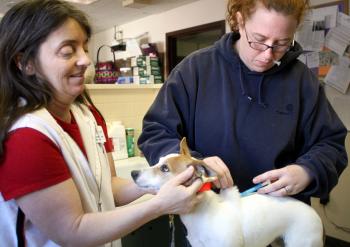
That’s why Ferreira is behind a new program at the Animal Refuge League, in which a microchip is placed in every dog or cat at the shelter before it’s adopted. The Westbrook-based shelter is among only a few in Maine that have adopted the practice. According to Ferreira, about 70 cats and 25 dogs have had the microchip implanted.
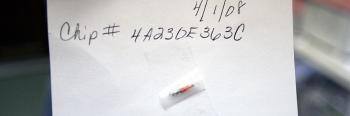
Ferreira said the microchip is about the size of a grain of rice and is inserted in a fleshy part of the animal’s back, between the shoulders. He said the procedure is no more painful than the other shots the animals have to get.
The number on the chip is then entered into a database. When a lost or stray pet is found, a special handheld microchip scanner can read the ID number. The shelter then contacts HomeAgain, which maintains a national database of dogs and cats and information about their owners. As long as that information is current, the shelter can contact the owner and return the pet.
“There’s a misconception that it’s a GPS tracking system,” said Julie Lux, spokeswoman for HomeAgain, who emphasized the importance of yearly registration.
“You need to have that current information,” she said.
At the Animal Refuge League, the staff has been able to read microchips on animals for the past few years with a scanner, but it wasn’t until the past few weeks that the shelter decided to do its own microchipping.
The shelter first started microchipping the some 250 dogs seized in August by the state from a Buxton kennel. According to Ferreira, it was a requirement by the state.
“We discovered just what a clean and useful process this really is,” he said.
There is no additional charge to the Animal Refuge League’s adoption fees, which are $75 for cats, $125 for kittens, $200 for dogs and $250 for Greyhounds. Those who adopt pets from the shelter also do not have to pay to register the animal in the database for the first year.
In addition to the microchip and database, HomeAgain offers other services to dogs, cats and their owners. HomeAgain sends out lost pet alerts to veterinarians and shelters in the area when pets are reported missing, and it offers lost pet medical insurance, which covers $3,000 of emergency medical treatment for pets that are injured when they are lost.
According to Lux, those injuries aren’t uncommon, and sometimes, even when a lost pet is returned to its owner, it can’t be saved because the owner can’t afford the medical treatment it needs.
“It can be a very tragic situation,” she said.
In recovering lost pets, HomeAgain seems to be working. Lux said since the company was founded in 1995, 500,000 pets were returned to their owners – 125,000 of those were reunited last year.
The Animal Refuge League serves 13 southern Maine communities, including Buxton, Gorham, Gray, Limerick, Limington, Long Island,
Portland, Raymond, Scarborough, South Portland, Standish, Westbrook and Windham. Ferreira said about 1,000 pets are recovered by the various animal control officers and brought into the Animal Refuge League each year.
According to Bonnie Waterman, the kennel manager, only about a dozen have had microchips. Three of those were returned to their owners, but the others were not because the database did not have accurate information.
Waterman said, though it’s still new to the Animal Refuge League, she thinks it’s a great idea and plans on having microchips implanted in her own dogs.
“We’re hoping it makes a difference,” she said.
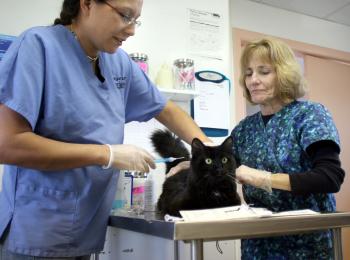 Sonia Gagne, left, Animal Refuge League feline manager, and Ellin Doyle, lead animal technician, prepare to place a microchip in a wide-eyed Wiley, a 1-year-old stray from Scarborough, Tuesday morning.
  Shelter adopts high-tech tracking for animals
 Shelter adopts high-tech tracking for animals
 Shelter adopts high-tech tracking for animals
Send questions/comments to the editors.
