



COPY BLOCK:
During the mid-19th century, when the town of Cape Elizabeth was becoming popular as a summer destination for tourists, inns and hotels were built and road improvements were made to benefit all.
At the same time, transportation was evolving. From the horse and buggy, to foot-powered bicycles, to horseless carriages, as the first motorized vehicles were called, the designs and uses of the many choices for transportation proliferated well into the 20th century. Shown are familiar sights around town many years ago. All photos are courtesy of the Cape Elizabeth Historical Preservation Society archives. Enjoy this peek into the past.
CUTLINES:
(locomotive at depot Broadway SP)
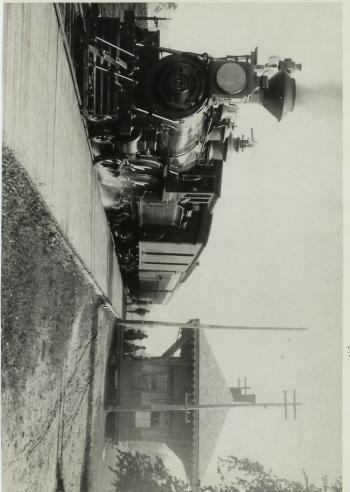
Steam locomotives provided faster trips to Portsmouth and Boston by rail. By late 1842, the Portland, Saco and Portsmouth Railroad began picking up passengers in Cape Elizabeth. At the time, the train depot was located near the intersection of Broadway and Evans Street in South Portland. Eight years later the summer schedule included three trips daily (except Sunday) for a fare of $2. (Courtesy of Ernest A. Bean)
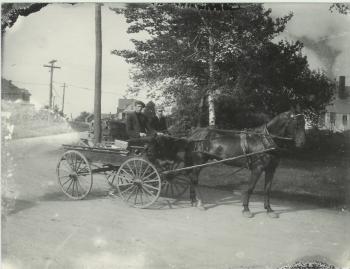
(Democrat wagon)
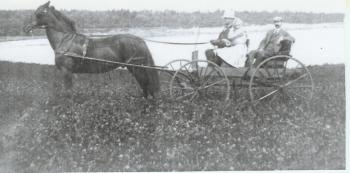
During the late 1890s, this “Democrat Wagon” was a familiar sight riding around the Broad Cove area. John F. Perkins and his daughter Helen are seated in front, accompanied by a family friend. According to Webster’s Unabridged Dictionary, 1956, Democrat Wagon is defined as a light wagon having several seats and no top. (C.E .Woodbury photo)
(First Stanley Steamer in CE)
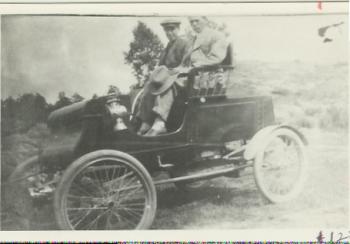
Edward L. Dyer owned the first automobile registered in Cape Elizabeth in 1902 and took great pleasure in driving his Stanley Steamer around town demonstrating his new mode of transportation. Photo shows Harry E. Dyer on the left with passenger Charles Tapley enjoying the ride on one of their frequent jaunts. (Vergie H. Dyer photo )
(White Bros. Grocer)
White Bros. Grocery, 537 Shore Road, began home deliveries by horse-drawn cart driven by Irving Garrett and his young assistant. (C.E. Woodbury photo, undated)
(Murray Ford)
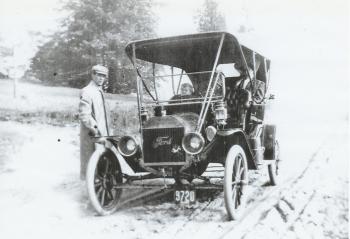
This undated photo shows a Murray family member standing beside his Ford vehicle while the passenger remains seated in the back. Note the full-length duster’and cap worn by the driver to help keep his clothing from becoming too soiled with all the dust raised by this latest version of the horseless carriage. The vehicle had no side windows for protection and a very short windshield with an opening at the top. (F.P Murray family photo)
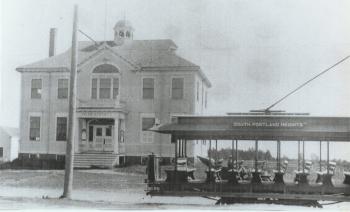
(Open-sided trolley)
Electric-powered trolley cars provided additional means of travel to and from Portland and Cape Elizabeth using two different routes. The first traversed from Monument Square, Portland through South Portland following Ocean House Road (Route 77) to the Town Hall in Cape Elizabeth and return. A new route traveled round trip from Portland through Willard Square, South Portland to Shore Road as far as Cape Cottage. A trolley park and casino was built by the Portland and Cape Elizabeth Railway Co. to provide summer theatre performances, dining and entertainment. On both routes during the summer months, open-sided trolleys were provided for the comfort of the passengers. The motorman’s controls, located at the front of the trolley, exposed him to the elements with just the bare minimum of roof overhead. Photo circa 1915.
 History matters – Transportation a la mode
 History matters – Transportation a la mode
 History matters – Transportation a la mode
 History matters – Transportation a la mode
 History matters – Transportation a la mode
 History matters – Transportation a la mode
Send questions/comments to the editors.
