




Kathleen Florance, “Between #16”, relief ink on gessoed Gatorboard, 86″ x 144.” Photo by Sarah Szwajkos
Many ideas have fueled painters over time, ideas that go beyond easily graspable distinctions like those between figuration and abstraction. Artists have probed the very nature of painting; whether it should be an exaltation of the material itself (as with the Impressionists, for example, who used raw, undiluted pigments) or a vehicle that becomes subservient to abstract concepts not neatly dissected by a conventional picture (such as the autonomic painters of Surrealism, who employed it in the service of translating the meanderings of the unconscious mind onto a surface).
Two shows at Portland galleries currently offer us unique ways to consider what painting is today: “Kathleen Florance: Singing My Song” at Cove Street Arts (through March 25) and “Geoffrey Dorfman: Antikythera” at Moss Galleries (through March 5).
In her artist’s statement, Thomaston painter Kathleen Florance quotes Danish novelist Thorkild Hansen: “Between chance and fate speaks the human tongue.” The space between these inevitabilities, she believes, is where the artist has “the opportunity to act, and therein lies our hope.”
In fact, a series of paintings – “Gossamer Threads” – in this exhibition inhabits a kind of “in-between” space all its own. To one side are Florance’s extraordinary large-scale charcoal and litho crayon drawings depicting actual forms in nature: a butterfly, a bee, wasps’ nests, a Queen Anne’s lace plant in winter. They are extraordinary in the sense of being not only exquisitely detailed, but in their size. “A Paucity of Time” (the butterfly image) is 50-by-72 inches.
Kathleen Florance, “My Little Etude #12”, relief ink, Bombay ink on Stonehenge paper, 22″ x 18.” Photo courtesy of the artist
At the opposite end is a series of works called “Between,” executed in relief inks on gessoed Gatorboard or watercolor paper, and another called “My Little Etudes” which share an affinity with the “Between” series both in composition and material (here a mixture of relief inks and Bombay inks on paper). These works are mostly abstract interplays of shape, color and line that recall Stuart Davis’ paintings of the 1920s (though with the musicality of his busier later work included).
Kathleen Florance, “Gossamer Threads #2,” litho crayon, colored pencils, relief ink on yupo, 36″ x 25.” Photo courtesy of the artist
The “Gossamer Threads” paintings, completed last year, combine all these media. They serve as a kind of Rosetta Stone whereby we can see how certain shapes become abstracted into fields of color and line that appear in the other series.
Kathleen Florance, “Milkweed Pod Study,” litho crayon on yupo, 26″ x 20.” Photo courtesy of the artist
For example, compare the litho crayon drawing “Milkweed Pod Study” of 2019 with “Gossamer Threads #2” and you can see how the pods of the former transmute to black-outlined triangles of orange in the latter. Or how the shape of the litho drawing “Sugar Maple Polypore” repeats in “Gossamer Threads #4” as an incomplete oval traced by a single blue line.
The bulbous shape of that polypore, as well as of wasps’ nests in Florance’s drawings, in turn show up in various “Etudes” (“#7,” “#8” and “#12,” the latter in concert with the spent cup-like shape of Queen Anne’s lace). The stem and cupped blossom of the Queen Anne’s lace also sprouts from the bottom middle of “Between #9” as a thick black line.
All of these take place in that in-between space Hansen speaks of, and we can see every series as a different way Florance navigates the play between randomness and inevitability. The “Between” paintings, in particular, best express this struggle to find balance between opposing forces. Of these, the ones that lend equal attention to both chance and fate work the best.
Kathleen Florance, “Between #13,” relief ink on Arches watercolor paper, 48″ x 40.” Photo by Sarah Szwajkos
There is something “fated,” for example, when Florance creates a composition against a deeper color, as she does with “#10” (dove gray), “#12” (robin’s-egg blue) and “#13” (cantaloupe orange). I say “fated” because there is a way these color fields hold the compositions within them, fix them in place. Their pervasiveness allows something more ephemeral, like these compositions, to lightly dance within them.
Conversely, “#16,” which is painted against white, seems about ready to dissipate and fly apart compositionally. A loose scarlet square superimposed on a deep blue oval provides a measure of gravitational pull and stability that barely holds things together. But here the randomness seems on the verge of taking over.
A red form at the center of “#15” does something similar. Yet what would normally represent “fate” – in this picture, that means something we can read literally, like the fish skeletons at left and right – feel too flimsy to pull things into coherent composition (and the insubstantiality of their literalness also works against the freedom of form that makes other pieces so strong).
The “Gossamer Threads” paintings, to me, are the most interesting. They seem to combine the rigorous geometries and volumetric presence of forms in Russian Constructivist paintings of Vladimir Tatlin and El Lissitzky with the lithe hand and emotional color of Kazimir Malevich’s Suprematism, while simultaneously creating a sense of depth neither movement cared for. But each series fascinatingly tries to resolve the same dichotomies.
PAINTING AS BEING AND NOTHINGNESS
In 1900, a group of sponge divers discovered a shipwreck off the coast of Antikythera, an island floating at the nexus of the Aegean and Mediterranean seas. Subsequent excavations turned up a Greek 1st Century BCE mechanical device capable of calculating astronomical phenomena, including the movement of the sun, moon and planets, as well as eclipses, far into the future.
This discovery catapulted New York-based painter Geoffrey Dorfman into his own exploration of the deepest mysteries of the universe that the Antikythera mechanism might have tried to divine: namely, how all form and reality manifest out of so-called “nothingness.”
The forms that emerge within these paintings recall the gears, rings and circular faces of the mechanism, as well as characters that might be referencing faint inscriptions found on its various parts. In most of them, “nothingness” is shown as a highly charged field of layered color achieved through quick, obsessive, all-over brushstrokes. The way Dorfman mixes his colors creates areas of particular activity within the nothingness.
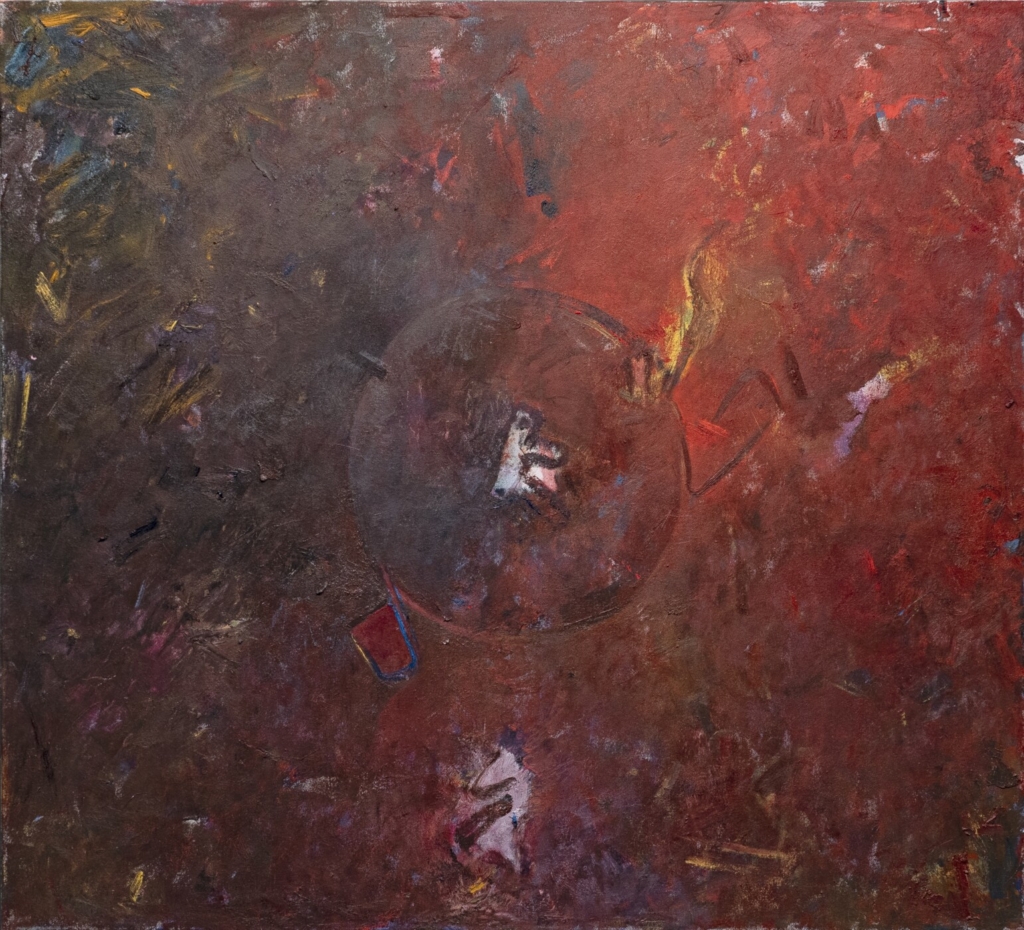
Geoffrey Dorfman, “Antikythera 1,” 2021, oil on canvas. Photo courtesy of the artist
In “Antikythera 1,” for instance, reds layered onto yellows and whites in the upper right quadrant suggest heat and light emerging from some void. In “Antikythera 16,” this activity is also confined to the upper-right quadrant, but in brilliant yellows that seem literally to be on fire.
Sometimes, as in “Antikythera 2” and “4,” inchoate forms appear out of darkness. The large circular forms are not quite precisely defined, but seem partially to share a certain depth with the nothingness in their brown coloration. We can feel them pushing through, but there is a tension in that effort.
Geoffrey Dorfman, “Antikythera 8,” 2021, oil on canvas. Photo courtesy of the artist
Other times, forms appear as though they’ve floated free from the ground of nothingness. Some of these – particularly “Antikythera 9” and “17,” and the most sublime work, “Antikythera 8” – have not only taken form, but then differentiated into more complex organisms within themselves. This implies a kind of development, growth and individuation that has become independently operational in the world.
While there’s a certain excitement to this in the way they embody the qualities of will, self-determination and existence, there is also an implication of forms having separated from their source that can now be subjected to all manner of other influences – both beneficial and detrimental. The large central sphere in “8” already seems crowded with other forces individuating within it. How long can peace be maintained within the confines of this form? What happens when there is no more space in which to expand?
Geoffrey Dorfman, “Antikythera 2,” 2021, oil on canvas. Photo courtesy of the artist
When we compare the brilliant light of creation in “8” with the muddy swamp of colors of “2,” do we draw a value judgment about oneness versus individuation? And what of “Antikythera 15,” where it seems a riot of conflicting forms have almost obliterated the source? The forms in this work are cacophonous and chaotic. It feels unresolved and jittery.
Geoffrey Dorfman, “Antikythera 15,” 2021, oil on canvas. Photo courtesy of the artist
Do these paintings together describe a repetitive universal cycle that moves from murk and mire (“2”) to birth and creation within a state of innocence (“8”) to an explosive self-destruction (“15”) … and back to the primeval swamp again?
Wherever you land within these works, what is remarkable about them is what paint can do, its ability to depict everything from the emptiness of the cosmos to the ephemeral dance of life.
Send questions/comments to the editors.
