




Ahmed Alasow, left, gets a tour during a recent open house for a new program called Renter 2 Owner in Lewiston. The building owner, Amy Smith, center, as well as Allie Smith, chair of the Lewiston Housing Committee, started the program to create more pathways to home ownership. Smith, a Lewiston landlord with 25 units, says the federal moratorium on evictions had good intentions, but was implemented poorly, resulting in “all sorts of unintended consequences and a lot of psychological damage to both tenants and landlords alike.” Andree Kehn/Sun Journal
LEWISTON — Renters may have gotten a reprieve last week when the country’s leading health agency issued an order to put the brakes on evictions in high-COVID-19 transmission counties.
But the new moratorium appears to have raised more questions than answers among tenants, housing advocates and the legal community. At the same time, those involved say Maine’s rent relief program has alleviated much of the concern for suddenly hitting a wave of evictions.
The Sun Journal spoke with several experts this week in order to help renters navigate these uncharted waters.
The extended moratorium, announced Tuesday, follows the same U.S. Centers for Disease Control & Prevention guidance used for masking recommendations, meaning evictions for nonpayment of rent are prohibited only in counties designated as having “substantial” community transmission of COVID-19. In Maine, those counties have been changing almost daily.
If a county meets the CDC’s “substantial” level, residents are protected from evictions for at least two weeks. But, the moratorium no longer applies if that county falls below the CDC’s threshold for two weeks.
Notably, Androscoggin County has not yet crossed into the CDC’s definition of substantial community transmission. Lewiston has one of the highest percentages of renters in the state.
But, the county might not be far off. On Friday, Franklin County joined the list of Maine counties on the CDC’s list. Statewide, cases have been on a steady rise.
IN THE KNOW
Greg Payne, director of the Maine Affordable Housing Coalition, doesn’t believe the moratorium extension will have a significant impact on evictions in Maine, simply because of the state’s success — at least compared to the rest of the country — in getting rent relief dollars to those in need.
He said the moratoriums have been “intertwined” with the deployment of rent relief dollars, and because Maine has been deploying them well, “the very people that the moratoria are supposed to protect are getting access to the rent relief program.”
But, he said, some nonpayment eviction cases will continue to funnel through the courts in Lewiston unless Androscoggin County is added to the list of counties with substantial transmission. Even then, those cases could continue if the tenant is unaware of the potential protection.
Tenants may not know that they qualify for the protection, or for rent relief.
“It remains true that the protections of the moratorium don’t automatically attach,” he said. “It requires tenants to have an understanding of the moratorium and provide a declaration form. So, you could certainly have a landlord in court filing an eviction claim for nonpayment of rent, and the tenant having no clue that there is such a thing as the CDC moratorium.”
Payne said an “increased presence” from Pine Tree Legal Assistance, a nonprofit that provides free legal services to low-income Mainers, may be helping to stave off those situations.
NEW MORATORIUM
It’s important to remember that the CDC moratorium requires the tenant to take an affirmative step in order to invoke the protections provided in the order, said Erica Veazey, managing attorney in the Bangor office of the nonprofit Pine Tree Legal Assistance.
The new temporary moratorium on evictions took effect Aug. 3 and is set to expire Oct. 4.
The CDC website includes a “COVID Data Tracker” that shows which counties have substantial or high levels of community transmission. That data tracker can be found at https://covid.cdc.gov/covid-data-tracker/#county-view.
All tenants seeking protection under the moratorium must complete an “Eviction Protection Declaration” and provide it to their landlords in order to be protected by this moratorium, Veazey said.
She said the new moratorium follows the one that expired at the end of July. It differs from the former moratorium in that it only applies in counties with high transmission rates rather than in all counties.
The moratorium can be applied to a limited number of cases, Veazey said, where the issue was nonpayment of rent and the tenant was arguing that they had a significant impact to their income because of a COVID-related reason. For example, she said, they lost their job, they had to homeschool their kids and couldn’t work the same number of hours, or they got sick and were out of work.
The moratorium doesn’t prevent a lot of eviction cases in the courts that might be either based on a no cause eviction notice, which can be given to some types of tenants, or evictions that are happening for cause, she said.
If lease language prevents smoking in an apartment and a landlord alleges a tenant has violated the terms of the lease, this moratorium wouldn’t stop an eviction in that case, Veazey said.
She said that with both the former moratorium and the newer one, tenants must take certain steps to seek participation, including signing a declaration form saying that they believe that the moratorium applies to them and give that form to the landlord.
“If that doesn’t happen, the landlord can continue to move forward in the court system with an eviction case,” she said.
The courts only held up all evictions (except ones brought on an emergency basis) from late March until August 2020 as the courts grappled with the wide-ranging implications of the pandemic, Veazey said.
From August 2020 and continuing to the present, evictions court was lengthened to a two-hearing process as opposed to being held on a single day as had been the case before the pandemic, she said.
In 8th District Court in Lewiston on Wednesday, Judge Jennifer Archer held evictions court by telephone conference call.
Archer had landlords and tenants update her on the status of their cases.
The cases would be scheduled for mitigation or a final hearing, where the two parties could present evidence supporting their respective legal positions.
Veazey said the Lewiston court may be returning to its former one-day evictions hearing process next month.
Those hearings may be held by remote videoconference rather than in the courtroom, where they had traditionally been held.
Veazey said Pine Tree Legal Pine represents low-income individuals and families in civil legal issues, such as housing, which affects people’s basic human rights.
Her organization, which has six offices throughout the state — including in Lewiston — can help people when they have an eviction case scheduled in court or have an initial eviction notice, she said.
“We can also help folks who even have a question or concern that an eviction might be imminent or forthcoming and we can help with a variety of other landlord tenant issues, even if there’s no eviction pending,” she said.
‘PSYCHOLOGICAL DAMAGE’
Amy Smith, a Lewiston landlord with 25 units, said this week that the moratorium has had good intentions, but was implemented poorly, resulting in “all sorts of unintended consequences and a lot of psychological damage to both tenants and landlords alike.”
Smith, who also runs Healthy Homeworks, and has been closely involved with the city’s Choice Neighborhoods effort, said a large percentage of renters, especially during the pandemic “are on the razor’s edge of being able to afford their housing in the first place.” The questions surrounding whether the moratorium would end, or be extended, put a “mental toll” on people, she said.
While a large majority of her tenants worked well with her during the pandemic, she said a few were “emboldened” by the moratorium, “terrorizing” neighbors. They felt that they could do anything and not be evicted. She said the moratorium didn’t make it clear that it only halted evictions for nonpayment.
Many agree that the new, more targeted moratorium, is just more confusing.

Craig Saddlemire
Craig Saddlemire, coordinator of the Raise-Op Housing Cooperative in Lewiston, says the new moratorium is leaving everyone scratching their heads, not just renters.
“The latest CDC eviction moratorium is far too confusing for tenants, property managers or courts to follow,” he said. “People don’t need confusion right now, they need clarity. I would have preferred a simple extension of the existing moratorium.”
Saddlemire, who oversees the growing cooperative housing organization, said the nationwide moratorium has been “very important to saving lives and reducing the spread of COVID-19,” and believes it’s too soon for it to be lifted.
He said in Maine, the MaineHousing rent relief program has “really helped people in a substantial way,” including some Raise-Op members.
“However, I think administrative capacity has not caught up to demand yet and many people may face eviction — or at least the first stages of eviction, which can still be very disruptive — before their emergency rental application is processed,” he said. “Overall, it seems like Maine is doing better at getting rental assistance to people who need it than many other states, but I think this problem is playing out nationwide and we need more protections for renters, not less.”
An eviction mediation bill, designed to protect tenants from being evicted without first having the opportunity to go through mediation, was passed by the Maine Legislature in June, but according to Payne, isn’t slated to go into effect until Oct. 17.
Saddlemire said once enacted, it could help address issues like late payment of rent.
A QUIET PUBLIC
At Lewiston City Hall, staff members say they have not encountered many questions or concerns from the public regarding the extended moratorium.
Elaine Brackett, director of Lewiston’s Social Services department, said she hasn’t seen “an abundance of requests for assistance with evictions.”
“For those that we have encountered we have referred them to the Emergency Rental Assistance Program to find out if they qualify for that program,” she said.
David Hediger, director of Planning and Code Enforcement, said his department hasn’t received much communication either. He said tenants concerned about their rights are often referred to Pine Tree Legal Assistance.
“Any comments received are typically from landlords frustrated by tenants taking advantage of the situation,” he said.
Payne believes there’s a good chance the new moratorium could be struck down by the courts before it’s set to expire Oct. 3, but that the extra few weeks could provide meaningful time for states to get more relief money out.
FINANCIAL RELIEF
Since March 1, the Maine State Housing Authority has paid out more than $46 million in emergency rental assistance benefits to 9,286 households in the state.
The Centers for Disease Control & Prevention developed the program because, at the start of the pandemic, they wanted people to shelter in place and quarantine in place (if needed) in an effort to reduce disease transmission.
Those benefits include current, past and future rental payments as well as utilities, said Denise Lord, spokeswoman at Maine State Housing Authority.
The benefits are paid directly to the landlords and utilities in most case, unless they are refused, Lord said, in which case the assistance is provided to the tenant who, in turn, will make the payments that are owed.
“That has been very rare,” she said.
The past due rents that are eligible may date back to March 2020, she said, when the pandemic struck Maine.
Benefits include up to three months of future rental payments, Lord said.
Tenants must meet three criteria to be eligible for emergency rental assistance: meet income guidelines; a reduction of income or financial impact due to COVID-19; and risk of homelessness, facing eviction or living in unsafe housing.
The second criterion was expanded last week to include financial hardship not directly to the pandemic, such as a longer commute due to work reassignment or increased food costs due to the closure of food pantries, she said.
The emergency rental assistance program began in April 2020 with state funding, continuing through December, when federal funds were made available through the U.S. Treasury Department resulting from the American Rescue Plan Act.
Tenants seeking assistance through the MaineHousing program in Androscoggin and Oxford counties may apply directly through Community Concepts Inc., Lord said.
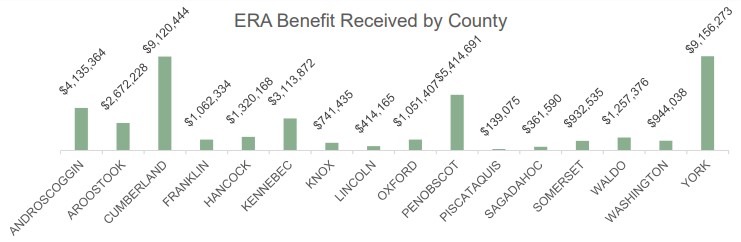
This graph shows — by county — the amount of emergency rental assistance that has been provided to tenants by Maine State Housing Authority since March 1. Source: MaineHousing.org Maine State Housing Authority
Send questions/comments to the editors.
