




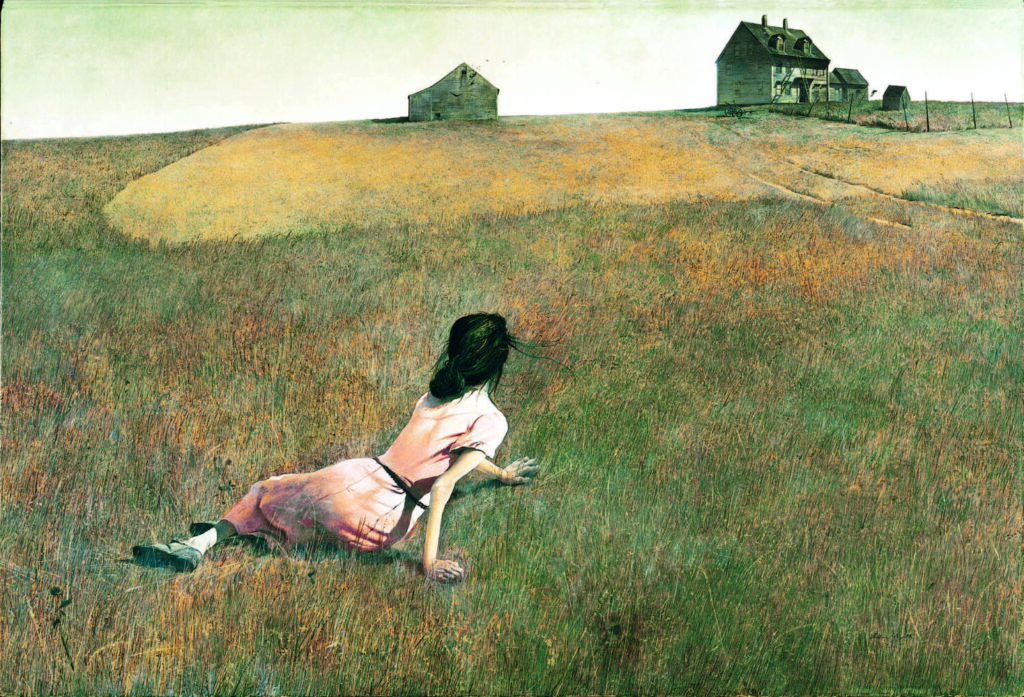
Andrew Wyeth “Christina’s World”
Andrew Wyeth’s iconic painting “Christina’s World,” which has been in the public eye since Wyeth painted it in Maine more than 70 years ago, is no longer on view at the Museum of Modern Art in New York, an apparent victim of a larger art-world debate about which artists warrant wall space in modern American museums.
The move has angered many in Maine, where the painting represents the hardscrabble life of rural people and holds a special place among those in the midcoast communities of Cushing and Port Clyde, where Wyeth made many of his best paintings and portrayed local people with respect and admiration.

Artist Jamie Wyeth, son of “Christina’s World” painter Andrew Wyeth, at the Farnsworth last year. Brianna Soukup/Staff Photographer
“It’s sort of sad,” said the artist’s son, the painter Jamie Wyeth, who called the museum’s decision “petty” and the latest example of the museum world’s lingering disrespect for his father. “The Museum of Modern Art is depriving their audience of the experience of viewing an utterly strange and affecting work. For years, they have denigrated it by hanging it in the darkest part of the museum, in the hallway and next to the escalator. After 70 years, they’ve decided to put it in storage. It’s very sad and very art-trendy.”
MoMA bought the painting directly from Andrew Wyeth for $1,800 in 1949, soon after he finished it, and it’s been on view in New York nearly continuously since, leaving only for rare traveling exhibitions while becoming one of the most-recognized and maligned paintings in American art. It’s also probably the best-known painting ever made in Maine.
When the museum reopened last fall after a renovation, “Christina’s World” wasn’t part of the mix, reflecting the conviction of the curators to tell multiple art histories from many perspectives with galleries changing frequently and more works from the permanent collection circulating into public view.
Wyeth, who split his time between Maine and Pennsylvania, painted “Christina’s World” in Cushing in 1948, when he was 31 years old. At a time when post-World War II America was burgeoning with hope, Wyeth shows the young woman Christina Olson, stricken by polio, pulling herself through tall grass, her faded pink farm dress contrasting with the brown fields, a distant farmhouse and empty gray sky beyond.
As much as anything, Wyeth portrays the difficult circumstances of rural life and the determination of rugged people, and hints at the psychological drama that lurks beneath the surface.
It was a breakthrough painting, launching Wyeth on a trajectory that turned him into a superstar painter. The painting also become a target of scorn among art critics, who often saw it as sentimental and simplistic at a time when abstract expressionism and pop art were gaining currency. The tension between popularity and critical acceptance became a recurring storyline in Wyeth’s career, though it has diminished in the 11 years since his death, when many critics have reconsidered Wyeth’s work and recognized its complexity and layers.
“Christina’s World” became one of the most recognized paintings in American art history. Millions of people have seen it, flocking to New York like pilgrims for a glimpse – and many come to Cushing, too, to experience where Wyeth painted it. Jamie Wyeth thinks its popularity has always rankled the art elite, and that’s why it was relegated to a fifth-floor hallway among escalators and restrooms, instead of in a gallery.
“It’s a remarkable experience,” he said. “There’s always a crowd around it, which is what upsets (the curators). It’s too accessible, and anything that is accessible and well-liked is suspect. They feel it’s not cutting-edge enough. … This sort of thing has gone on for years. It’s just kind of petty.”
A spokesperson for the Museum of Modern Art did not respond to requests for an interview, but the museum’s chief curator of painting and sculpture, Ann Temkin, told the writer Christina Baker Kline that the museum had expanded its collection and “Christina’s World” was among the paintings swapped out for something else. She said the painting’s coming off view does not reflect a demotion, and it will likely be brought back on view this year.
CHRISTINA’S TAKE
Kline, a part-time Mainer, wrote the best-selling novel “A Piece of the World” based on her experience with the painting and the Olson House over time. In the novel, Kline reimagines the story of real-life Christina Olson, who became a frequent Wyeth subject, along with her family and home.

Author Christina Baker Kline outside the Olson House in Cushing in 2017. Kline wrote a fictionalized account of Andrew Wyeth’s relationship with Christina Olson, the model in his iconic painting “Christina’s World.” Gregory Rec/Staff Photographer
In an opinion piece that she wrote for The Boston Globe, Kline expressed her dismay about the painting’s removal, writing, ” ‘Christina’s World’ doesn’t belong at MoMA, where it will never be appreciated. It belongs in a place that will do it justice, situating it in context with artists who influenced Wyeth and who, in turn, were influenced by him.” She compared the painting to Leonardo DaVinci’s “Mona Lisa” and Johnannes Vermeer’s “Girl with a Pearl Earring” in its recognition and cultural weight.
“The painting will never be appreciated at a place like MoMA, where its broad appeal is confirmation that it’s little more than sentimental kitsch,” Kline wrote. “Having fallen out of favor in the 1960s with the rise of Pop Art, Abstract Expressionism, and Minimalism, it is still, in certain highbrow circles, considered embarrassingly uncool.”
In a phone interview, Kline said she thinks the painting should end up in Maine, either at the Farnsworth Art Museum in Rockland or the Portland Museum of Art, close to where Wyeth created it and where the ethos of the painting resonates. “A lot of curators I’ve talked to feel they could give it a good home, but it would be incredible if the Farnsworth could get it,” Kline said.
The Farnsworth was the last museum to borrow the painting. It was part of the exhibition “Christina Olson: Her World” on view in Rockland in fall 2000. The Farnsworth also manages the Olson House in Cushing, opening the home to visitors during the warm-weather months. Wyeth, who died Jan. 16, 2009, is buried nearby, within view of the stark farmhouse that helped make him one of America’s most popular painters.
Christopher Brownawell, the Farnsworth’s executive director, said MoMA has declined recent requests from the Farnsworth to bring the painting back to Maine. “They cited the fragility of the piece. That is not unusual. We encounter that once in while with our pieces here,” he said. “When they do travel, there is a risk. Whether it be exposure to the elements or the knocks of shipping, those are risks. Each institution has to reconcile those risks when they make decisions (about loaning paintings).”
Because of the risks, the costs associated with borrowing the painting would be “exorbitant, substantial. It’s probably one of the most iconic works in American art. It ranks right up there,” he said.
The costs would include crating, shipping, security and insurance. Brownawell wouldn’t guess the price. “I wouldn’t know. At some point, I hope we have to face that,” he said, adding that the Farnsworth will likely try to borrow it again “down the road” as plans for future exhibitions evolve. “The hope is it’s not a done deal. Of course we would love to have it, and it would be a sort of reunion. It’s high on our list of important works of Andrew’s,” he said.
Kline realized the painting was no longer on view when she visited MoMA in mid-December, her first visit to the museum since it reopened in October after a four-month renovation and reinstallation of galleries. She is a museum member, and visits often. During her December visit, she couldn’t find the painting.
“I went through the whole place and realized it wasn’t anywhere,” she said.
When she approached the information desk to ask about it, other visitors were already inquiring after the whereabouts of “Christina’s World,” she said. “People were asking at the desk when I walked up. The woman who was working was lovely and very knowledgeable, and said, ‘Honestly, I think it’s a scandal and a huge shame. They shunted it off to a hallway, and now it’s gone.’ ”
That’s when Kline decided to write the column.
She said she appreciates the motivations of curators to show other works or art but believes the curatorial team at MoMA made a bad decision in taking down “Christina’s World,” even temporarily. “There are so many ways to deal with this and think about this. I do completely understand and support that MoMA wants to feature artists who have been outsider artists, people of color, women. That is really important. I am not arguing that those works shouldn’t be featured and there shouldn’t be room for them.
“What I am saying is, a work like ‘Christina’s World,’ in my view, is one of those paintings that should always be on view. There aren’t very many of them. People come to New York to see it, they come from all over the world to see it. It’s shocking not to be there.”
WHAT GOES UP
Jessica May, chief curator and deputy director at the Portland Museum of Art, said curatorial decisions about removing popular works from view, even temporarily, are complicated, and they include a desire by curators to tell stories about art and artists that have not been told and the need to perform essential conservation.
That’s especially true with paintings that rarely come off public view and serve as magnets for crowds. People expect to see them and are disappointed when they’re not on view, May said. Works on paper, including watercolors and drawings, are especially challenging because they degrade with exposure to light. “For preservation reasons, we can’t have works on paper on view for more than six months out of 10 years. That’s a fact that’s surprising to many people,” she said.
While it’s true that oil-on-canvas paintings can withstand more light, “there are still limitations and still practical conservation reasons to take a work off view, including just to take it off view from constant light, which does affect everything,” she said.
Besides, giving attention to other artists and paintings is good curatorial practice, she added. “As we make space for people who haven’t had space, sometimes our favorites are going to get a break. They are going to be in storage while we tell other stories,” she said.
The PMA will take the most iconic painting in its collection, Winslow Homer’s “Weatherbeaten,” off view later this winter, in four weeks or so. It’s not going into storage but is part of a traveling exhibition “Mythmakers: The Art of Winslow Homer & Frederic Remington” that will open in March in Denver. The exhibition will come to the PMA this summer and travel to Texas in the fall.
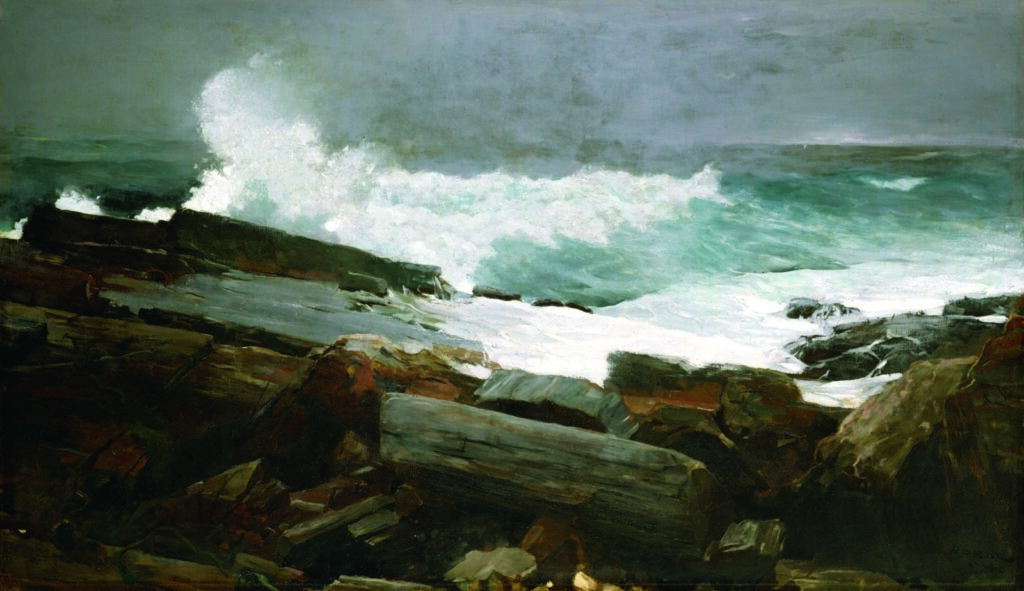
The Portland Museum of Art has made sure to let its members know that the most iconic painting in its collection, seen here, won’t be on view temporarily. Winslow Homer (United States, 1836-1910) “Weatherbeaten,” 1894 oil on canvas 28 1/2 x 48 3/8 inches Portland Museum of Art, Maine. Bequest of Charles Shipman Payson. Photo by Melville D. McLean
In addition to “Weatherbeaten,” another popular Homer oil painting regularly on view in Portland, “Wild Geese in Flight,” will be part of the “Mythmakers” exhibition. The PMA has told its members, through its magazine and other communication avenues, that the paintings won’t be on view and will try to fill the void by showing other Homer paintings and telling other stories, May said.
“We’ll bring out a suite of works that touch on the same theme as ‘Weatherbeaten,’ and we can tell a much broader story about the number of artists thinking about the Maine coastline,” she said.
The museum also is working with a private collector to borrow a painting that Homer made during the American Reconstruction to show while “Weatherbeaten” is away. “It will still be a Homer-rich year here, but our collection galleries will offer a different narrative than they do at this moment,” she said.
At the PMA, the decision to loan paintings to other museums rests with the board of directors. That high level of oversight reflects how seriously museums treat loaning certain works of art and the risks associated with doing so, May said. “Every painting that leaves our walls, we ask the board to consider the merits of the loan,” she said. “Art is most vulnerable when it is moving.”
COLORS OF HOME
“Christina’s World” has special resonance for people who live in the communities where Wyeth did much of his painting. The original has been gone since the paint dried, but reproductions of “Christina’s World” have hung in the walls of homes and fishing shacks across the peninsulas since then, said Port Clyde painter C. Wilder Oakes.
Oakes’ uncle, Walter Anderson, was a close friend of Wyeth’s, and became a frequent figure in Wyeth’s paintings.
Oakes remembers seeing a reproduction of “Christina’s World” for the first time at age 8 or 9 on the wall of a dark house in Port Clyde. The painting scared him. “The hands were like claws to me. I thought it was a beautiful woman in the field. Then I got up close and I saw the hands,” he said. “I asked about it, and I was told by the person who had it in her house it was Andy, and everybody knew Andy around Port Clyde.”
Later, when Oakes saw the original painting at MoMA, he appreciated it more. “I was much more impressed with the painting than the print,” Oakes said. “I could really see the hands, and it seems like I could just see a little bit of her face.”
Warren sculptor Jay Sawyer understands the uproar over the painting’s removal from the walls of MoMA, and said the attention on the painting because of the controversy may help illuminate the human story that Wyeth conveyed of a young woman struggling to cope in a harsh world.
“It was in all the local houses and businesses, and I probably overlooked it until I heard the story about Christina and her disability. Then the emotional end of it really grabbed me. There is so much emotion in that picture,” Sawyer said. “You can critique the workmanship or the painterly process, but you can’t question the fact that it creates emotions.”

Kelly Thorndike, an artist and veteran of the Iraq war, near the Thomaston Train Bridge along the banks of the St. Georges River in 2018. Thorndike said the colors of “Christina’s World” remind him of home. Brianna Soukup/Staff Photographer
Kelly Thorndike grew up across the St. Georges River from Cushing, and has always identified the tone and texture of “Christina’s World” as “the colors of my life. The house and the temperature of the painting reminded me of the temperature of the houses I grew up in – cold. It’s real, it’s authentic,” Thorndike said. “And beyond that house is where my people are from.”
A painter himself, Thorndike evokes Wyeth’s colors in his own work. And when he was serving in Iraq with the Maine National Guard, it was vivid memories of Christina that motivated him to survive.
“I still marvel over the pink color of Christina’s dress – the absolute power of that rugosa-colored dress, like Christmas wrapping on a wonderful story, which I understand now as a grown artist,” he said. “That painting takes me to a sublime place in my journey as an artist. That painting takes me home.”
Send questions/comments to the editors.
