



During Congress’ February recess, Sen. Susan Collins faced protesters at home, many of them angry about her handling of the confirmation of Betsy DeVos, President Trump’s controversial secretary of education. Collins was one of only two Republican senators to vote against DeVos on the Senate floor, but she voted to let the Michigan billionaire out of committee one week earlier.
“The DeVos nomination is Susan Collins in a nutshell – say one thing to your constituents and another to your Washington insider friends,” protest organizer April Humphrey of Yarmouth, a co-founder of the group Mainers for Accountable Leadership, said at the time. “Collins had the opportunity to stop Betsy DeVos and her extreme education agenda in committee, but instead she played politics with our kids’ education.”
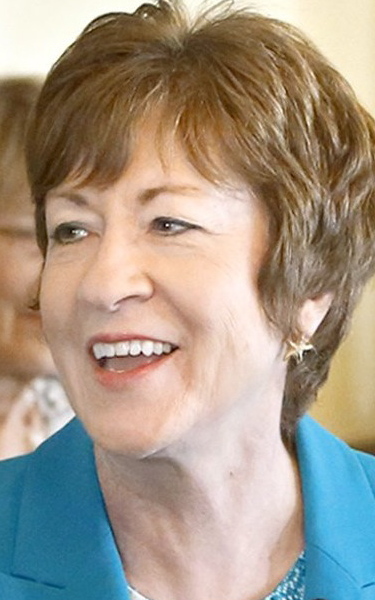
It’s a charge that has dogged Collins for much of her two decades in the Senate: that she often states one position to satisfy moderate supporters at home while voting against it in sometimes key procedural votes, when fewer people are paying attention. But an analysis of some of her most crucial votes shows that in most cases her explanations pass a straight-face test and generally satisfied the people who had the most at stake in the outcome.
Collins’ votes are being scrutinized more closely than ever, especially by Trump’s opponents, who want her to help check his power at a time when her party controls both houses of Congress. She has defended her voting record as consistent and principled, saying critics misjudge her motives or misunderstand the sometimes arcane procedures and maneuvers senators must vote on.
“I think there’s a lot of misunderstanding about Senate procedure, and that’s understandable,” she told the Maine Sunday Telegram. “The Senate is totally different from the House, and we have a lot of procedural motions to allow an issue to come before the Senate whether it’s a bill or a nominee.”
The Sunday Telegram analyzed a half-dozen of the most high-profile votes for which Collins was criticized for trying to have it both ways. In most cases, her explanations stand up to scrutiny, but on occasion the senator does appear to have taken procedural votes that support her Republican colleagues rather than her stated goals.
Congressional scholar Sarah Binder says that’s just part of being a successful legislator.
“There are very few senators over Senate history who are all that principled on procedural votes,” says Binder, a professor of political science at George Washington University and a fellow at the Brookings Institution. “A senator who is in a cross-pressured situation tries to find a way out of it, and procedure is one way to thread the needle.
“I get that it can be frustrating to people outside the institution, but that’s the reality of legislative bodies,” she adds.
Journalism you can trust.
We need it now more than ever.
Get a digital subscription to the
Portland Press Herald
• Don’t Ask, Don’t Tell repeal (2010)
Collins’ position: She championed ending the Clinton-era policy that prevented openly gay people from serving in the military.
Controversy: She voted in support of a Republican filibuster that blocked the underlying bill. Television host Jon Stewart blasted her for it in a segment of “The Daily Show.”
Collins says: The procedural vote was against an underhanded move by the Democratic majority to limit amendments to the underlying bill, the Defense Authorization Act, which finances the Pentagon. She played a key role in ultimately repealing the policy.
Analysis: Collins did in fact spearhead the repeal effort, championing it among her Republican colleagues, according to Joe Solmonese, then president of the Human Rights Campaign, the Washington-based LGBT rights organization. “I literally see her as the linchpin of getting us over the finish line over everyone else with the exception of (Connecticut Senator) Joe Lieberman,” he says. “She was nothing short of heroic, and I don’t say that about many.”
The repeal was attached to a $726 billion defense authorization bill, which normally includes dozens of amendments and weeks of debate. But in 2010 the Senate’s Democratic leadership decided to severely restrict the number of amendments that could be introduced, upsetting the Republican minority, who blocked the bill. “I was shocked because we were in the midst of negotiation,” Collins recalls. “I was very angry at the situation, but I wanted to show that I didn’t want the repeal to die, so Joe Lieberman and I decided to introduce our own free-standing bill,” which ultimately passed.
“I can’t speak more highly of her leadership on this and it wouldn’t have happened without her,” says David Stacy, HRC’s government affairs director. “She personally spent the time, and senators don’t always do that.”
• DISCLOSE Act (2010)
Collins’ position: She championed campaign finance reform, including the McCain-Feingold act that was overturned by Citizens United and the principle of requiring disclosure of donors.
Controversy: She voted against the DISCLOSE Act, which required independent expenditure groups to reveal their donors and was defeated by one vote. The nonpartisan League of Women Voters deplored the senator’s vote.
Collins says: She supports disclosure, but this bill was unacceptable because it favored unions over corporations.
Analysis: Anthony Corrado, a nationally recognized expert on political finance at Colby College, says Collins is correct: The bill was flawed. “Concern about favoritism towards unions was a legitimate issue in the debate and was a point highlighted by Senator Collins, who has been a supporter of disclosure,” he says, noting that unions could generally avoid disclosing donors, while corporations and industry associations could not.
• Government shutdown (2013)
Collins’ position: Collins opposed an effort by the House Tea Party caucus to shut down the government unless President Obama and the Democratic Senate majority defunded the new Affordable Care Act, also known as Obamacare.
Controversy: When the House’s short-term spending bill came before the Senate, Collins thrice voted with her colleagues to keep the anti-Obamacare measure in the bill, ultimately triggering a disruptive, 16-day shutdown.
Collins says: Negotiations had broken down at the time she made those votes, so she sided with her party’s version, but later spearheaded the compromise that ended the shutdown.
Analysis: Collins and her staff point out that she was instrumental in reopening the government, even providing a video montage of senators from both parties praising her role on the Senate floor. “The process had broken down, there was fault on both sides, and the (Obama) administration was not cooperative,” Collins recalls. “We eventually came up with a framework that led to the government reopening, and I am proud of that work and I think that’s what the people of Maine expect me to do.”
However, when pressed, her staff tacitly admits that her earlier votes on the spending bill were essentially partisan. “The leaders of both sides were not negotiating, … which left us between a rock and a hard place,” says her spokeswoman, Annie Clark. “Ultimately, Senator Collins supported the Republican proposal,” the one that repealed Obamacare funding.
“My read of those votes is that she was playing loyal party soldier,” says George Washington University’s Binder. “She was part and parcel of a strategy with (Senate Minority Leader Mitch) McConnell, but eventually they broke the logjam because Republican senators including Collins said they’d had enough.”
• Planned Parenthood defunding (2015)
Collins’ position: After conservative activists released a selectively edited videotape of Planned Parenthood officials discussing the use of donated fetal tissue, Republicans sought to defund the organization, a move Collins opposed.
Controversy: She cast a vote in favor of the defunding bill, infuriating women’s health groups.
Collins says: She cast the vote on procedural grounds in order to advance her own measure, which would have maintained most Planned Parenthood funding while ordering a federal investigation of the allegations in the video. Ultimately the defunding effort failed, with Collins voting several times to continue funding the parts of the organization that did not engage in fetal tissue donations.
Analysis: Women’s advocacy groups appreciated Collins’ ultimate stance but had misgivings that she gave the videos credence, as they were ultimately discredited and the activists who filmed them indicted. (Charges were eventually dropped on procedural grounds.)
“For me the most troubling aspect of Senator Collins’ approach that summer was that she offered an investigation of Planned Parenthood based on illegal videos that were false, misleading and fraudulently produced,” says Andrea Irwin, executive director of the Mabel Wadsworth Center in Bangor, a women’s health provider that does not accept federal funding. “While we can say now that it’s great that Susan Collins wants to oppose blocking Planned Parenthood defunding in 2017, we’re all here at this point because of what happened in August 2015.”
Republicans are again threatening to defund Planned Parenthood, and the organization is looking to Collins for support. “She is a strong advocate for women’s health and Planned Parenthood,” Amy Cookson, communications director for Planned Parenthood of Northern New England, says via email. “With renewed efforts to defund us in Congress, her voice of support for the work we do in Maine, across the country, and around the globe is powerful and evidenced by her leadership in the Senate.”
As the 2015 defunding drama was winding down, the president of Planned Parenthood’s national federation, Cecile Richards, wrote Collins thanking her for her role in protecting the organization’s funding, saying, “I am deeply grateful for your support.”
• Betsy DeVos confirmation (2017)
Collins’ position: DeVos was not qualified to serve as education secretary and did not have the interests of public schools at heart.
Controversy: Collins voted to allow DeVos’ nomination out of committee and the measure passed by one vote. She voted against DeVos on the Senate floor.
Collins says: She has always believed the full Senate should have a say in confirming Cabinet-level nominees.
Analysis: Agree with it or not, Collins has been consistent on this point. In her 20-year career, she has never voted in committee against cloture for a Cabinet-level nominee. This included two of Obama’s Cabinet picks that she voted against on the Senate floor, Defense Secretary Chuck Hagel and Labor Secretary Tom Perez. She also called for Senate hearings for Obama’s Supreme Court nominee, Merrick Garland.
But an unfavorable committee vote does not foreclose the possibility of a nominee going before the full Senate, which undermines the senator’s argument. “It’s not the case that had her floor vote and committee vote on DeVos been identical, the (education) committee would have said, ‘Oh, we can’t get the nomination out of committee,” Binder says. “They have lots of options on how they send nominations to the floor, even if they don’t have a majority to make a favorable report.”
Critics also debate the merit of Collins’ principle, which effectively negates the role of the various Senate committees in screening Cabinet nominees. “Suppose every senator always sent a name out of committee to the entire Senate. … Why bother with the committee?” asks Lois Kilby-Chesley, president of the Maine Education Association, the state’s biggest teachers’ union. “Senator Collins chose to send the nomination forward in spite of having reservations as to her qualifications.”
Others ask why Collins doesn’t adhere to the same principles for the hundreds of lower-level nominees who require Senate confirmation, several of whom she voted to block from a full Senate vote via fillibuster during the Obama administration, including David Hayes as deputy interior secretary and Melvin Watt as director of the Federal Housing Finance Agency.
“There’s no principled reason for Collins to support cloture automatically on Cabinet nominees while reserving the right to oppose it for other appointees – if anything, presidents should have more discretion when it comes to lower-level staffing,” says Dan Aibel, a New York City playwright who has followed and criticized Collins intensively for a decade on his blog Collins Watch.
• Affordable Care Act Repeal and Replace (2017)
Collins’ position: Obamacare should be repealed but simultaneously replaced with something better. She co-sponsored an amendment to a budget measure that delayed repeal.
Controversy: After her amendment was removed, she voted for the budget measure anyway.
Collins says: She received assurances from Senate leadership that repeal would be delayed until March, allowing time to develop a replacement plan, which she herself did.
Analysis: Collins has been a consistent critic of the Affordable Care Act, so there was no inconsistency in her casting a vote to enable it to be repealed. The assurances she received regarding the delay were upheld; it is now March, and the Senate has not held a vote to repeal Obamacare.
Republicans have also yet to rally around a replacement plan, with neither Collins’ plan nor House Speaker Paul Ryan’s gaining traction.
Emily Brostek, executive director of Consumers for Affordable Health Care, an Augusta-based nonprofit seeking universal health care for Mainers, says it’s too early to judge Collins on the issue. “That was a procedural vote, one that we knew was fairly inevitable would move forward, so it wasn’t something we were surprised about,” she says. “Ultimately it’s going to come down to the actual vote on whatever the repeal-and-replace package is. That’s what we’re watching really closely for with Senator Collins.”
Colin Woodard can be contacted at:
cwoodard@pressherald.com
Send questions/comments to the editors.
