




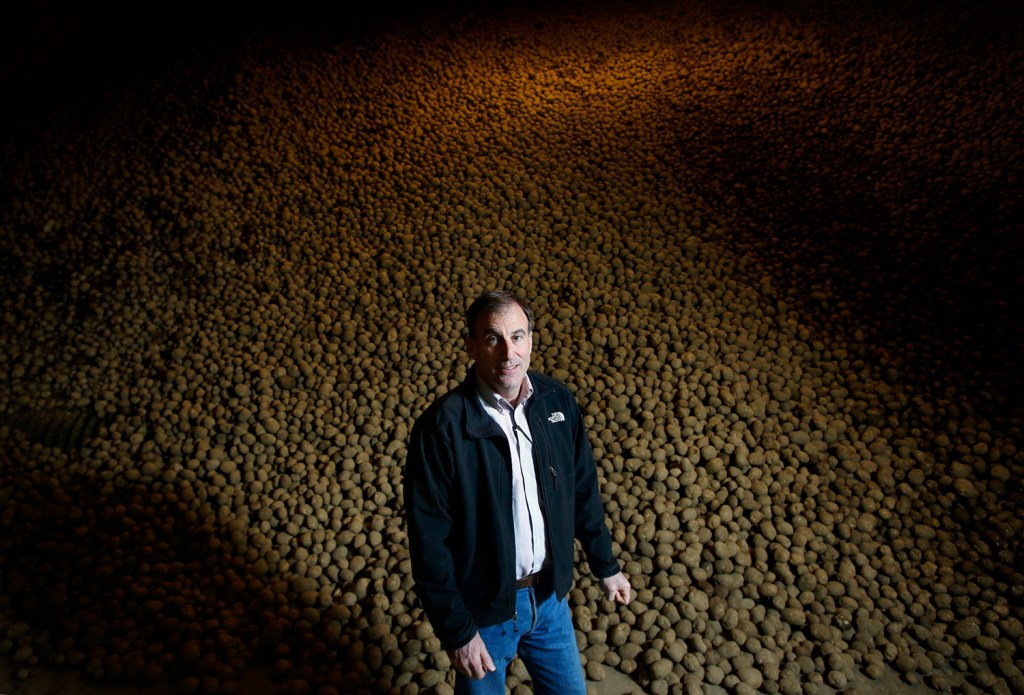



Farmer Don Thibodeau grew up in Aroostook County in the era when a potato was vaunted, but hardly pampered. The packaging was a brown paper bag. If there was value being added, it was at home and involved sour cream and butter.
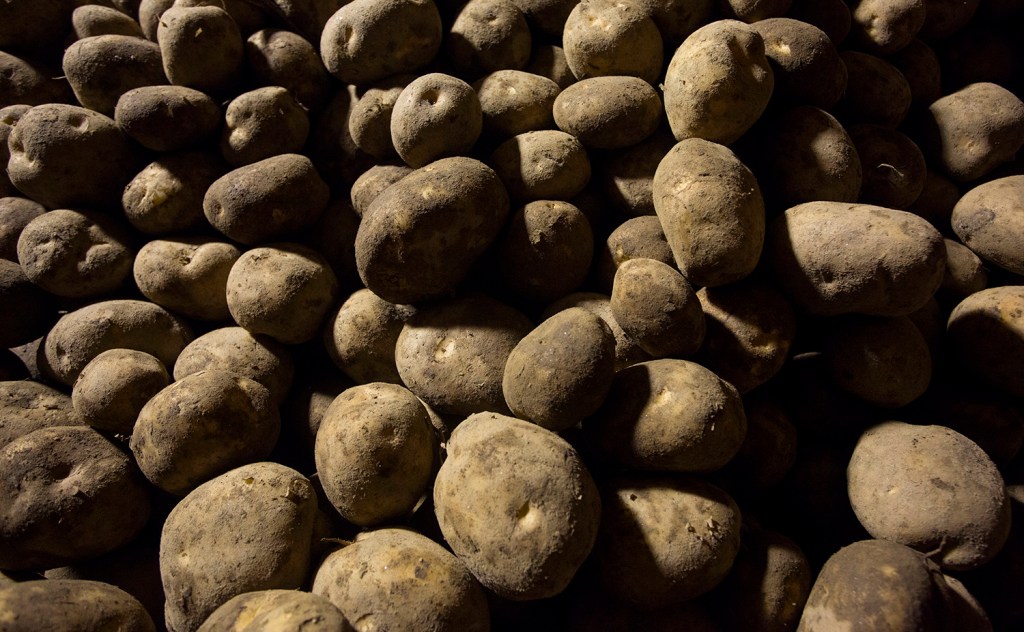
Today he grows potatoes on 725 of his 2,400 acres at Green Thumb Farms in Fryeburg, and adds value like nobody’s business. Through Maine Distilleries, which Thibodeau co-founded, he has a means of making use of his ugly potatoes, the ones too imperfect to qualify as table stock (ie, fit for the table).

Source Sustainability Awards: Call for nominations
Recognizing the people, nonprofits and businesses connecting Maine to its roots and making the state a healthier place to live.
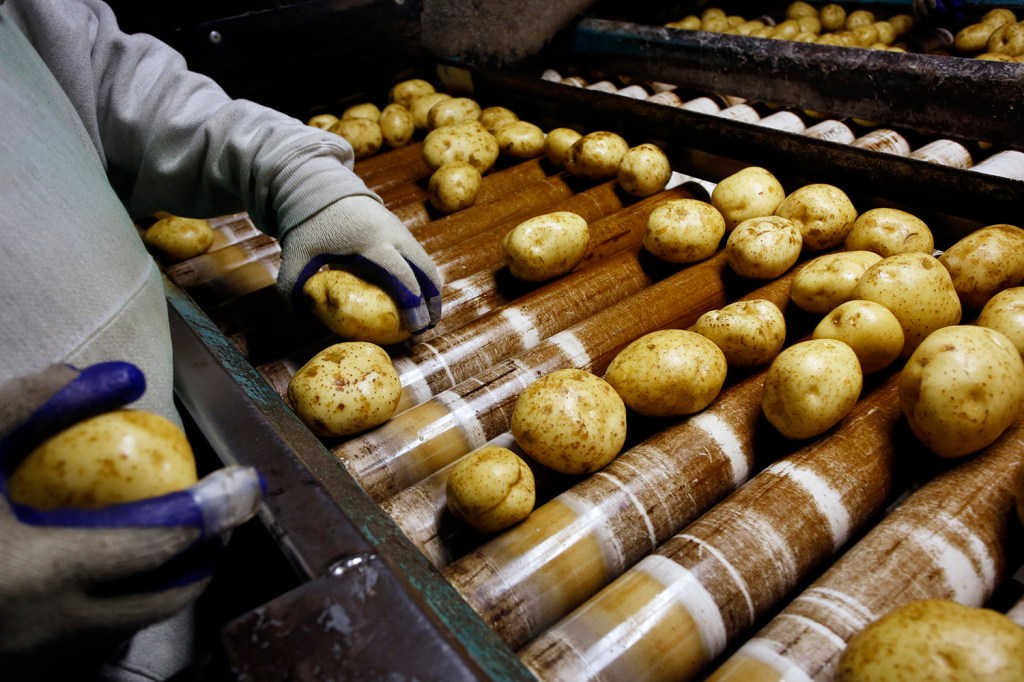
His prettiest potatoes are being used for value-added products like “Steamables,” a product available nationally via a network of eight family-owned farms called Fresh Solutions Networks, of which Thibodeau is an owner/director.
“Steamables” come in a pouch, are prewashed (thrice) and sorted to all be the same approximate size, a 1.5-pound portion perfect for a family of four. Packaged under the Side Delights brand, these “Steamables” are intended to be nuked for eight minutes in their perforated bag.
There is not a lot of obvious Yankee ethic in that. And the product, which is packaged in a bag that looks the same no matter which of the farms in the network fills and distributes it, doesn’t exactly scream local, which Thibodeau readily acknowledges.
“Generally, people look at things like that and say, ‘Oh, that must be from California or Texas or something like that.’ ”
These products are intended for a customer like the harried working person who wants something fresh, with the provenance (and flavor) of a vegetable grown on a family farm, but likes the convenience of a product where the most strenuous action involved is carrying it into the house. Thiboudeau knows this might be a hard sell for say, one of his old friends from a childhood in Presque Isle.
“It’s a different group of people than the people I grew up with, which were looking for a value to feed their family,” Thibodeau said. “It is very difficult to get your head around, that some people aren’t looking for value. It is a high-end market.”
BIGGER REACH
Thibodeau joined Fresh Solutions Network in 2010. The group focuses almost entirely on potatoes and onions (they’re dabbling in sweet potatoes) and sells to the food service industry and chain stores like Walmart and Hannaford. Members include Red Isle in Prince Edward Island, Mack Farms in Florida, Sun-Glo of Idaho and Masser Potato Farms in Pennsylvania. The last, located in Pennsylvania Dutch country, has been a family farm for eight generations.
Each represents a general growing region, each ships to either a processing facility or packs on their property and then travels to a distributor. Their products include MOFGA- and USDA-certified bagged organic potatoes, restaurant-style pre-cut and cooked potatoes and eight different kinds of potatoes ready to be tossed in the oven and roasted.
It’s a means for a Maine potato farmer to enter the more lucrative value-added market without being hampered by issues that hold many producers back from going beyond highly localized markets (reliability of supply, for instance – a dearth in one area could be compensated for by one of the other producers in the network if need be).
“As a fairly large potato farm from Maine we aren’t large enough to take on national markets,” Thibodeau said. Not that he’s small; he estimates that Green Thumb is in the top 10 potato producers in Maine, “But with this, we are able to compete at Walmart and the larger chains across the nation.”
Kathleen Triou, the president and CEO of Fresh Solutions Network, said Fresh Solutions Network commands about 20 percent of the fresh supply market nationwide.
STRATEGIC SPUDS
Thibodeau’s Green Thumb Farms is the only Maine-based (and indeed, New England-based) member of Fresh Solutions Network, and Triou said he was “recruited” for that position.
“We know that potatoes from Maine are a special commodity,” Triou said. “People know potatoes from Maine. We specifically sought out the best partner we could find, and Donnie really fit the bill for us.”
Joining the network was a smart move for a mid-sized Maine farmer like Green Thumb, said Mark Lapping, a professor emeritus at the University of Southern Maine who has been working with the Maine Food Strategy, a statewide plan to strengthen Maine’s food systems.
“They couldn’t make it with just the foodie market,” Lapping said, referring to farmers markets and selling to specialty stores.
“One of the big problems for farmers is, ‘how do I get my product in front of you?’ ” he said, meaning corporate purchasers. Green Thumb gets the benefit of Fresh Solutions Network’s marketing plan, which means the farmer doesn’t have to pitch, the network will.
“Fresh Solutions can say to, for example, the University of Maine system’s food procurement people, ‘We will bring you the very best local products and if you contract with us for potatoes or onions, we can guarantee to you not only local food but very best local food,’ ” Lapping said. “I think that is part of the magic.”
The potato business is “incredibly competitive,” Triou said, with about 1,400 growers nationwide. They vie for markets that shift with diet fads or government recommendations.
“These eight growers have seen a different way,” she said. “They recognized efficiencies that can be had by choosing to work together, so that the sum of the total is much greater.”
For instance, there’s a “99.9” percent chance that if you buy Side Delights at a Hannaford in, say, Maine or Massachusetts, the potatoes will be from Green Thumb, reducing the number of food miles the product has to travel.
Can more Maine potato farmers get in on the action? Doubtful. Triou said Fresh Solutions Network is happy with the farms it is currently working with.
“They are all very strategically located,” Triou said. “Right now that is working for us very well.”
BOTTOMS UP
Joining Fresh Solutions Network and selling under the Side Delights brand is not Thibodeau’s first deep dive into clever diversification. About 12 years ago, his musings about what to do with his imperfect potatoes led directly to Maine Distilleries Cold River Vodka, now sold in 18 states. It was a business concept that floated up from his memories of the stories his father used to tell about growing up in the County in the era of Prohibition.
“It was as good as turning on your TV,’ Thibodeau said. There was the great-uncle that died from jake leg (paralysis from drinking bad alcohol). The elder Thibodeau had watched his uncles making alcohol on the farm in north Caribou. They didn’t call it vodka, but it was clear alcohol made from potatoes. Thibodeau’s father had also watched a disapproving Grammy Thibodeau smash an oak barrel of the stuff with an axe. The stories were so vivid that Don Thibodeau could just about picture the still his great-uncles had used.
Flash forward to more than a decade ago, when the Atkins Diet was in full fad mode. If Thiboudeau was going to make it in a diminishing market, he needed to innovate. “I kept thinking about how do we get better, get out of the box.”
He looked at the chip market, the pre-peeled market and other boutique products. All those markets already seemed mature, but he noticed that “no one was messing with making alcohol from potatoes.”
On a February day, when his father was 82 and preparing for a surgery, Don Thibodeau and his brother Lee, a Portland neurosurgeon, headed up Interstate 95 to be with him. Don pitched his idea to Lee. Lee said he’d pay for a portable still for Don to experiment with. Eventually, they partnered with Chris Dowe – his wife worked with Lee Thibodeau as an anesthesia nurse – and Maine Distilleries was born. As they celebrated their 10th anniversary in business they added a gin-like liquor also made with potatoes, called Distiller’s Reserve, to the line.
“The vodka doesn’t care about how pretty the potato is,” Thibodeau said. “Only the consumer cares about how pretty it is.”
ALL THE PRETTY POTATOES
But Steamables? “They are beautiful, beautiful potatoes,” Triou said, speaking of the tubers headed for microwavable pouches. “Tender skinned but really flavorful.”
Triou said the target audience is the home cook who wants to serve good food but quickly. “They’re for that meal that you want to get ready in 15 minutes or less.”
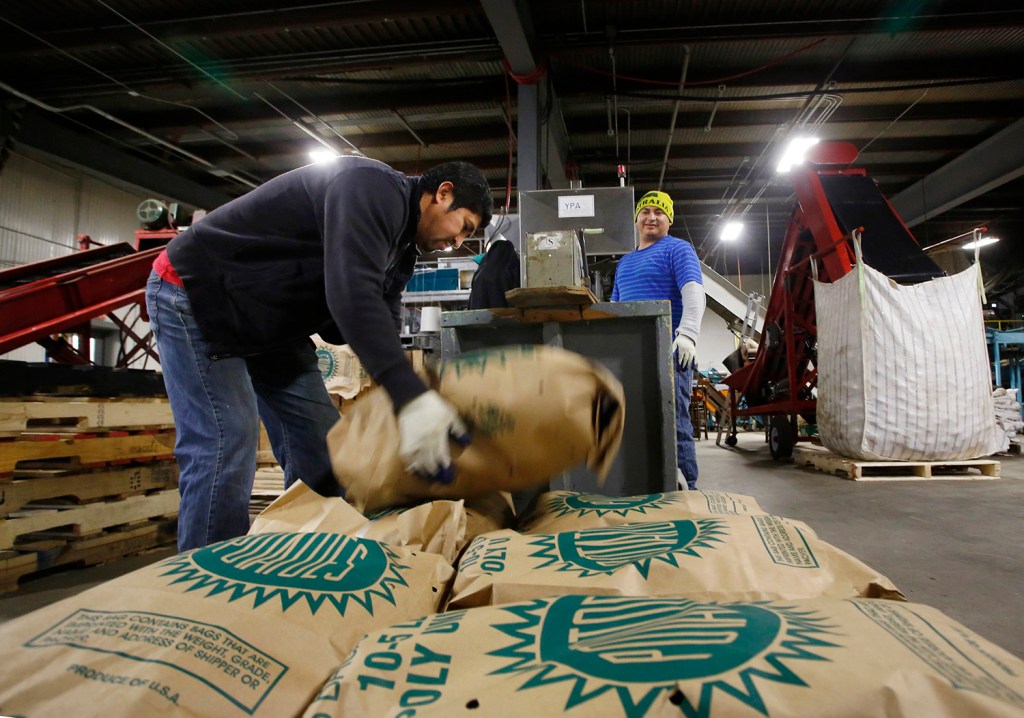
The bags are stamped out and filled at Thibodeau’s Fryeburg farm. They’re recyclable. The opaque package provides a UV shield to keep the potatoes fresher longer on the shelves. But again, they’re plastic, which caused Scott Cassel, CEO of the national watchdog group Product Stewardship Institute, to question their environmental impact.
“Even if it is recyclable, is it being recycled?” Cassel asked. Beyond the lazy or uninformed consumer, there are energy and environmental costs associated with making the bags. But there is no ideal way of getting potatoes, or any fresh foods, to the market, he said.
“One thing that the packaging industry will tell you, which is true, is that we want to protect the food in transport,” Cassel said. “”It costs money to grow these products. If they are being damaged in transit, that’s wasteful.”
A skeptic might point out that potatoes don’t bruise easily and they already store well. Either way, Cassel is uneasy about the packaging.
“There is a waste here,” he said. “I couldn’t tell you that this is wrong definitively, but I would hope we could come up with a better way.”
Marada Cook produces a similar value-added product for Northern Girl, a line distributed by Crown O’ Maine Organic Cooperative. Those packages come in clear plastic and contain cut-up vegetables such as beets, potatoes, carrots and other root vegetables ready for cooking. No peeling, no chopping, seriously convenient. She posed a question to anyone who might feel guilty buying even only semi-prepared foods.
“What if marketing helped more with that?”
In other words, maybe there isn’t anything wrong with having your potatoes be both local and easy, even if your grandmother in Houlton would roll her eyes.
For Thiboudeau, communicating about the local part is the last part of his sales equation. Because Side Delight products like the Steamables come in the same bag, whatever region of the country they are grown in and shipping from, it’s a challenge to brand them with the sweet story of a family farm that one gets from shopping at a local farmers market.
To that end, this month he started adding Green Thumb of Fryeburg, Maine stickers to those distinctly slick-looking bags so that they can be part of Hannaford’s Locally Grown program. Because though they are not supposed to, appearances do matter, and this farmer wants to sell.
Send questions/comments to the editors.
