



There never was a good war, Benjamin Franklin famously wrote. And, as Mahoney Middle School students recently discovered, serving in a war can be painful.
By interviewing local veterans for a school project, eighth-graders at the South Portland school learned many important lessons, including that war is hard and often lonely for those serving, and they gained a new respect for their elders who served during conflict.
The students also learned that war is anything but glamorous, with bad food, bad lodgings and fear of the enemy dogging the servicemen, who sometimes, as in the case of the Vietnam War, may question why they’re sent into combat at all.
During a special ceremony held at the school last Thursday in honor of Veterans Day, which was observed on Nov. 11, several students shared the stories of the South Portland veterans they interviewed.
“The best way to honor our veterans is to listen and learn from their experiences. And, any time we can honor them, we should do it,” said Susan Thornfeldt, an eighth-grade social studies teacher at Mahoney, whose own son is in the military. The veterans project was her idea, and, following the special event last week, she told the Current she was “very surprised about how open the veterans were with students.”
After months of research and making calls, she was able to find 22 local veterans willing to speak with the students about their wartime experiences.
She said the veterans were “apprehensive at first,” with many unsure if they wanted to share their “horrific experiences” and others feeling that “their role was (too) insignificant,” to be of interest. But Thornfeldt eventually convinced a number of local veterans to become a living history lesson for her students.
Speaking to the assembly of Maine military brass, including Brig. Gen. Gerard Bolduc, commander of the Maine Air National Guard, local veterans and fellow students, Isaac Sobey told of some of his recent discoveries regarding his grandfather, a Vietnam vet.
Christopher Queally was drafted in 1968 and was in Vietnam for about six months before he was wounded. Sobey said his grandfather’s first thought was relief to be out of the war, even though his injuries were so severe that he spent a year in the hospital recovering. He also talked about the pain his grandfather felt when a sister and brother-in-law protested the war.
Max Jones spoke about his grandfather, David Jones, a Vietnam veteran, who graduated from West Point in 1967. Even though he was a member of the Army Corps of Engineers, charged with building roads and bridges capable of bearing tanks, Jones saw some combat.
Max Jones called the veterans project “very meaningful” and said it had given him a new respect for his grandfather.
Hattie Tetzlaff interviewed veteran David Worthing, who served in the Navy during Vietnam. One of the things that she learned from Worthing is that certain smells can still trigger memories from the war.
And although Worthing felt it was “the wrong war, in the wrong place,” he told Tetzlaff that he has no regrets about joining the Navy at the age of 17 – even though he went off to war before graduating from high school.
Anna Folley interviewed veteran Werner Splettstoesser, who served in both the Navy and the Coast Guard, and said the main thing she learned from him was that it’s “easy to take for granted that we live in a free country,” which is why it’s so important to “take the time to thank a vet.”
Maddie Drolet was one of the few students able to interview a soldier from World War II, James Mardin.
Mardin was forthright and told Drolet that he felt like a coward because when he was shot at the first time, he dove under a nearby tank for cover.
But, Drolet said, what she learned from him is that getting up and going on is the “true meaning of selflessness and courage.”
Student Gage Herring closed out last week’s event by reminding the audience to “remember our veterans, not just on Veterans Day, but every day and to tell them thanks for their service and sacrifice.”
Thornfeldt said she was grateful to the veterans for being willing to spend time with the students and share their stories – some funny, some scary and some poignant.
Overall, Thornfeldt wanted her students “to hear all perspectives, not just from the combat side of things.”
“They heard from veterans who took part in the Cold War and the Vietnam War. They heard from Coast Guard and Navy veterans who were patrolling the waters around the Soviet Union during the Cold War, from those on submarines who had missiles pointed at the Soviets, those who had combat roles and those soldiers who didn’t,” she said.
In the end, Thornfeldt said, “my students received a well-rounded (view) of war and conflict and the role of our military.”
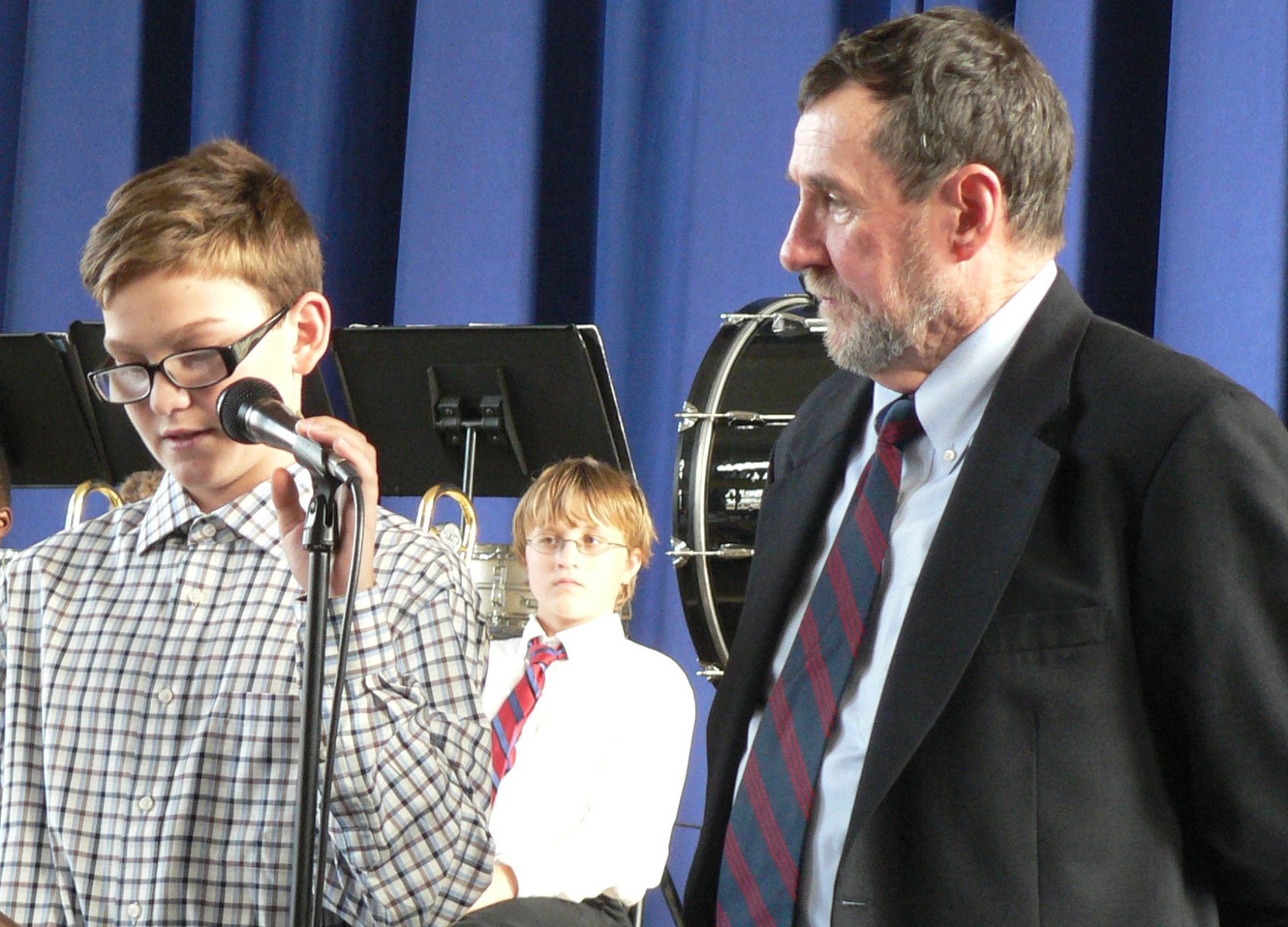 Student Isaac Sobey and his grandfather, Christopher Queally, a Vietnam War veteran, during a special ceremony at Mahoney Middle School in South Portland.
Send questions/comments to the editors.
