



SOUTH PORTLAND – This fall Southern Maine Community College in South Portland acquired a high-capacity composter designed to create compost from food waste.
Called “The Rocket,” the composter is 13 feet long and is capable of continuously composting up to 460 gallons of food waste each week, according to David Palm, a horticulture professor who oversees the composter.
The goal is for the machine to turn food waste from the college’s culinary arts program into compost that can be used for landscaping and gardening needs on campus.
What’s also great about the giant composter, Palm said, is that “this is a student-driven project (where) students are learning about recycling, sustainability and the environment as part of their daily education.”
The composter was paid for through a grant and is located under a protective shelter behind the culinary arts building.
Culinary arts student Tony Leslie agreed that it’s important for the college to be as self-sustaining as possible and “to teach students about the value of conservation and recycling.”
He added, “It’s good this (composting program) is incorporated into our training so we can continue this practice throughout our careers.”
Palm said “The Rocket” was first fired up in late September and that installing a giant composter at Southern Maine Community
College was a joint effort between himself and Cheryl Rich, the horticulture department’s chairwoman.
He said the two first began talking about how to better use the large amount of food waste generated by the college two years ago believing that food scraps could be made into compost and used by the horticulture program.
Palm said the new composting program is important because of the college’s commitment to practicing sustainability and to reduce its carbon footprint.
“This is also an important piece for the accreditation of the culinary arts program,” Palm said. “One of the pieces (required) for accreditation is sustainable practices, and composting is an important step toward” that goal.
He said the food waste fed into “The Rocket” comes from both the culinary arts program and from special events held at the McKernan Center.
Palm said the compost created will “be used on the horticulture gardens, as well as the Spring Point Arboretum and the community gardens on (campus).”
Overall, he said, “Our goal would be to have not only culinary students practicing this in their kitchens, but also for students and staff to begin practicing it at home.”
Second-year horticulture student Mike Howland said what’s great about turning food waste into compost is that it will help improve the “health of the soil around campus, which will result in a robust and well-maintained landscape.”
He also said, “The compost initiative is important for the students’ education (and) I would think having ‘The Rocket’ on campus will help reduce the amount of fossil fuels used to haul the food scraps away.”
Howland said that, “food waste is a great source of compost. If it can be eaten or grown in a field, then it can be composted.”
He added, “I intend to bring composting into my professional career. It is (something) that truly reflects my values of recycling and nutrition. I (already) keep a Vermi composting unit in my kitchen and use red wiggler worms,” too.
In addition, Howland said use of “The Rocket” has helped to bridge the gap between the culinary arts program and the horticultural program.
“It will certainly make conversations start,” he said.
In addition to “The Rocket,” the college has also contracted with the Portland-based company, We Compost It, to collect food waste from the school’s cafeteria.
Since school started this fall, more than 28,000 pounds of food waste has been collected.
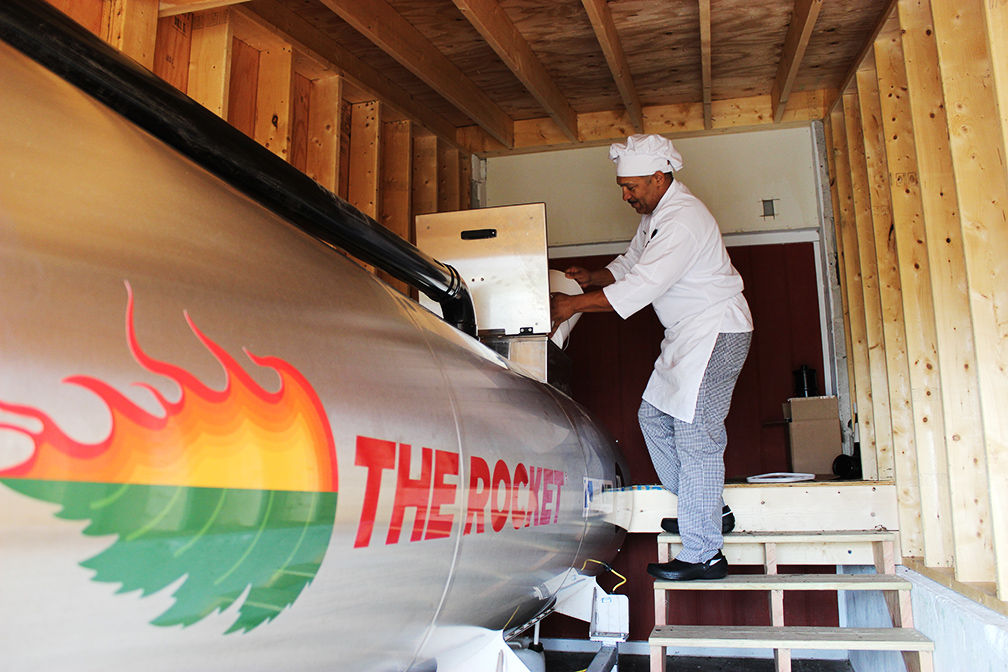 Tony Leslie, a culinary arts student at Southern Maine Community College in South Portland, pours food waste into the college’s new high-capacity composter, called “The Rocket.” Courtesy photo
Send questions/comments to the editors.
