



A beautiful old home next to the Freeport Baptist Church at 183 Main St., will now serve as home to the town’s newest private school, the Freeport Montessori School. Owned by Marnee Harke of Yarmouth, it will begin its first season of classes on Sept. 14. Open houses are scheduled for Aug. 11 from 9:30-11 a.m., Aug. 19 at 5 p.m. and Aug. 26 from 9:30-11 a.m.
Harke is owner, director and lead teacher of Freeport Montessori School, which joins several other private schools operating in town. For children ages 21?2 to 5 years old, Freeport Montessori School will follow what Harke calls a modified Freeport school schedule. Calendar details will be available soon at www.freeportmontessori.org.
Born in Vermont and raised in Connecticut, Harke has lived and worked as a Montessori teacher in Vermont, Connecticut and now Maine. She has lived in Yarmouth with her husband, William, and their three boys for nearly two years.
“It was always our dream to move to this area of Maine and it came to fruition two years ago,” Harke said. “Previous to coming to Maine I was a head of school in Fairfield, Conn., for three years. In fact, Marcia (Clark, her co-teacher) was one of the co-founders of the school I headed in Connecticut.”
Harke answered questions on the new school and on Montessori education for the Tri-Town Weekly
Q: Freeport seems to be a big draw for private schools. Is there anything particular about the town that prompted you to begin your Montessori school here?
A: For me the proximity of the school to the interstate, downtown and the Freeport Community Lbrary were the biggest draws, as well as the overall walkability of Freeport, which affords so many great opportunities for learning and community involvement. Further, the people we have met in Freeport, both parents and business owners alike, have all been incredibly warm, welcoming and supportive, especially the Rev. (Sandy) Williams and the First Baptist Church community, who own the building. Freeport Montessori School will be working with the community center, visiting the public library and starting a garden with Farm to Table Kids, a not-for-profit program run by Stephanie O’Neil. In the end, our children are all individuals and what is the right fit for one may not be the right fit for another. As a parent and educator, I understand the importance of choice for what are our most valuable assets, our children.
Q: Describe a Montessori education for us.
A: Montessori education is a form of education developed over 100 years ago by Maria Montessori in Italy. She believed that children learn from real-life, hands-on experiences. The children work independently throughout the day choosing the activities that are of interest to them. Students are encouraged to follow their passions. Teachers act as guides in the environment. It is our job to make sure that children are choosing works from all the subject areas and leaving us with exposure to all areas of the classroom. In addition, the Montessori method focuses on lessons of grace and courtesy. The children learn the importance of taking care of the environment and taking care of one another and many other important life skills.
Q: Why is the school for children 21?2 to 5 years of age?
A: Montessori education is based on multi-aged classrooms. It becomes a community of learners where the older children are teaching the younger students and the younger students are aspiring to do all the wonderful works their older friends are doing. It enables the children to learn to nurture and co-operate with children of all ages. The teachers role is to facilitate that learning and that involvement by softly directing the child, but letting him or her learn at their own pace.
Q: How many teachers will there be? Do they have different subject areas?
A: There will be two teachers, Marcia Clark and myself. We have seven different areas in the Montessori classroom: practical life, sensorial, math, language, science, culture and art. Most of those you should have a pretty good idea of what they are. The two you may not are practical life and sensorial. Practical life allows the child to foster self-confidence with independence. We teach simple, everyday skills such as buttoning, shoe lacing, pouring and cutting. The sensorial materials allow the child to explore their environment with sight and touch by classification into groups (smooth/rough, magnetic/non-magnetic, etc.) Marcia and I are both trained Montessori teachers and work in all areas of the classroom.
Q: Do you recommend certain schools once these children reach kindergarten level?
A: We like our students to stay with us for their kindergarten year if possible. It is the culminating year in a Montessori primary classroom and leaves the children ready to take on their next academic challenge. After kindergarten our children will attend a wide variety of schools. Our goal is to prepare children for school and for life. I expect that most of our students will go onto a traditional first-grade program, whether public or private. We are also hoping to work closely with the Freeport school system to better understand their curriculum to help facilitate an easy transition to their next step in education.
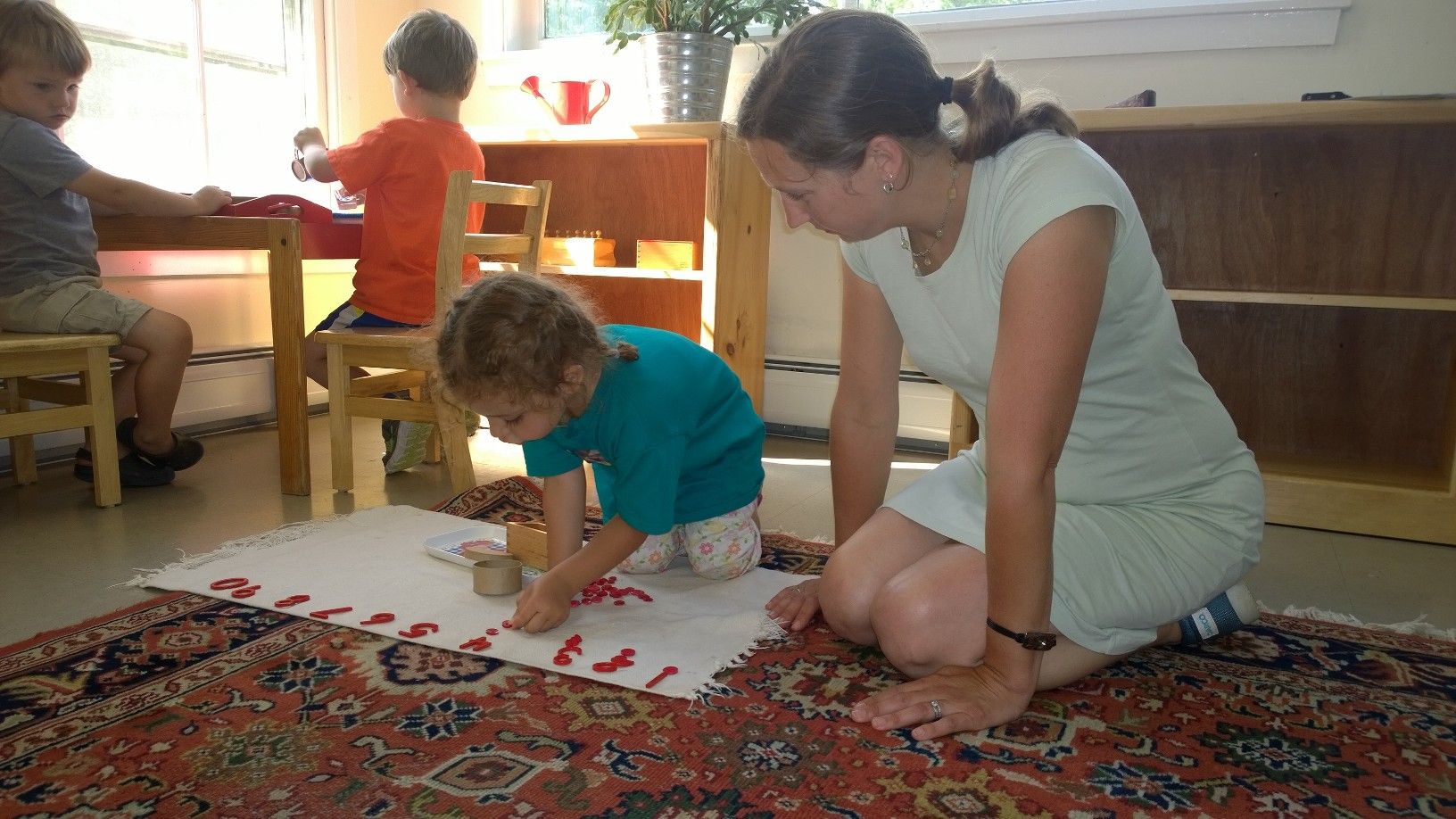 Marnee Harke, owner of the new Freeport Montessori School, works with Lucy Charette during a recent open house at the school. In the background are her youngest son, Nolan Harke, and Carter Kenniff.Courtesy photo
Send questions/comments to the editors.
