



WESTBROOK – Rare and well-preserved wooden water pipes have been unearthed from the ground on Longfellow Street in Westbrook.
The find, just before Labor Day weekend, stunned Casey Reynolds and the rest of his crew from St. Laurent & Son, an excavation company working as a subcontractor on a 1,100-foot water main replacement for the Portland Water District. Normally, workers see fragments of similar systems during such projects, but Reynolds said this week that they’ve never seen one “this extensive.”
“Usually you find pieces of this stuff here and there, but this just kept going,” Reynolds said, adding that some of the younger members of the crew didn’t recognize the significance of their find.
“I said, ‘You don’t understand. I’ve been doing this for over 20 years, and you just don’t find this stuff,’” he said.
Roughly 15 cedar logs, totaling about 200 feet, were excavated from the site, and since that time, Portland Water District officials have been conducting research into where, or when, they came from.
Michelle Clements, the public relations manager for the Portland Water District, said the piping is estimated to be from somewhere in “the 1820-1850 time frame.”
She said that the Portland Water District has no records of installing, or even using, wooden pipe. The Portland Water Co. was formed in 1869.
On Tuesday, at Portland Water District headquarters in Portland, Clements, Reynolds and maintenance foreman Andrew Welch discussed their best guesses on the circumstances behind the pipes.
“Occasionally, remnants of wooden water systems are found during excavation projects, but this appears to be one of the most extensive systems we have uncovered,” Clements said.
While Clements said the department usually finds systems where logs with bored holes are fitted together, the system discovered on Longfellow Street used logs with one tapered side, which were jammed into other bored-out logs to create a series.
Reynolds, a project superintendent for the Lewiston-based excavators, said his team found the pipes buried about 31?2 feet in the ground, before finding the cast-iron water main from 1896 that they were originally digging for. Reynolds said the team found boards that were used to prop up the older wooden pipes while the cast-iron system was installed.
Noticing a steel ring near the base of where each tapered log was fitted to the next, Reynolds estimated Tuesday that the ring was pounded into the wood once the logs were fitted together. He said once water was added, this would cause the wood to swell and the logs to fit more tightly together.
Since the pipes arrived at the office two weeks ago, Welch has been charged with choosing and working to preserve a few to eventually display at the Portland Water District office with other historical items retrieved through the years. He said Tuesday that he attempted to find two pipes with the best connection, and plans to treat them with linseed oil and polish to protect them.
Welch said the logs were covered in clay and plugged with dirt and debris, which he removed with a pressure washer.
“I’m not 100 percent sure how we’re going to preserve it,” he said, adding that the craftsmanship involved in making the pipes is impressive. “I’m a woodworker by trade and this is more than I’d ever be able to do. These guys were pretty clever.”
Reynolds added that now that the wood is out of the ground and has dried out, it will deteriorate if not preserved quickly. He said that not all the wood was salvageable – the crew was using a 2-ton excavator, which inadvertently destroyed some of the pieces.
Barbara Brewer, the executive administrative assistant at the Portland Water District, who Clements called the department’s “resident historian,” has also been looking into Westbrook history in order to speculate on the possible origins of the piping.
From information passed on from the Westbrook Historical Society, Brewer leans toward a theory that the piping was installed by brothers George and Lewis P. Warren, who, according to an 1871 atlas, owned the strip of land along Longfellow Street.
While their relationship to S.D. Warren, the paper mill owner, is unclear, their company, G & L.P. Warren, along with their father, John Warren, was prominent in lumbering and farming. Brewer speculates that the water “may have been piped in for their endeavors.”
Brewer also found that all three Warrens, along with others, incorporated the Marblehead Water Power Co. in 1869, and later the Presumpscot Water Power Co. in 1878.
“While the incorporation of these water companies post-dates the pipes and were mainly for the purpose of constructing and maintaining dams, it does demonstrate that each had an interest in water rights,” Brewer said in an email. “They were also very capable of construction of wooden water pipe systems.”
“If you had a water pipe running in front of your house, with water going in, back in the 1800s, you were something special,” Reynolds said Tuesday.
Westbrook City Councilor Mike Sanphy, president of the Westbrook Historical Society, said Tuesday that while the Warrens may have had a hand in the operation, he believes the piping stems from the Cumberland & Oxford Canal, which connected the Lakes Region to Westbrook through a series of locks.
Sanphy speculated that the pipes brought water from the river in order to bring water levels up in the lock system.
“If you look at it, it was probably more logical to have water coming that way to feed the locks than it would for anything else,” he said.
Sanphy added that the Westbrook Historical Society would be “very interested” in obtaining a portion of the piping for display.
Clements said the Maine Historical Society has also expressed interest in receiving a sample of the wooden pipes.
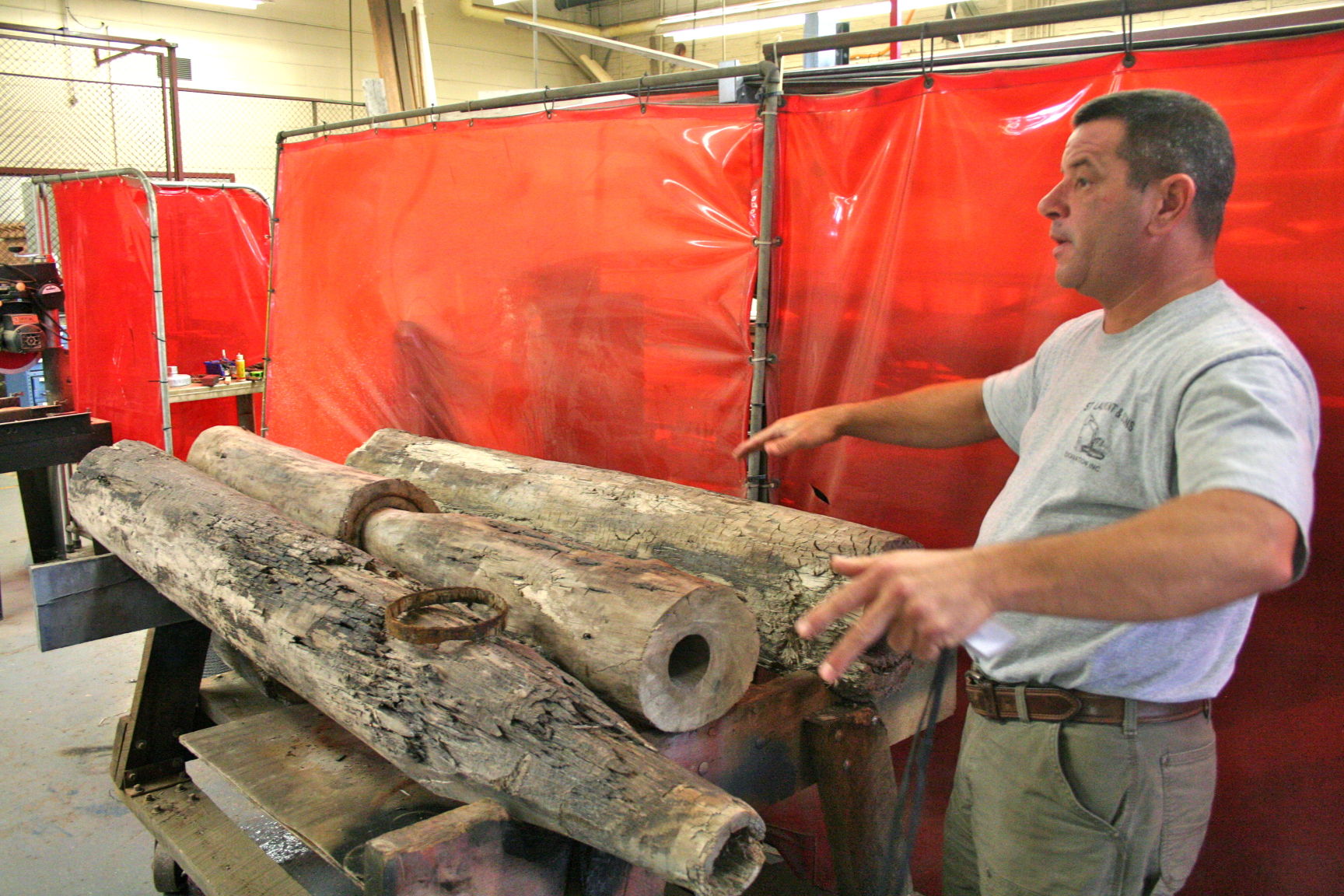 Casey Reynolds of St. Laurent & Son, an excavation company, talks about the find his crew made while working on a water main replacement project on Longfellow Street in Westbrook. “I’ve been doing this for over 20 years, and you just don’t find this stuff,’” he said of the centuries-old wooden water pipes, which are now at the Portland Water District facility.
 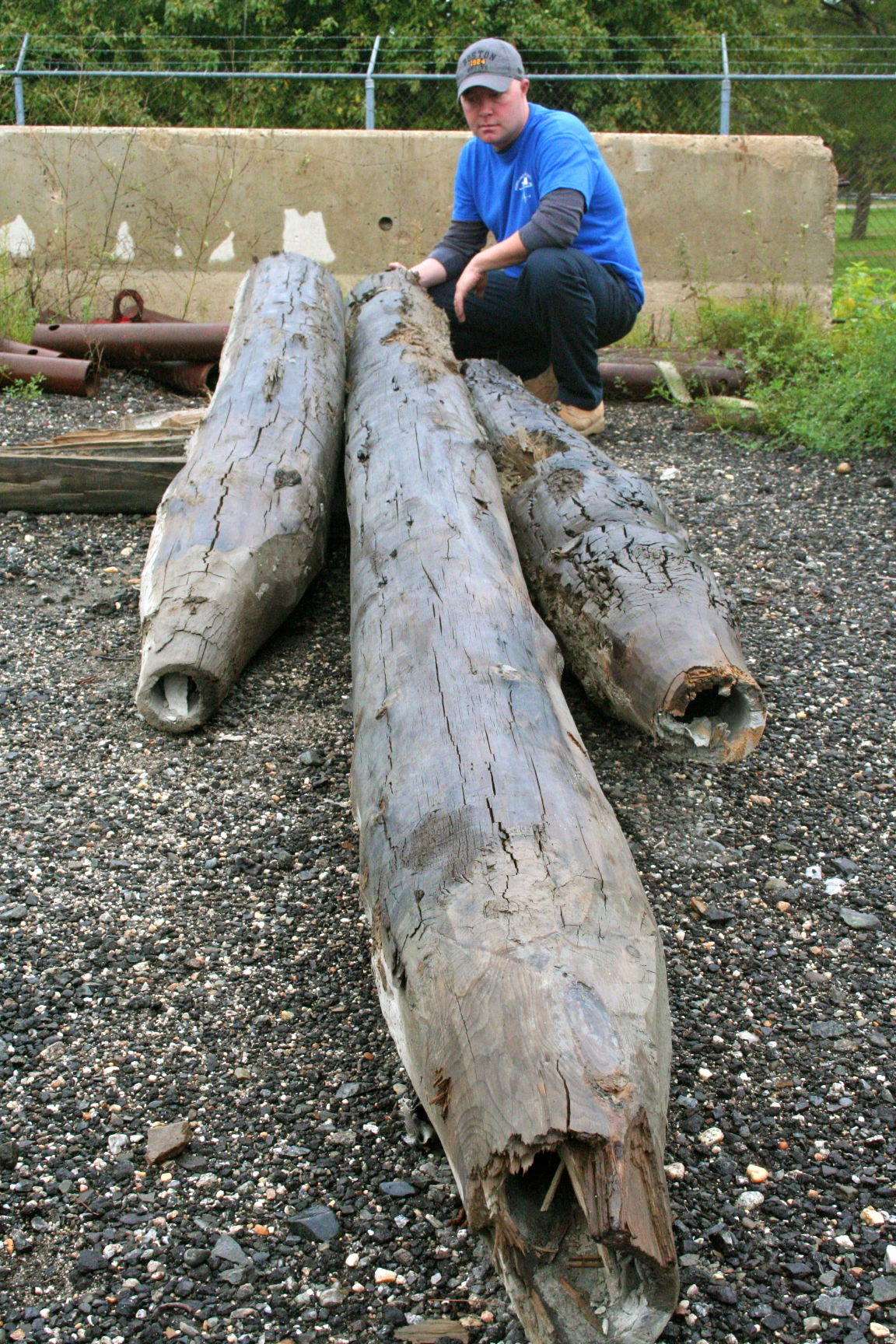 Andrew Welch, maintenance foreman with the Portland Water District, ??surveys some of the centuries-old wooden water pipes dug up recently in Westbrook.
 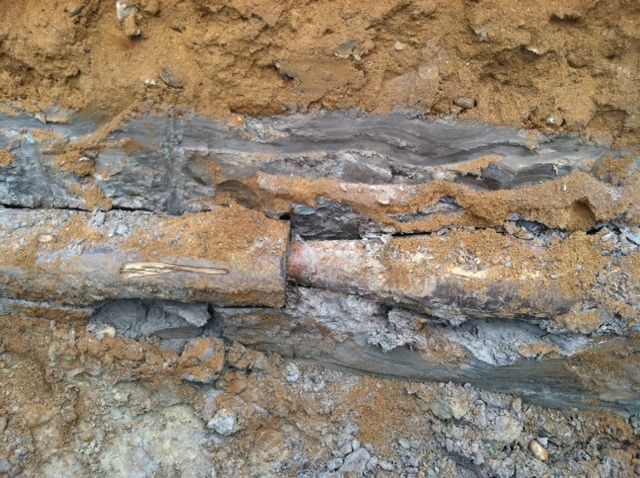 In the recently discovered wooden pipes, tapered, bored-out logs were jammed into other bored-out logs to create a pipeline.
Send questions/comments to the editors.
