



FREEPORT – Kate McCarty, food preservation community education assistant for the University of Maine Cooperative Extension Cumberland County, will be among experts on hand for a guided tour of back yards in Freeport and Brunswick during the sixth annual Backyard Locavore Day on Aug. 9.
McCarty 31, of Portland, teaches food preservation workshops and manages the Cooperative Extension’s master food preserver volunteers. During the tour, she will show people how to increase self-sufficiency to meet their own food needs. Demonstrations will focus on backyard gardening techniques, food preservation methods and more.
People participating will see backyard poultry, honeybees at work, plants of all sizes and varieties, techniques for container gardening, square-foot gardening, and demonstrations on preserving the harvest. McCarty, as well as UMaine Extension master gardeners, will answer questions.
The three Freeport sites include organically managed property on Kendall Lane, featuring shade trees and shrubs dating back to the 1800s, with a vegetable garden and chickens; on South Street, featuring a terraced, hillside fruit and vegetable garden overlooking the Harraseeket River; and a shady property with water features, a vegetable bed and an ornamental garden on Burnett Road.
Tickets are $15 in advance and $20 the day of the event, and are available at http://extension.umaine.edu/cumberland/programs/locavore/.
McCarty spoke to the Tri-Town Weekly recently about what it means to be a locavore.
Q: What is a locavore, and how did the term arise?
A: A locavore is someone who eats food grown and produced locally. What constitutes as local is up to the individual – any effort at increasing local food systems is appreciated.
Q: Are you a locavore? If so, why?
A: I am. I love Maine and believe it produces incredible food. I take every opportunity to support our local food producers, and it’s easy to do so with so many talented chefs, farmers, bakers, cheese makers and brewers.
Q: How does the Cooperative Extension go about choosing people for these backyard sessions?
A: We ask friends of Extension to volunteer, but we have definitely stopped on the road when we’ve seen a beautiful property and asked the homeowner to participate.
Q: Do locavores usually favor organic food?
A: Not necessarily, no. Many home gardeners choose organic methods for their gardens, though.
Q: Is this mostly a rural or an urban phenomenon, and is that changing?
A: It is certainly easier to have a large garden in the country, where homeowners typically have use of more land, but as more people become interested in growing and preserving their own food, urbanites are finding creative ways to produce food from small spaces.
Q: Are local farmers being helped a lot with this?
A: Yes, farming in Maine is on the increase, due to people’s growing interest in local food. We have great farmers markets, community-supported agriculture shares and farm stands.
Q: Are local supermarkets taking notice?
A: They are. Maine supermarkets are increasingly incorporating local foods into their offerings, like Maine apples, potatoes, and value-added specialty products like jams, maple syrup, barbecue sauces, etc.
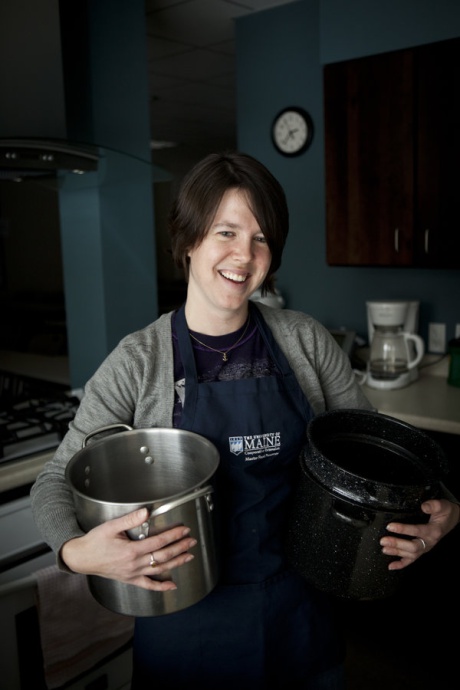 Kate McCarty, a food preservation specialist with the University of Maine Cooperative Extension, will be in Freeport on Aug. 9 for the annual Backyard Locavore Day.
 Send questions/comments to the editors.
