



RAYMOND – Initially hired as a Raymond town secretary on Jan. 16, 1989, Louise Lester became deputy clerk in 1996, and town clerk in 2001. Now, Lester plans to relax. On June 30, she will retire, and that same day, fly to Montana for 10 days of sightseeing, as well as some time on a cattle ranch.
When asked to reflect on her quarter-century with the town of Raymond, Lester is economical with her words.
Why retire?
“I’m 69 years old. It’s time.”
How did you get into this business?
“They called me.”
Why stick around Raymond for all these years?
“It’s my home. I’m not going to go anywhere else.”
But when asked to convey a message of her choosing to the citizens of Raymond, Lester’s initial brevity – “Yeah. Get out the vote.” – quickly yields to an impassioned, lengthy appeal.
“I think town meeting is just one of the neatest things,” Lester said. “New England is the last place in the United States you’re going to find a town meeting and to have a say and be able to tell your fellow citizens what you think on an item, instead of leaving it up to 7, 8, 9 council members to make your decisions for you. It’s just; it’s really wonderful. I think people have lost sight of the fact that this is the last seed of democracy, true democracy, where the average citizen can get up and say something and make a difference. They can, but we just don’t see people coming out to do that, and I think that’s sad. That’s really sad.”
Born in New Jersey, Lester’s family moved to Raymond in 1950. The town’s population was 750. Her father, James Hartley, built the marina that is now Port Harbor Marine. He was also a Raymond selectman, fire chief, and a ham radio operator. She said her father, a traveling salesman, had moved to Raymond in order to spend more time with her family.
These days, Lester lives on Route 302 with a “barn full of horses,” across the street from her daughter, Charlotte. Lester’s husband, Charles “Duce” Lester, died in 2010.
Compared with her childhood, Lester says she’s seen a decline in Raymond’s democratic spirit. The demise of civic responsibility, she says, has most conspicuously manifested itself at the annual town meeting.
“When I was a kid, it was an occasion,” Lester says. “Town meeting was a big deal. And I think that’s true of most of the small towns. For one thing, it was a social time. But the other thing was that they used to take all day. They’d start at 10 o’clock in the morning, and we might not get done at 6 o’clock at night, and I can’t say that the articles and the issues were any different than they are now.”
Easily 200 people would show up to the Raymond town meetings during Lester’s childhood. These days, as the town’s population has swelled to 4,300, it’s lucky if 200 people show up to town meeting, which now take place on a weeknight. The town meetings were an annual institution, as well as combative, rowdy social gatherings, Lester says.
“It was fun,” she says. “We expected people to get up and have arguments and argue across the floor and have votes and possibly have ties and have to revote. I don’t know. People’s attitudes were just different, more down-home, I think. Sometimes a group like the library ladies would have sandwiches and drinks for lunchtime. They’d break for an hour and go and out and come back and argue some more.”
Given how busy people seem to be nowadays, Lester says she’s seen a decline in volunteerism at the town office, as well.
“I don’t think it’s anything horrendously disturbing, except maybe to me personally, but it’s the way it is, and you have to deal with it,” she says. “I don’t know what the future’s going to bring. Especially when you talk about money, like everybody else, the national debt, the whole thing. Are people going to be working so hard to make a living and staying afloat that they won’t have time for anything having to do with, I don’t care whether it’s a 5K run or something for the town like the beautification committee, or whatever, I don’t know. Are we still going to be able to find some volunteers out there?”
Town Manager Don Willard, who says Lester will be missed at the town office, agrees that town meeting used to be an “annual rite of spring” in many small towns. In more recent history, Willard suggests that town meeting attendance has dropped as a result of school consolidation.
“The decrease in town meeting is probably more related to the fact that we don’t have the school to consider anymore,” Willard says. “There isn’t the open town meeting debate on the school budget.”
Selectmen Mike Reynolds says that Lester’s sense of institutional memory will be difficult to replace.
“No matter who we find to be the new clerk, you cannot replace her history, her knowledge of history,” says Reynolds. “She knows things that no matter who you hire you’re not going to get that replaced.”
After she retires, Lester plans to spend a lot of time riding her horses. But she’ll also be keeping an eye on the venerable tradition of the Raymond town meeting.
“Ultimately, I think it will do away with town meetings,” Lester says, referring to the pervasive busyness of contemporary Raymond citizens. “Eventually, everybody will go to a council and we’ll get the same kind of governance that we’re getting at the state, with our legislature, or the federal government with our Congress and senate. The average guy won’t be able to have a voice.”
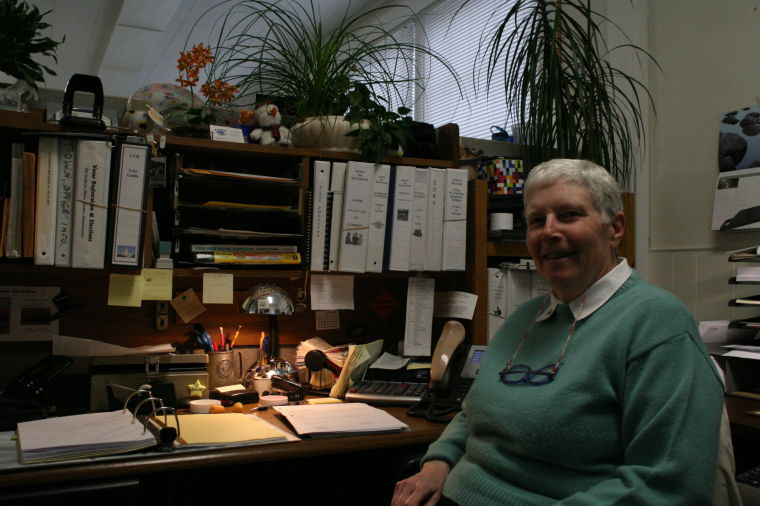 After serving in the front office at Raymond Town Hall for 25 years, Louise Lester is retiring at the end of June.
 Send questions/comments to the editors.
