



POWNAL – Matt Welch and his friends in the Pownal Conservation Commission have a wanted poster out.
It reads: “Wanted. The invasive plant gang. These are a few of the common ones seen locally. Be on the look out. They may be growing on your property choking out native trees and plants. Bittersweet aka Celastrus Orbiculata. Knotweed/Bamboo aka Fallopia Japonica. And the Bush Honeysuckle brothers, Tartarian and Morrow.”
Again this year, Pownal Conservation Commission members and other volunteers will be out on a stretch of the town-owned forest, off Poland Range Road, pulling up these invaders that choke out native wood species. They will be there on April 19, from 8:30-noon, with some welcome help from Edna & Lucy’s Restaurant/Cafe, which will provide much-needed doughnuts.
Honeysuckle, Welch says, is Public Enemy No. 1.
“It grows fast and ends up choking out new tree growth,” Welch said. “If you go out on Route 9 you’ll really notice it. It’s the first thing you see getting green in April.”
The volunteers will concentrate on a 1-acre plot on the western side of the 100-acre town forest.
“The honeysuckle is bad there,” Welch said. “We’ve seen a little knotweed and bamboo, and we keep our eyes out for bittersweet, a climbing vine that wraps itself around trees. It restricts the growth of our trees.”
Welch said that most of the invasive forest species were introduced to Maine for decorative reasons – honeysuckle as late as the 1980s.
“We’re just trying to be aware and stay ahead of the game,” he said. “We’re going after the young ones and pulling them up.”
The Pownal commission is part of a regional effort to keep invasive species in check, Welch said.
“We’re just trying to keep track of this one forest, and we’re doing what we can to manage it,” he said. “Other communities are doing this.”
Welch described the town-owned land as a “multi-use forest,” both for recreational use and for wood. A few years back, he said, the town harvested wood there as part of a sustainable harvest plan.
“Every 10 or 15 years they go in and take 25 or 30 percent,” he said.
Lois Stack, a horticulturalist with the University of Maine Cooperative Extension, said the problem of invasive plants gets worse every year.
“The fact is, we might have to live with them,” Stack said. “We can’t get ahead of all of these. But there are valued places such as Acadia National Park, and Bradbury Mountain State Park. If (the Pownal Conservation Commission) values that piece of property and they’re willing to get out there every year, good for them.”
Stack said there are 50 more invasive plants in the state.
“The problem is not that they’re weeds in our gardens, it’s that they’re disrupting our natural systems,” she said.
Not all invasive plants have an “equal ability to invade,” Stack said. Bittersweet does particularly well in upland forests. Honeysuckle is widely distributed, she said.
“It’s still sold as an ornamental shrub, and as a hedge row plant in farming systems,” she said. “It has beautiful fruits in fall and fragrant flowers in June. Songbirds eat the seeds and distribute them.”
Stack said there must be political will in order to manage the distribution of these plants, or even to quarantine them.
“We simply haven’t gotten that far in Maine,” she said. “There are very few states that regulate invasive plants. Massachusetts and New Hampshire do. It needs to be a really well thought-out plan. And it requires legislative will.”
The state does regulate invasive aquatic plants, Stack pointed out.
A CLOSER LOOK
Honeysuckle can rapidly invade and degrade native plant communities. It forms a dense layer that shades the ground, interfering with the growth of many native woody and herbaceous species, including rare plants. The ground under a honeysuckle thicket is often void of other vegetation. Shrub honeysuckles leaf out earlier than native species and they retain their leaves longer into the fall, giving them a competitive edge. The fruit of these shrubs is eaten by common birds, which helps spread the seed into new locations and makes the shrub even more difficult to control.Source: University of Maine Cooperative Extension
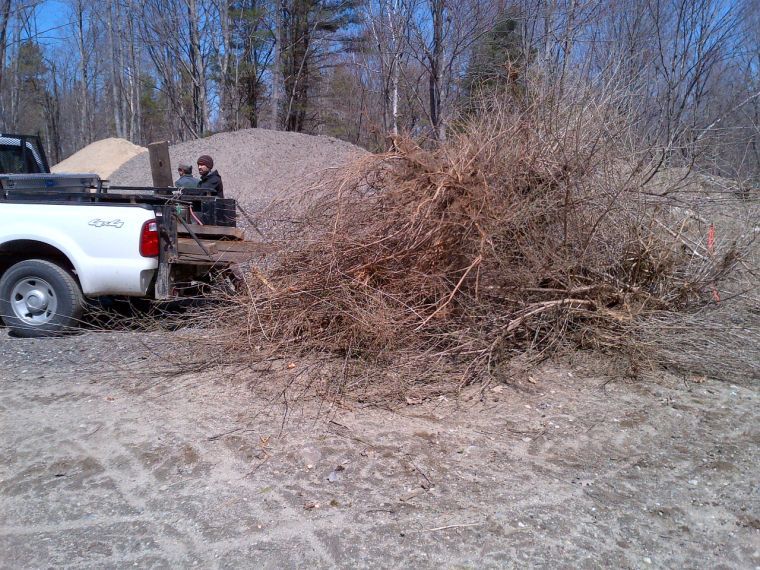 Members of the Pownal Conservation Commission go out to a portion of the town forest last year to pull invasive species such as honeysuckle. From left are Matt Welch and Jon Hogue.
 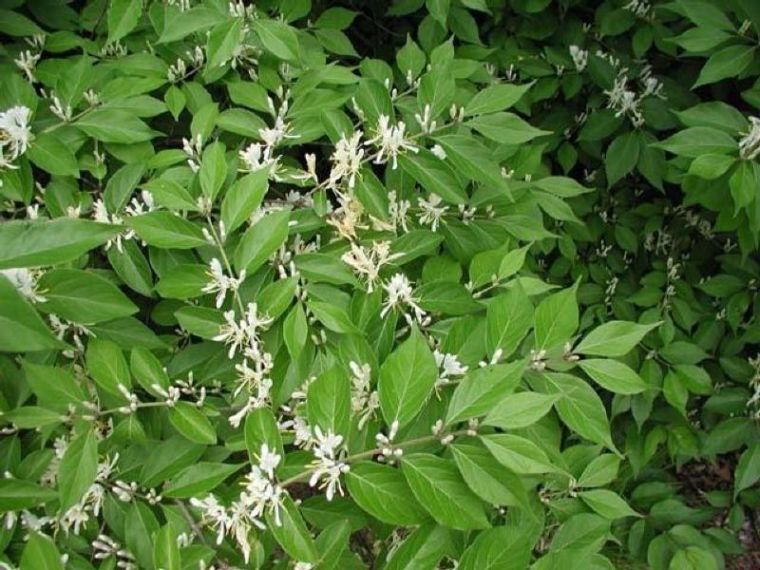 Honeysuckle is Public Enemy No. 1, says the Pownal Conservation Commission.
Send questions/comments to the editors.
