



STANDISH – Although more than 140 Saint Joseph’s College faculty, staff and students have signed a pledge opposing the transport of tar-sands oil through the Lakes Region, school President James Dlugos – who says he personally opposes tar sands, but did not sign the petition – is not ready to spearhead an institutional stand on the controversy.
The petition, which was posted on the school’s website in early November, cites concerns that the transport of tar-sands oil from Alberta could cause spills in the Sebago Lake watershed and exacerbate global climate change. The petitioners expressed solidarity with anti-tar sands activists in South Portland, as well as nearby towns that have considered or passed protective resolutions in opposition to tar-sands transport, including Raymond, Casco and Bridgton.
In an interview, Dlugos said that no one asked him to sign the petition. Still Dlugos said he was aware of the drive, and chose not to sign the petition because of concerns about the broader institutional implications.
“I don’t want people to feel that they need to do something one way or the other because of what I’ve done,” he said. “As a person, I have a very strong environmental concern, and I, personally, am opposed to the flow of tar-sands oil to the coast.”
“One of the things that makes us special and distinctive is our location – 2,400 linear feet of Sebago Lake shorefront as part of campus,” Dlugos said. “The lake is part of our conscious and unconscious experience of the place. Anything that would degrade the quality of the lake would be terrible for Saint Joseph’s.”
Dlugos said that some members of the campus community support the transport of tar sands through the region, while others believe that the college should remain neutral and disinterested, in order to preserve its function as an institution of “pure” knowledge.
Dlugos contested the notion that an institution is, or can be, disinterested. In October 2012, several months after he became president, Dlugos signed the American College and University Presidents Climate Commitment, setting in motion a process that could eventually eliminate or offset all greenhouse gas emissions on campus.
But Dlugos is not yet convinced that the transport of tar sands through the Lakes Region is an issue that Saint Joseph’s – as an organization – should take a formal, political stance on.
“If there was a proposed action that would impact Saint Joseph’s College directly, then we would take an institutional stand on it,” Dlugos said. “This was happening in relation to the activity in South Portland … But institutionally we’re not in South Portland. We’re in Standish. I would have a clear imperative on any matter that was directly impacting Saint Joseph’s College relative to Standish and the immediate communities around us.”
The petition effort was conceived by a sustainability steering committee composed of 11 faculty members, staff and students, said Nancy Kristiansen, the director of online business programs at Saint Joseph’s, as well as the chairwoman of the committee. In late October, the petitioners collected signatures in the campus cafeteria, she said.
“The goal was to provide an avenue for self-expression for students, faculty and staff who live in the region and rely on the Portland watershed,” Kristiansen said.
According to Jeanne Gulnick, an assistant professor in the Department of Natural Sciences, as well as the campus sustainability coordinator, Dlugos’ administration has been helpful.
“I would say that we have the support of the administration,” said Gulnick, who also sits on the sustainability steering committee. “I can’t say that the institution will never take a stand on something like this, but currently they’re not in a position to do that.”
The petition language also ties Saint Joseph’s Catholic mission to an “ethic of environmental stewardship within our campus community and the region as a whole.”
“Stewardship is an important ethic that we attempt to cultivate on campus,” Gulnick said. “Stewardship toward both the planet now and for future generations – that’s something we really hope to develop among our entire campus community. We don’t feel that tar-sands oil is in keeping with that.”
Jonathan Malmude, a history professor who signed the petition, said his opposition to the further destruction of Canada’s vast boreal forest and the consequent damage to humans and wildlife was grounded in “good will,” a concept common to all the world’s religions, not just Catholicism.
“I believe that favoring sustainability is basically favoring good will toward humankind, and that sustainable policies are policies of good will, which almost all religions support as far as I know,” Malmude said. “I equate sustainability and environmental stewardship with good will, and that’s how I see the consistency between the school’s religious perspective and this particular issue.”
In the next few weeks, Dlugos said he plans to initiate a study group that will examine how the college can best express the diverse opinions of its members, as an institution.
“One of the things that we’ve learned as a result of this process, is we don’t yet have a mechanism – a set of recognized conventions on campus – to allow us to know institutionally when we have arrived at a place of alignment that would allow us to take an institutional stance,” he said.
Dlugos said the petition effort is a window into the deliberative processes that characterize campus life across the country.
“I think it was simply an opportunity for people to express their belief about a particular issue. It’s simply the kind of thing that colleges and universities engage in on a regular basis. We’re process places.”
A CLOSER LOOK
About 140 staff members and students from Saint Joseph’s College in Standish recently signed a document opposing the transport of tar-sands oil through the Lakes Region via the Portland-to-Montreal pipeline. The document, titled the “Tar Sands and Environmental and Economic Sustainability Petition,” reads as follows:
“Saint Joseph’s College is a major stakeholder in the Lakes Region Community, occupying one of the largest shorelines on Sebago Lake. As a faith-based institution of higher learning, we are committed to cultivating an ethic of environmental stewardship within our campus community and the region as a whole. Our concerns extend to the well-being and welfare of our children and of future generations.
“We remain committed to setting an example of environmentally sensitive and sustainable practices by our own actions and by supporting our community through outreach and providing our expertise and resources.
“We, the undersigned members of the Saint Joseph’s College community, are opposed to the transport of tar sands oil through the Lakes Region. Local concerns include the threat of a spill in the Sebago Watershed that would dramatically impact the foundation of our economy and our quality of life. We stand in solidarity with the citizens of South Portland who are working to develop a waterfront protection ordinance specific to tar sands and to develop a feasible plan for the economic growth and prosperity of their community. We also stand with communities such as Otisfield, Raymond, Casco, Bethel, Bridgton, Harrison and Waterboro who are considering or have already passed protection resolutions on this issue.
“Furthermore, due to our concerns about the global impacts of the destruction of habitat and a critical carbon storehouse, as well as increasing atmospheric carbon pollution, we are also opposed to continued tar sands extraction in the boreal forest.”
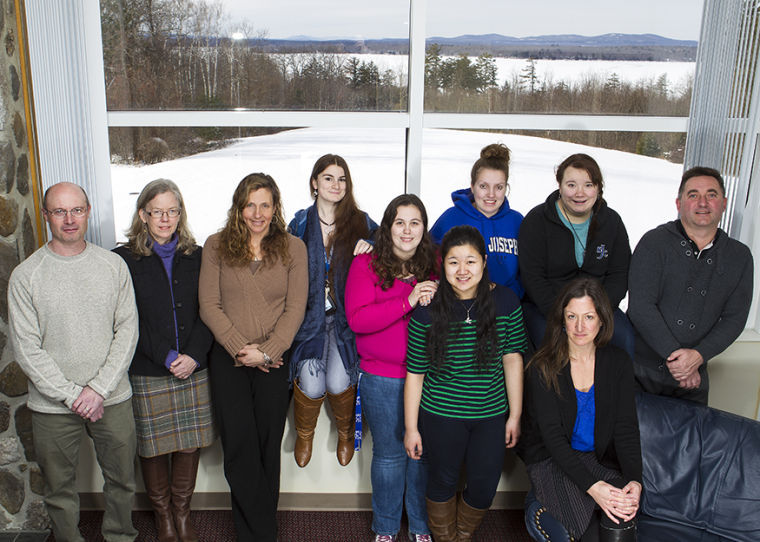 With the frozen expanse of Sebago Lake glistening in the background, some of the approximately 150 members of the Saint Joseph’s College community who have signed a petition opposing plans to bring tar sands into Maine gather in the Alumni Lounge in Alfond Center. From left are Greg Teegarden, Nancy Kristiansen, Jeanne Gulnick, Maria Liberti, Cassie Theriaque, Nhu Vo, Michelle Rocker, Allisha Yandian, Kimberly Post (bottom) and Stuart Leckie.
Send questions/comments to the editors.
