



SOUTH PORTLAND – Sharon Ward can still remember the first time she got to ring the bell at the First United Methodist Church, located at 179 Ridgeland Ave. in South Portland. She was 4 years old at the time, maybe 5, and, with her brother helping, she pulled down on the rope looped around the giant wooden pulley located far overhead in the belfry.
Together the siblings drew down on the cord, sounding the first rich, sonorous tone of the famed Revere Bell and the call to service. But then, as the counterweight of the 1-ton bell drew the rope back up, Ward’s brother let go and the little girl, still clutching it as tightly as she could, left the ground.
“I flew right up in the air, I’ll never forget it,” Ward said with a laugh last week, as she gave a tour of the old church building.
But the memory was bittersweet. Back then, Ward says, the old church built atop Brown’s Hill in 1866 drew “400 to 500” worshipers every Sunday. There were 150 children in Sunday School alone.
Now, First United no longer offers Sunday School and its Methodist congregation has dwindled to fewer than 20 regular attendees. Five times as many people enter the building for meetings of Alcoholics Anonymous each week than attend worship. Ward, who started as a Sunday School student, eventually became a Sunday School teacher, and now serves as church historian and one of two lay speakers, is, at age 66, one of the youngest members of her church.
Last month, with maintenance bills mounting, another winter heating season on the horizon, and the front face of the building continuing to deteriorate, the membership voted to close down and go their separate ways, with a final service Aug. 25. That leaves the future of the building, and that of the Brown’s Hill Cemetery next to it, uncertain.
“It is what it is,” said Carolyn Williams, who, like Ward, has attended First United from childhood. “I feel bad. It’s very sad. I know it’s happening all over the place. It’s not just our church. I think we have to keep reminding ourselves of that. It’s nothing that we did wrong.
“I realize it’s just a building, but you do get attached to a church and the people in it,” said Williams. “People say you can pray anywhere, and that’s true, but there’s a lot to be said for being part of a church family.”
Last week, a public works crew came by to measure the old church bell. Sometime this week, they’re due to move it into storage for the South Portland Historical Society, which has agreed to care for it, a quilt made by the remaining church ladies on the occasion of the church’s bicentennial in 2003, and all of the records collected by Ward and her mother, who was church historian before her.
According to Ward, the Methodist Archives housed at Boston University is the only party interested in membership records from the local church, including births, deaths, marriages, and weddings. But Ward and her mother also collected memorabilia from almost everything church members did, stockpiling a thick album for each year, with “a lot of material” going back to 1934 and significant records saved from even earlier.
Luckily, the historical society was willing to take on the material for safe keeping.
“That’s a gift. I’m so happy about that,” said Williams. “It’s so nice just to know that people will know we were there, to keep our legacy alive.”
The bronze bell, believed to have been cast by Paul Revere’s son, Joseph Warren Revere, was made sometime between 1824 and 1828. Those are the years when Revere, who took over the foundry upon his father’s death in 1818, was turning it into the Revere Copper Co., and did not date his bells. There is no record of where the bell was until 1871, when church member Ebon Nutter bought it and raised it to the belfry with the help of neighbors.
The church steeple, which originally towered 55 feet, was struck by lighting in 1879 and replaced with a smaller version. That was taken down in 1997 due to structural concerns, and the bell has lived on the church’s front lawn ever since.
Kathryn DiPhilippo, executive director of the historical society, said she hopes to put the bell on display in the field across the road from the society museum. However, that section of Bug Light Park is owned by the Portland Pipe Line Corp., meaning the bell will go into storage for now.
“We have to let this whole tar sands thing settle down, I think, before we even approach them,” said DiPhilippo, whose father, the Rev. Gerard Onas, was the pastor at First United from 1978 to 1982.
Still, DiPhilippo said, although the bell will remain in storage for the time being, she’s glad to have it and the other materials, and only wishes she could take more. One thing the historical society can’t accept, for example, is the church’s 14-stop pipe organ, built around 1888 by Cole & Woodbury of Boston. The organ was purchased from the South Berwick Methodist Church in 1931 and brought piece by piece to the Brown’s Hill Church where it was reassembled and has been in continuous use since 1934.
“There are some things they’d like to donate that we just don’t have the room for,” said DiPhilippo. “You do kind of have to pick and choose. But that’s all very valuable history. That’s not just history of a building or a church – it’s a community. There was a congregation there and that represents a whole community of people in South Portland.”
Ward says there’s talk of giving bibles and hymnals back to the families that donated them, and possibly even allowing families to take out the pews they called their own for generations.
“We have a meeting about that this week,” she said.
Cemetery’s fate
More uncertain than the bell or other artifacts, however, is the fate of the Brown’s Hill Cemetery, located next to the Methodist Church, at 1257 Broadway. Ward says the original records for the 0.92-acre burial ground were lost in the great Portland fire of 1866. That was the year the First United Methodist Church of South Portland, then known as the Methodist Episcopal Church was built. However, the church itself was founded using circuit rider preachers in 1800, and has been on Brown’s Hill since 1803, when, Ward says, the original “little house of worship” was hauled up the slope by oxen from Pleasantdale. The earliest readable headstones in the cemetery date to 1810.
According to South Portland Assessor Elizabeth Sawyer, records for the cemetery simply read, “owner unknown.” Ward says she met with City Manager Jim Gailey recently, but he was unwilling to have public works take on regular care of the cemetery after the church shuts down.
“By state statute, the city is responsible for veterans’ graves,” wrote Gailey in an email on Monday. “It would not be in the city’s best interest to take over the annual maintenance of the entire cemetery, a cemetery that is full with no revenue or endowment to offset the city’s annual costs.”
“I know the city has limited funds, but I feel bad for the people who have relatives there, who still put flowers on their graves.” said Williams. “That concerns me.”
The church pays a person to mow the cemetery, but Ward says given the question of ownership, it’s not clear if the Tri-State District of the New England Conference of the United Methodist Church will continue to cover those costs when it takes over the South Portland building following its final service.
DiPhilippo says the Brown’s Hill Cemetery is believed to be the final resting place of George and Andrew Cash, for whom Cash Corner is named, given the stores they grew there from peddler’s carts they once manned at the intersection.
“I’m not going to come out with any opinion saying I think the city should take it over,” said DiPhilippo. “It’s a very difficult thing and I honestly don’t know what to think. As a historian, I think that’s a very important piece of South Portland’s history and it should be maintained, but who does it, I don’t know.
“Because of its location right on Broadway, the city’s going to have a tough time ignoring it, but they are definitely going to want to see some significant public interest before they commit the public’s money,” she said.
“I guess I’ll continue to do it until I drop,” said Ward, who tended to the plots for 20 years and still assists the caretaker. “That may be where I put my energy in the future.”
Moving on
Meanwhile, Ward says she’ll sample each of the four Methodist churches in South Portland, in hopes of finding one that “feels like home.” Williams, on the other hand, has already settled on the Thornton Heights Methodist Church, which, like the Elm Street Methodist Church, split off from the parent on Brown’s Hill when it became overcrowded. The pastor at Thornton Heights Methodist, the Rev. Kathleen H.N. Towns, also led First United from 1995 to 2002, and that helps, said Williams.
Overcrowding, of course, was not a problem at First United in recent decades, as noted by the fact that its pastor since 2009, the Rev. Johanne Dame, is able to minister part time while also tending to another church.
As the congregation dwindled, so, too, did money for maintenance. A four-phase renovation fund was started after the belfry and steeple came down in 1997, but church members only got as far as Phase 1, the installation of a chair lift for older members.
Money to take down and renovate the front edifice of the church, where warped boards are covered with peeling paint, just never materialized in the amounts needed to take on such a huge project. At one point, when it became clear there would never be enough money in the kitty, the church began to donate its bottles to the South Portland Food Cupboard.
“Methodists are all about reaching out to help others,” said Ward. “That may have been part of our downfall. It’s easy for people to bring food for others, or toiletries for the shelters, or whatever else were collecting for, than it is to go out and be an evangelist.
“Unfortunately, that’s part of it,” she said. “When you don’t have young people coming in, the aging population continues to age. In my generation, you were expected to go to church when you were younger. That hasn’t been happening for a while. The younger generation is unchurched and the unchurched are not going to walk through the doors. You have to go out to meet them where they are, or find some other way to bring them in to show them God’s love.”
Ward and Williams also agree their church may not have adapted to the times, focusing on the contemporary music-based services that play well with younger audiences.
“When we used to have a choir, that made me feel as close to God as anything else,” said Ward.
“I am concerned for people who have no religion in their lives, or who see no need for it,” said Williams, as she pondered what would become of the First United building.
As for the church building itself, Williams would like to see it continue to serve the city.
“I’d love to see the South Portland Food Cupboard in there. That would be a wonderful legacy for us, also,” said Williams. “I’d like to see the building used for something meaningful.
“It was a wonderful church for us for over 200 years,” she said. We did a lot of good while we were there. We have a lot to be proud of. It’ll be fine, I think. Everyone will find a new niche.”
“It’s just a building, the people are the church,” said Ward. “I’m confident that God will walk with us wherever we go.”
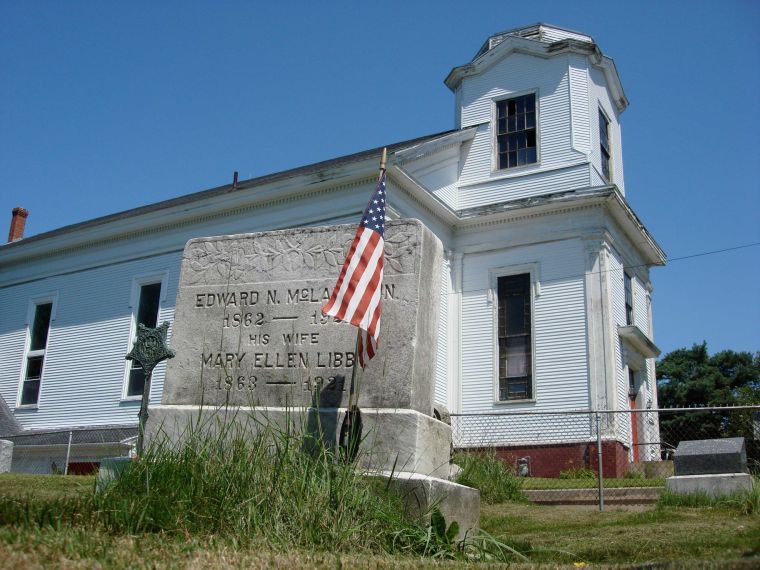 What will happen to the Brown Hill Cemetery following the Aug. 25 closure of South Portland’s First United Methodist Church remains uncertain. Nobody knows who actually owns the 0.92-acre cemetery located at 1257 Broadway. City records indicate “owner unknown,” and though state law compels it to care for the graves of veterans, the city has been unwilling to take over maintenance of the entire parcel.
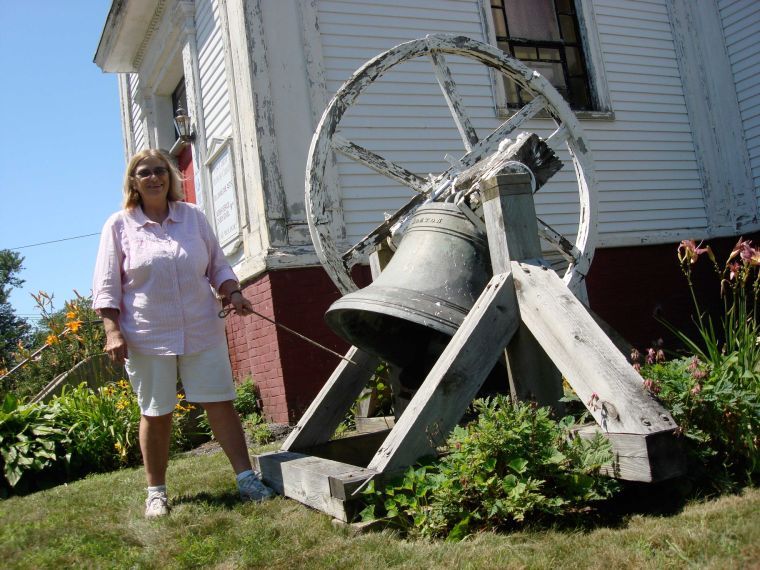 Sharon Ward, historian and lay speaker at the First United Methodist Church of South Portland, holds the clapper to the building’s famed Revere Bell. The bell, cast about 1824, was scheduled to be moved this week into storage by the South Portland Historical Society, which will take ownership of the bell, church records and several other artifacts following the church’s final service, Aug. 25.
 In this undated photo, two men stand atop the 55-foot steeple of the First United Methodist Church in South Portland. The steeple was replaced with a smaller version after it was struck by lightning in 1879, and then removed entirely due to structural concerns in 1997.
Send questions/comments to the editors.
