



SACO – Saco Mayor Mark Johnston does not think it’s an exaggeration to say that Camp Ellis and Ferry Beach are experiencing the worst erosion problems in the state, which is why he’s asking the governor for help.
The city is working with the Army Corps of Engineers on a solution to the erosion problem, which includes the construction of a spur jetty off the existing mile-long jetty that protects the mouth of the Saco River in Camp Ellis, as well as beach re-nourishment.
However, that mitigation project cannot move forward until the Army corps has a project partnership agreement in hand with a local entity or entities that would take on the responsibility for maintaining both the spur jetty and further beach re-nourishment projects, which would need to take place every 12 years for the next 50 years.
The problem is that Johnston and the City Council don’t believe that Saco alone can or should shoulder the anticipated costs, estimated to be about $200,000 a year, once the Army engineers have built the spur jetty and completed the initial beach re-nourishment.
That’s why city leaders are hoping that Gov. Paul LePage will agree to have the state also be a part of the partnership agreement and therefore share the annual costs of upkeep with Saco.
To that end, Johnston sent a letter to LePage, dated July 9, requesting a visit from him toward the end of August, during which time Johnston would give the governor a tour of the city’s coastline so he can have “a clear understanding of what is happening here.”
In his letter, Johnston outlines the existing conditions in Camp Ellis and Ferry Beach, including the loss of more than 30 homes, roadways and public and private infrastructure during the past several decades.
The problem is that the jetty, which protects the mouth of the river, is also preventing sand from reaching Camp Ellis and Ferry Beach. The goal with the mitigation project, according to the Army Corps of Engineers, is that the spur jetty would prevent the waves from scouring the beach, which would help prevent erosion, while the re-nourishments would also build back a “strong beach profile.”
The original mile-long jetty was built by the Army Corps of Engineers in the 1800s and was last modified in the late 1960s in order to reduce the number of dredging projects needed to keep the federal navigation channel in the Saco River open to both commercial and private boat traffic.
This week, Johnston said it’s his goal for the governor to see exactly what’s been happening in Camp Ellis and Ferry Beach and to understand the “disruption in people’s lives” and the “destruction of property” during the past 30 years.
He also argued that mitigating the erosion problem is not just a Saco problem.
“This is an economic issue for the whole state,” he said. “When Camp Ellis has no more sand to send to the eco-system, it will first affect Old Orchard Beach and then Scarborough.”
Johnston added, “A lot of people should be concerned about what’s happening here.”
He said the Army engineers would not do the mitigation project without a local partner; however, Johnston also doesn’t feel it’s fair for the whole cost of maintaining the spur jetty and the beaches to fall on Saco alone.
In his letter to LePage, Johnston said, “(We) invite the state of Maine to partner with us in this most critical of situations on our beautiful Maine coast. Having you and the state engaged in this process would clearly demonstrate the state’s commitment to its natural resources.”
Johnston is unsure what process LePage could use to make the state a signatory on the project partnership agreement, but said he would like to avoid the legislative process if possible because time is precious.
During their last visit to Saco in late May, representatives from the Army Corps of Engineers said the agreement was a key feature to the mitigation project moving forward and the corps may reach a point where it can do no further work without having the partnership agreement in hand.
The best-case scenario, the corps said this spring, would be for construction on the mitigation project to begin sometime in 2016. However, the longer it takes to get the project partnership agreement signed, the longer it would be before any work could get under way.
Johnston hopes LePage may be willing to answer Saco’s call for help.
“The governor has a lot of friends in this area and he understands the importance of economic development,” he said.
According to Bob Marvinney, a division director for the Maine Geological Survey, the state of Maine has no other similar agreements with the Army Corps of Engineers.
But, Marvinney also believes that the Army corps “would welcome the state as a partner,” and said it was not an “outlandish idea” for Saco to seek the state’s help with the future costs of maintaining the spur jetty and the beaches.
He said the Army Corps of Engineers hopes to finalize its plans for the mitigation project by the end of the calendar year and that’s why getting the project partnership agreement signed sooner rather than later would be key to moving the project forward.
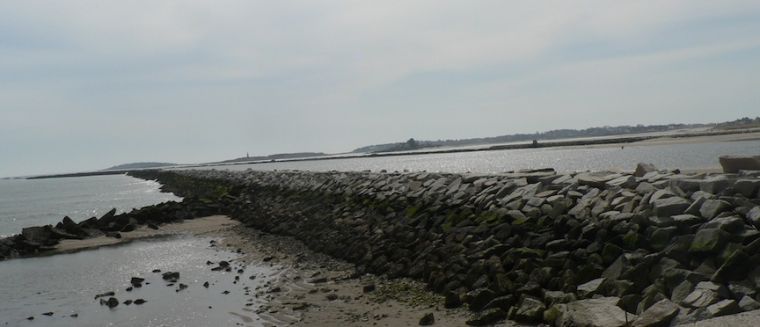 This breakwater, built by the U.S. Army Corps of Engineers in the mid-1800s, is responsible for the severe erosion in Camp Ellis and Ferry Beach in Saco.
Send questions/comments to the editors.
