



Louis Philippe, 57, is returning to the spotlight after 30 years, in Biddeford’s City Theater production of “9 to 5: The Musical.”
This will be Philippe’s first time acting on the City Theater stage and the return performance has given Philippe, who lives in Westbrook, a renewed respect for the amount of work and creativity that goes into an ensemble production.
At one time, Philippe was a familiar presence on community theater stages, mainly at Lyric Music Theater and Portland Players in South Portland. He refocused his efforts, becoming more of a force behind the curtain as the head of Reindeer Theatre Company, his own community theater company, and all of Reindeer’s offshoot projects, including the Reindeer Rock-Off, the high school band competition.
In 2012, Philippe had open-heart surgery and during recovery, was looking for a new creative adventure. His answer came the same way many of his other life-changing moments occurred – unexpectedly – with a phone call and an offer to audition for the role of Frank Hart Jr., the egotistical, sexist and overall bad- guy boss played in the “9 to 5” film by Dabney Coleman.
The plot centers on three working women living out their fantasies of getting even with Hart. Sara Thurston plays Doralee, Lynn Boren-McKellar plays Violet and Suzy Dowling plays Judy in the City Theater production, which opens Friday.
As he gets ready for opening weekend, Philippe talks about his love of community theater, his enjoyment and disgust at playing Hart and his future ventures.
Q: You have a long history acting locally at places like Lyric Theater and Portland Players, but Biddeford is a larger stage. does that add to the excitement of a performance?
A: I’ve always considered City Theater to be an equal option for audiences – and actors – in the network of Central and Southern Maine community theater groups. The stage, the renovated classic building, the tech, the crew, the organization, all combine for an awesome experience. What is personally exciting to me is working with a top-notch bunch of people that I have never met before, in a completely new market.
Q: It’s been a few years since you’ve been on stage. What kept you away?
A: I’ve never not been without juggling three to four productions in some level of creation. Since the early 1990s, my focus was on Reindeer Group Inc., a nonprofit performing arts organization I formed that included Reindeer PAK (Performing Arts for Kids) and then Reindeer Theatre Company, both originally based out of the Warren Memorial Library in Westbrook. I wasn’t on stage, but I was off stage or backstage, wearing many hats from director to clean-up guy. I was also busy developing artists and products for Reindeer Records (local independent record label) as well as producing the Rock-Off, an annual statewide high school rock band competition I started in 1987. I really had no interest in being on stage. It was more rewarding working behind the scenes to make someone else shine.
Q: Are you excited to be back on stage?
A: I would describe it as a mature adult thumbs-up, thank-you God feeling. I am creatively and physically nourished and comfortable challenged.
Q: Has anything changed for you since being away from the front of the stage?
A: I would have to say the world of community theater has changed a lot in three decades. It used to be much more socially intense, a non-stop party from auditions to closing night, with tons of drama and emotion shared by everyone in your new instant stage family. With plenty of socio-political, cultural and economic factors, and more government decrees coming out of this administration daily that negatively impact the arts, business, personal income – let’s face it, community theaters had to make many changes in order to survive, artistically and financially, and all while competing for decreased discretionary spending. As a result, things seem more even-tempered, carefully focused and more professionally organized.
Q: In “9 to 5: The musical,” your first role back to community stage, you get a chance to play Franklin Hart Jr. It’s my understanding you took the character’s name as a “sign” to get back into acting after an illness. Is that correct?
A: Not so much as a sign to get back into acting, but more of a sign that God has a sense of humor and that I made the right decision. Strange as it may sound, after having a myxoma removed (a benign tumor that was hanging on the outside of my heart – open heart surgery kind of puts your life in a whole new perspective), my focus was on cardio rehab, ongoing exercise and a healthy heart. But one day I specifically prayed for some form of creative therapy that would satisfy my cardio, physical and creative appetites. The very next day I got a call from Bethany Ferland, assistant music director, who urged me to audition. When I received word that I got the part, that’s when it hit me that this was all part of God’s plan, and to play a character named Hart (a not-so- healthy one) made me chuckle even more.
Q: Tell us a little bit about your role in the musical?
A: Mr. Hart is a sexist, egotistical, lying, hypocritical, bigot of a boss that the audience will love to hate. He is completely counter-intuitive to my personality, which makes playing the role a fun and challenging escape – although sometimes I step offstage and feel awful for the demeaning things I’ve just said to “my girls.” For the audience, he becomes the personification of every mean boss one may have had, so it’s no wonder they share in the victory when the office girls (Doralee, Judy and Violet) champion their cause for fair treatment. By the finale, the empowered ladies exact their revenge – assault, kidnap, murder, poison, shoot, brand, chain up, catch him cooking the books – and ultimately pave the way for an office renewal.
Q: At one point in time you were doing quite a lot with music students and high school bands in and around Westbrook. Do you think you’ll ever start up those types of music programs again?
A: Wow, this is near and dear to my heart.
After 25 years of producing the Rock-Off for high school musicians statewide, it was evident that the existence of young career-oriented rock musicians was dwindling. The world of electronica doomed many a young band. The competition wasn’t other bands; it was DJs, video games, the Internet, and the malls. Plus the culture of traditional families was being redefined and therefore the traditional resources of support for young musicians simply vanished in many cases. Generally speaking, I found that kids were getting less support from home; they had no part-time jobs, no money for equipment, no place to practice, etc. They might make a DIY home recording, throw it on the Internet for free downloads and become stars, for about 10 minutes, then break up. Young musicians (my opinion) were too distracted by outside influences to develop the skills necessary for a successful career in music – communication, organization, inter-personal and marketing skills.
For someone like me, who makes a great living with music and could proclaim non-stop the extraordinary power and benefits of music – as a career, a form of entertainment, a therapeutic tool for behavioral modification, and a viable form of cross-education – I felt the standard “battle-of-the-band” format needed to be revamped. So after two years of brainstorming, researching and planning, Reindeer announced a much more in-depth competition, the Off-Ramp, a six-month program that featured a stronger education component, much more video and Internet interaction, and lots of marketing potential. It was all to benefit my bigger goal: to create and implement a curriculum that would be presented as part of Maine’s Alternative Education programs.
The Maine Department of Education loved it; teachers loved it; young musicians loved it. But again, we were dealing with a very dysfunctional pool of players, and an economy that was very dark. Not enough bands and not enough funding meant putting everything on hold, which is where things stand today. It is my dream to pursue funding sources for the RAMP (Reindeer’s Alternative Music Program) curriculum, and to one day continue offering the Off-Ramp for dedicated, career-minded young musicians. All we need is $140,000 to make that dream come true.
Q: What do you think of Westbrook’s music and art scene? Has it improved in recent years?
A: I think moving to Westbrook was one of the best things I’ve ever done. Westbrook doesn’t offer as much as a big city, but it offers a little of everything to appease many tastes and fans of many genres. There are so many creative individuals in Westbrook that present pockets of grassroots music and art, dance and theater, and the city is very supportive with year-round community programs. The Westbrook PAC is a gem and the many organizations; businesses and churches all do a great job at contributing to Westbrook’s vision of what a community should be.
Q: What has been your all-time favorite role?
A: On stage, the master of ceremonies in “Cabaret.”
Off stage, the proud daddy of Joy, my 14-year-old shepherd-husky.
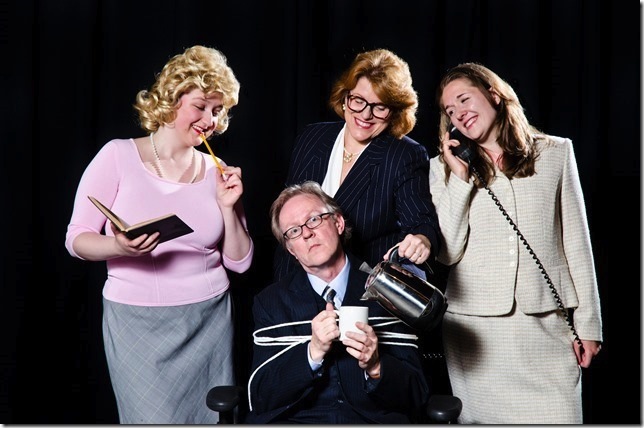 Louis Philippe as Franklin Hart Jr. in “9 to 5: The Musical,” with his girls, from left, ? Sara Thurston as Doralee, Lynn Boren-McKellar as Violet and Suzy Dowling as Judy.
Send questions/comments to the editors.
