



SOUTH PORTLAND – By this time next year, South Portland could be all aboard the bike-share bandwagon that’s been gaining momentum nationwide.
On Wednesday, July 17, Assistant City Manager Jon Jennings will appear before South Portland’s bicycle/pedestrian committee to unveil a concept plan to make bikes available for public use, possibly as soon as the snow melts in 2014.
The idea, said Jennings in a June 21 interview, is based on a bike-share system launched June 1 at the Portland Transportation Center. That program, a partnership between the Northern New England Passenger Rail Authority and Zagster, a Philadelphia-based bike vendor founded in 2007, lets people rent a heavy-duty bike at $20 for 24 hours. Passengers of the Amtrak Downeaster simply join Zagster online to get a text message from the company with a code to unlock one of 10 bikes, which comes with a lock to secure it during the 24-hour rental.
“That would be very similar to what we’re looking at,” said Jennings, adding that he got the idea at a two-day conference in Portland in early May.
That session was run by Alta Planning and Design, a firm hired by the state Department of Environmental Protection to workshop the possibility of bringing to smaller metro areas the same type of bike-share program that’s worked well in Boston, where Alta has put more than 1,000 bicycles into public circulation since 2011, and in Washington, D.C., which claims 4 million riders in the three-year existence of its program.
According to Portland’s bicycle-pedestrian coordinator, Bruce Hyman, the rail authority project with Zagster was in the works at least a month before the Alta workshop and is separate from what the city itself is trying to develop.
“We are in the very early stages of looking at a wide-scale bike share program, looking to prove its feasibility,” said Hyman, on Monday. “We’d want to complement or mesh very easily with their system, but at this point in time there is no direct involvement.”
According to Hyman, if Jennings can get a municipal bike share program up and running in South Portland next year, he would likely beat Portland to market with the concept.
“It really depends on what direction we go in,” said Portland’s director of planning and urban development, Jeff Levine. “We’re looking at some different models. We might be able to get a simpler one up by 2014, but we’re actually looking at something more comprehensive. So, more likely, we’re a little further out than that.”
Unlike Zagster’s model, said to cater to tourists because riders return bikes to the spot from which they were rented, Portland is interested in Alta’s “point-to-point” system, in which riders can drop off bikes at any one of several stations, said Levine.
Alta has a three-year, $6 million contract to run Boston’s bike-share program, called Hubway. That service is sponsored by New Balance, just as Citibank fronts New York City’s new bike share program, launched by Alta in May.
Advertising is likely to be a part of any program Portland creates, whether on its own or contracted to a firm like Alta.
“Everything is on the table,” said Levine. “We’re not planning on using a huge amount of public money. Instead, we’ll look to grants, corporate sponsorships and advertising.”
The same is true in South Portland. According to Jennings, he can get a six-bike station from Zagster for $10,000, which includes all maintenance and monitoring. To hedge against being able to recoup that investment on $20 rentals during a season lasting, at most, eight months, advertising will likely be a component of South Portland’s program, said Jennings.
“It’s not a terribly expensive thing, but it’s expensive enough that we want to make sure we do it right,” he said. “That’s really important to me. We don’t need to overburden city staff or the taxpayers with this. It really needs to be as revenue neutral as possible, so that there’s no impact, other than the benefit to people who live here, or may come here.”
However, both Rosemarie De Angelis and Carl Eppich wonder which group a bike share program would serve in South Portland. De Angelis is founder and chairwoman of the city’s bicycle/pedestrian committee. Eppich, besides being a committee member, is a transportation planner with the Portland Area Comprehensive Transportation System, a sidearm of the Greater Portland Council of Governments.
“I think this is something the committee would be very much in favor of,” said De Angelis, on June 28. “The members have definitely said in the past that this is something they support, but if you are trying to get everybody from tourists to people who need a bike for basic transportation, I’m not sure if this is the best model, or not.”
For tourists, including families, any vendor would have to supply a wide ranch of bicycle types, said De Angelis, while the use of any tax money to fund the program calls into question accessibility for lower-income residents.
Meanwhile, Eppich says that while a company like Zagster can get a program up and running in a short period of time, it may not be suited to the long-term goal of getting people out of cars and onto bikes as a commuting lifestyle, rather than just something to do on a sunny vacation day.
“I was excited as anybody to learn they were thinking of this,” said Eppich. “I was thrilled. But is this for commuters or is it for recreation users? At $20, I don’t think students at SMCC are going to go for it.”
De Angelis said Southern Maine Community College continues to have traffic issues this summer’s rebuild of a section of Broadway is not likely to fully resolve.
“If the expectation is that these stations be self-sustaining, so nobody has to be there manning them, it seem like there are a lot of components that have to be resolved and discussed,” she said. “I think we’d like to weigh in on making some recommendations about how it’s constructed, how it’s configured, how much is the city’s investment and what’s the best way to get the greatest use.”
“This isn’t just one person trying to parachute in and start a bike share program,” said Jennings, making clear his intent to involve De Angelis’ group, as well as other stakeholders. “We want to be sure that everybody is vested in this. I don’t want to rush into this. I want to get it right, or as right as possible. With something like this, I think it’s prudent to be conservative and work out the kinks before you jump in.”
Eppich said he’s concerned that South Portland, even by launching a single bike station, could miss the boat on working cooperatively with Portland. It would be a shame, he said, if the two cities went their separate ways on bike programs even as they are working to consolidate bus services. However, Levine, who worked on Boston’s bike-share program before coming to Maine a year ago, notes that four suburban programs successfully merged into the Hubway system. That can easily happen here, as well, he said.
“There’s a lot of strength in numbers and Zagster is not necessarily a long-term commitment,” he said, suggesting Portland would be willing to involve South Portland in its plans, if it doesn’t get tied down to anything it can’t get out of.
Meanwhile, South Portland City Manager Jim Gailey said some form of bike-share program is definitely in the city’s future.
“It’s an interesting asset that we can bring into our community for our summer guests, or even our residents who don’t have bikes,” he said. “If we can get people commuting on bikes, or out on our trail systems, or even over into Portland for the day in the Old Port and back, I think that’s a great thing, if only to get people out of their cars.”
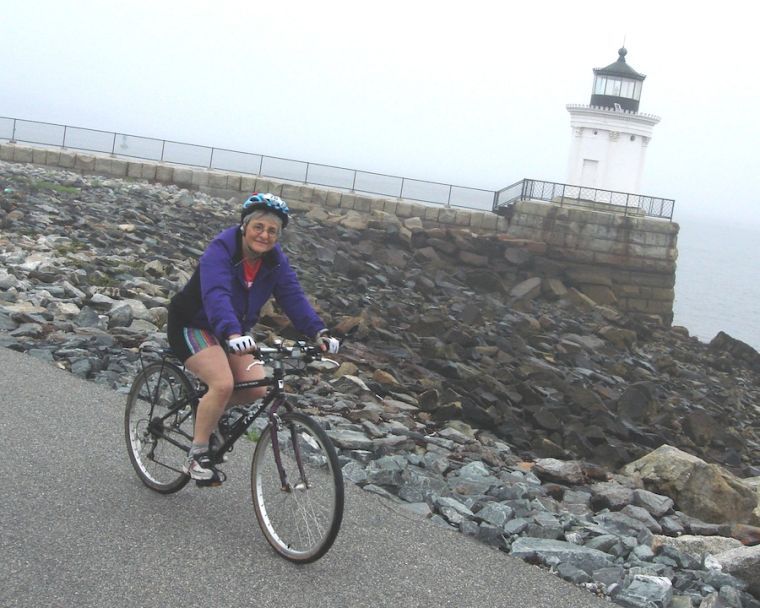 Rosemarie De Angelis, chairwoman of South Portland’s bicycle/pedestrian committee, rides her own bike past Bug Light. On July 17, South Portland’s assistant city manager, Jon Jennings, will appear before De Angelis’ group to unveil a proposal for a new “bike share” program that could be launched citywide next spring. Staff photo by Duke Harrington
 Send questions/comments to the editors.
