



CAPE ELIZABETH – As the trees begin to pop this week, sprouting their leafy plumage, residents of Cape Elizabeth may notice something quite odd – leaves emerging from their buds that are already torn and full of holes.
That’s because the winter moth, which has decimated thousands of acres in southern New England, took up housekeeping in Cape late last fall.
“Back around November, December, we had all these little white moths that were suddenly all over Cape Elizabeth,” said Town Manager Michael McGovern. “They were a little bit pretty with all those white flutters, but we now know they’re going to cause some damage.
“The good news is that they are not harmful to people,” said McGovern, “but we have the potential for a large problem and it’s not a good thing, particularly for a community that values its forest stock.”
It’s thought the winter moth was carried into Cape Elizabeth by landscapers from away. The concern is that the moth feeds on the leaves of all hardwood trees and bushes during the month of May, while in its caterpillar form. Targets include oak, maple and apple trees and, more importantly, blueberry bushes. Over time, the constant denuding can leave trees weak enough that they succumb to other diseases and conditions they might ordinarily resist.
While the threat means many trees in Cape Elizabeth will sport leaves this year that look like green Swiss cheese, the real threat could be to Maine’s $69 million blueberry crop if the moth can move beyond Cape, Harpswell and Vinalhaven, the three communities in which it appears to have gained a toehold. Although the moth has a fondness for high bush blueberries, it is not yet known if it will find Maine’s lowbush variety quite as tasty, says Charlene Donahue, a forest entomologist with the state Department of Conservation Agriculture and Forestry.
Moths cometh
According to Donahue, the winter moth (scientific name, Operophtera brumata) first arrived in Nova Scotia from Europe in the 1930s, although it was not until 20 years later that it drew notice when defoliation became a widespread problem.
The Canadian government handled the invasion by dispatching a counter force of its own – a parasitic fly (Cyzenis albicans) whose eggs, laid on leaves, are small enough to be eaten by the moth during its May feeding frenzy. The fly egg then hatches into a maggot that lives in the moth’s throat, escaping harm when it periodically molts its caterpillar skin and gut. Once the moth drops to the ground in June to cocoon in the soil, the fly begins to eat the pupate from the inside out.
The fly has kept the winter moth in check in Nova Scotia, as well as in Oregon, Washington and British Columbia, where it began to appear during the 1970s.
But then, in the 1990s, it came to Massachusetts.
“They didn’t notice it for a number of years,” said Donahue. “It’s defoliated tens of thousands of acres and has started to kills trees down there now.”
Since pillaging the eastern side of the Bay State, the winter moth has spread to Rhode Island, Connecticut and southern New Hampshire. It first began appearing in Maine in 2007.
“We did some trapping for the moths and found them in southernmost Maine, but just the male moths,” said Donahue. “We couldn’t find any infestations at that time.”
Finally, in December 2011, a call from a Harpswell homeowner alerted forestry officials that the invasion had finally begun in earnest.
“Last year, Harpswell had about 400 acres of defoliation,” said Donahue. “Because of that, they cancelled their annual plant sale last year, because the moth eggs can sometimes attach to plants and trees.”
Following Harpswell’s fall, Vinalhaven was conquered in the spring of 2012 and then, by the second week of December, the moth established a beachhead locally.
“We don’t have native moths that come out that late,” said Donahue. “Some people have said when you get a swarm of them it looks like driving through snow.”
Winter moths have now been found from Kittery to Bar Harbor, but Donahue calls Cape Elizabeth “a real hotspot.”
Two weeks ago, a survey at Two Lights State Park showed 1.3 moth larvae per leaf bud from a sample of 30 buds.
“People will see the result this year,” said Donahue, noting that as the moths hatch from cocoons in the ground, they excrete silk “balloons” that catch the air and blow them into the trees, where they crawl out to branch tips to feed on leaf buds.
“Then, after a few years the trees will decline and die because they’re not growing, they’re putting all of their energy into just trying to stay alive,” she said.
The “really important part,” says Donahue, is that when the moths are done feeding, they excrete more balloons and drop to the ground, where they form tiny cocoons in the soil.
“It looks like a little piece of dirt,” she said. “Literally, a piece of dirt. People don’t believe it but you absolutely cannot detect the cocoon. So, if you dig up anything from late May until December, you’re going to be taking cocoons with you.”
“Particularly in Cape Elizabeth, residents have properties inland,” said McGovern. “You’d be strongly advised not to take anything that’s in the ground to your inland properties as that could help it to spread.”
Fly funding
According to Maine’s top entomologist, Dave Struble, the state could buy enough of the parasitic flies from British Columbia, which has some to spare, to bring the winter moth infestation under control for “about $250,000 to maybe $500,000 per year,” combined, among all the coastal New England states.
“That’s not chump change, but I don’t think it’s insurmountable,” said Struble.
Unfortunately, there is no funding for the problem, not even in Massachusetts where it’s most widespread.
Instead, Donahue is working with Dr. Joe Elkinton, a professor of entomology at the University of Massachusetts at Amherst. Elkinton has a crew of 20 that’s been traveling to British Columbia to capture the flies – an expensive and difficult task, Donahue says, because it involves beating branches with sticks to knock winter moth caterpillars out of trees and then feeding them in buckets of foliage until they pupate. Once cocooned, they are cared for from June to November at the USDA research facility in Cape Cod.
In exchange for collecting and sharing data on the moth’s spread in Maine, Donahue was able to obtain a federal permit to import 10,000 flies. However, Elkinton only has 800 to spare.
“Unfortunately, he has no funding after this year, and we have no funding at all, so this may be it,” said Donahue.
Late last week Donahue wasn’t sure which of the two three spots would share those 800 flies. Tests this week in Harpswell and Vinalhaven will determine which two towns of the three hotspots get the flies. If Cape is chosen, Donahue will release its share at Two Lights as soon as this week.
She is confident however, that even at more significant numbers Cape would not trade a moth problem for an overpopulation of flies
“That is the first question everybody asks, but this is a natural control agent that is very closely tied to the life cycle of the moth,” she said. “It has not caused any adverse affects anywhere in Europe or in North America where it has been employed.
“But right now, there is one person who is collecting those flies,” said Donahue. “He’s been gracious enough to share some because I am helping him out, but his funding is gone after this year. So, we really don’t know what’s going to happen after that.”
Still, Donahue, notes that while the winter moth has been in eastern Massachusetts or 18 years, it’s only within the last four that trees have begin to die off.
“People don’t have to panic,” she said. “but it is something we are at least trying to be watchful of. Even if we somehow got a sufficient number of flies for next year, that’s not an immediate solution. It will take for or five years for the flies to acclimate to the environment and catch up to the moth in terms of population, so people will see damage for some time.
“Still,” said Donahue, “It is exciting to think that we could be getting in on the ground floor of this problem. Maybe, we could nip it in the bud before it gets out of hand.”
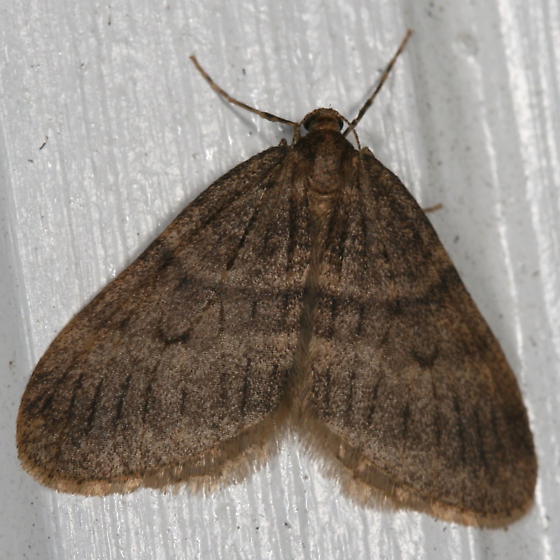 An adult male winter moth, like the ones seen in Cape Elizabeth in December, can strip hardwood trees and bushes, including apple and blueberry, of their leaves, leaving the plants weak enough over time that they die of other causes they might ordinarily resist. Courtesy photo
Send questions/comments to the editors.
