



RAYMOND – Raymond officials and broadcasting industry watchers were sad but not surprised following last week’s announcement of the impending closure of Dielectric Communications, one of the area’s largest and longest running manufacturers.
Sam Gifford, chairman of the Raymond Board of Selectmen, was alerted last Friday in an overnight letter from JB Ballard, the president of Dielectric, which has been located in Raymond since its beginning almost 60 years ago. The letter didn’t disclose why the company was closing but explained that each of the 57 employees in the broadcast operation would be terminated starting July 19.
By Tuesday, Gifford and Town Manager Don Willard had learned that Dielectric’s Charlotte, N.C.-based parent company, SPX Corp., expects to keep open a subsidiary, Radiodetection Ltd., which operates from the same building on Tower Road. Employees at Dielectric are being encouraged to apply for jobs at Radiodetection.
“So the fiscal impact is not anywhere near as bad as it sounds when you first read the paper,” Gifford said. “Things are brightening up a bit.”
The news is still pretty bad, Willard and Gifford said, especially for the well-paid workers who owned homes in the area. Maine Department of Labor officials were at the business Monday with information for the highly skilled workers, ranging from engineers to welders, as to health-care and job-retraining opportunities.
The closure didn’t come as a complete surprise since SPX has conducted several rounds of layoffs in the past.
“Over the 13 years I’ve been town manager I’ve basically seen reductions in force and reductions in production, so it’s probably not a shock to see it close, but it’s a great disappointment and a tremendous loss after 59 years for Raymond and the Sebago Lake region,” Willard said.
“This is a longstanding business, and you hate to see any business close, but this business has been historically one of the town’s larger employers and my real concern and worry is for the local people who lost those good jobs,” Willard added.
Dielectric was founded in 1954 when Raymond native Dr. Charles Brown convinced then-parent company RCA to allow him to set up operations in town. It has been a giant in the television and radio antenna industry since, providing antennas and broadcasting equipment for 63 percent of the country’s television stations. In recent years, the company played a pivotal role in helping the country’s television broadcasters make the shift to digital in 2009. Since then, business has shrunk, leading to its demise, industry watchers say.
Gary Cavell, of Cavell Mertz & Associates, a technical consulting firm in Manassas, Va., said Dielectric was a victim of its own success in the analog-to-digital conversion.
“By 2009, every TV station in the United States had to make the final cut from the old traditional analog television to digital, so during the ramp-up Dielectric and others sold an incredible amount of antennas and combiners and transmission lines and all kinds of technical toys,” he said. “And it’s well-built stuff and probably the testament to them is that their stuff was so well done that it lasted too long and that helped contribute to their own downfall.”
Like any business dealing with a spike in demand, Cavell said Dielectric had to handle the growth brought on by the federally mandated digital conversion by staffing up quickly.
“You get a lot of employees, get a lot of equipment, get a lot of plant and infrastructure to take care of this big rush of business, and once you build them and install them, there’s not much left to do except maintenance and spare parts,” Cavell said. “But TV and radio antennas have a very long lifespan in the tens of years. It’s not like a computer where it’s done in two years and you have to replace it again.
“So we’ve just replaced virtually every television station’s antenna in the United States back by 2009, here we are in 2013 and there’s a lot of years to go before there’s a need to replace them.”
Another element driving the company’s demise, Cavell said, is the federal government’s new effort to repack the digital spectrum. Broadcasters, he said, are being forced by the government to reduce their bandwidth by reducing their use of the television spectrum to one digital channel, a process that is already under way.
Doing so, however, leaves “holes in the spectrum,” Cavell said. The Federal Communications Commission wants to reshuffle that spectrum to allow bandwidth for new channels. New channels may mean additional need for more antennas and broadcasting equipment, which could signal a turnaround for equipment manufacturers such as Dielectric. But, he said, the country is years away from moving ahead on the issue.
“Since there are holes in the spectrum, someone had a bright idea to rejigger all the seats in the theater and move everybody to the front of the theater, leaving room in the back. So I think we will see yet another change in the television broadcast spectrum and it will probably mean more sales for antenna, transmission lines, combiners, same thing that Dielectric was making,” Cavell said. “Unfortunately, I think the demand won’t happen for a year or two or longer, and that’s not soon enough to save people’s jobs there in Raymond. But I think there will be another rush of business for those who hang in long enough.”
Maine is a hotbed of radio-frequency antenna and equipment makers, many of them spin-offs of Dielectric and several located in the Lakes Region area. Henry Downs, vice president of Mega Industries in Gorham, worked for Dielectric from 1998 to 2007 and helped with the digital conversion. He still has many friends working at Dielectric.
“I know a lot of people there, we’re starting to see some email rolling in. Obviously, they’re all out looking for work at this point. This, I’m sure, came as a complete shock to them,” he said. “But I’ve got a lot of good friends up there, there are a lot of good people, and it’s just unfortunate watching this thing unfold.”
He said Dielectric went from a $12 million business in 1993 to a $150 million-plus business in the early 2000s, “and now they’re down to where they were before, a sustainment and spare parts market.”
Mega Industries, Downs said, expects a few applications, but “we’re not really in the broadcast business per se, but a lot of the equipment we make is similar, and I’d like to think we could help fill in some of the void they’re going to leave.”
Downs has also been reading industry news and said another contributing factor to Dielectric’s downfall, as reported this weekend by Bloomberg News, is activist investors who want the $3.8 billion SPX Corp. to sell non-core businesses such as Dielectric so it can focus on producing its staple product, industrial pumps.
“So it seems to be a couple of things,” Downs said. “You have this market downturn after a spike when everybody had to buy new equipment. And also investors in SPX are basically saying you need to divest stuff that’s not in your core business, and Dielectric falls into one of those categories unfortunately.”
SPX company officials did not return calls seeking explanation regarding the investment aspects of Dielectric’s closure. Spokeswoman Jennifer Epstein released a statement regarding the reason for closing the Raymond company.
“Through normal course of business, SPX regularly conducts strategic assessments of its global operations,” the statement read. “After careful consideration, SPX has decided to discontinue the broadcast television and radio and wireless antenna operations of its Dielectric Communications business unit worldwide, due to extremely difficult global economic conditions in the broadcast marketplace, and SPX’s ongoing efforts to further focus its future growth strategy on its Flow Technology business. SPX is confident that this action is in the best interest of the company’s future growth and success.”
While town officials seem assured the building will remain occupied by Radiodetection Ltd., thereby avoiding the loss of $78,500 in property taxes for the business valued at $4.1 million, Selectman Joe Bruno said the real loss is to the employees.
“This is more devastating to the employees of Dielectric than to the town of Raymond,” he said. “The company will still be responsible for paying those property taxes and will probably be asking for an abatement as they wind down. My heart goes out to all the employees, many of whom live in Raymond.”
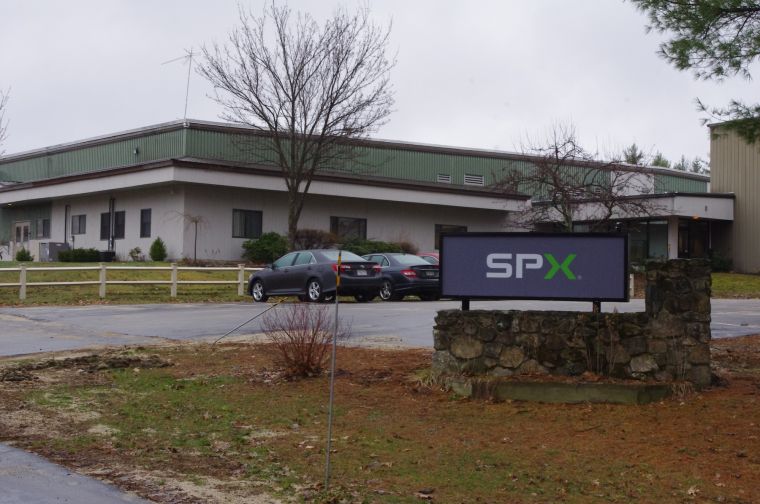 Dielectric Communications, a subsidiary of SPX Corp., is set to lay off its entire workforce of 57 by July 19, ending a 59-year run in Raymond. Staff photo by John Balentine
Send questions/comments to the editors.
