



SOUTH PORTLAND – After a year of debate, the final nail was pounded into the Wilkinson Park clubhouse Monday when the South Portland City Council agreed to tear down the building that was the centerpiece of its community for more than 60 years.
“For a lot of the members of the community, there is a bit of an emotional tie to that building, but I think everyone agrees it needs to come down,” said Berwick Street resident Matt Green, the only resident to attend Monday’s council workshop on the clubhouse, located at 172 New York Ave.
The council has debated the fate of the building since March 2012, when funds for its maintenance showed up on the annual capital improvement plan presented by City Manager Jim Gailey. Mayor Tom Blake, then a rank-and-file councilor, questioned the $50,000 investment given the building’s state of disrepair. At that time, Gailey admitted reshingling the roof and repairing the faulty furnace, which had forced the building to be closed that winter, was “just the tip of the iceberg.”
John M. Wilkinson quickly stepped up to try and save the building, saying he was “not at all pleased” the debate was delaying long-needed maintenance. His father and grandfather donated the land used to create what was originally known as Sunset Park as a community amenity, and the clubhouse was a vital part of that legacy, he said. Indeed, over the years it hosted everything from Girl Scout meetings to senior bridge tournaments.
However, by Jan. 16, at a neighborhood meeting called to gather input from local residents, Wilkinson had come around, saying he felt, “100 percent that tearing it down would be the right thing to do.”
The clubhouse dates to 1950, when John J. Wilkinson gave 9.47 acres at the end of New York Avenue to the Sunset Park Men’s Club, using land left over from one of the first major, mid-century subdivisions in South Portland. The club built the 2,132-square-foot clubhouse that summer, relying largely on volunteer labor. The park also included ball fields and a playground and Wilkinson’s only stipulation was that the property had to be used continually for public recreation. Otherwise ownership would revert back to him or his heirs.
But within a generation, the men’s club – having since changed its name to the Sunset Park Community Club – was in trouble. Records at the Cumberland County Registry of Deeds show six separate tax liens were placed on the property after 1988. Finally, in March 1994, the club worked with Wilkinson to sign the property over the city and disbanded soon after.
Reportedly, little money was put into the building even after the city took it on and official use fell from virtually every weekend for the better part of three decades to just 16 function rentals in its final full year of use.
Parks and Recreation Director Rick Towle closed the building soon after he was hired last August. With the $50,000 the council raised last spring, the city has $68,000 to work with, but Towle says fixing what’s physically wrong with the building, updating its mechanical systems and bringing it up to code for fire, health and handicapped accessibility, would have cost more than $140,000.
With the council, the community and Wilkinson now on board with bulldozing the building, Towle says he can have it down by March 1. Public works crews will be used to keep the cost down, he said.
However, before city trucks roll in, specialists will have to remove some hazardous material. A study turned in last week by Westbrook-based Abatement Professionals found asbestos in some tiles buried beneath the current floor. The assessment cost $700, cleanup is expected to run as high as $10,000.
“It appears over the years the folks who ran the building before the city took it over built each new floor on top of the old one, probably using whatever leftover materials were donated by some nearby contractor,” said Towle. “So, you’ve got layers of linoleum on top of linoleum on top of tile on top of tile, some of which have traces of asbestos, the same as you often find in any tile work from buildings of that era.”
That patchwork maintenance, Towle said, speaks to the well-meaning if sometimes under-funded way the community cared for the building, even in its heyday.
“I picture about eight guys with some adult beverages on a weekend getting together with screwdrivers and glue and whatever else and just doing it,” said Towle.
While that can-do spirit was “forward thinking” in the ‘50s and ‘60s, said Towle, it’s not the appropriate way to build and maintain a public building today. A large part of the Jan. 16 community meeting – attended by a dozen residents despite a snowstorm heavy enough to cancel a council meeting in Scarborough that night – revolved around what to do once the clubhouse comes down.
Cloning it could cost as much as $500,000, says Towle. Instead, he’s pushing for an open-air pavilion – essentially a steel roof on posts – with an enclosed “community kitchen” on one end. That, he said, might be had for less than $125,000 and possibly for as little as $35,000, depending on how heavily the kitchen gets tricked out.
Residents at the Jan. 16 meeting were slow to warm to that idea, and even less keen on Towle’s proposal to move the new structure away from the footprint of the clubhouse.
Still, it seems something will go up, as there was even less enthusiasm for replacing the clubhouse with open space.
“One of the big pieces that my dad had asked was that there be something,” said Wilkinson. “I won’t allow it to go with just open area, because that’s not what the intent was. That building was a piece of the whole idea and use of the park.
“I just don’t want too much time to go by without a friendly agreement by everybody as to what we are going to put there instead,” said Wilkinson.
Towle says he plans to convene another neighborhood meeting in early March to decide on next steps for the park as a whole. Residents who donated kitchen appliances in the clubhouse have been contracted and asked for permission to pass them along to local charities, said Towle. However, any copper tubing in the building, and even its famous paneled walls, could be sold off to pay for future park improvements. In addition to a new community building, projects could include reclaiming a play area that’s gone to seed, as well as a “paper street” adjacent to the park, repairing the basketball court and formalizing the park’s makeshift trail system, all to complement the two Little League fields on site.
Several members of the council have suggested taking something from the clubhouse to create a memorial or sorts to the original building, the Wilkinson family and the Sunset Club.
However, Councilor Jerry Jalbert, suggested the real memorial may be in how the park is maintained and used in the future.
“One thing that can’t get lost here is that Mr. Wilkinson has talked about going through his father’s notes, and how they said, despite a lot of suggested used for the property at the time, he ultimately really wanted to see it used by kids. It had to be kid friendly and kid oriented,” said Jalbert.
“As long as that’s the focus in all of this, I think we’ll have a successful result,” he said.
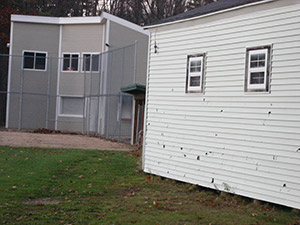 The back of the Wilkinson Park clubhouse on New York Avenue is pockmarked with damage borne by baseballs from the adjacent Little League field.
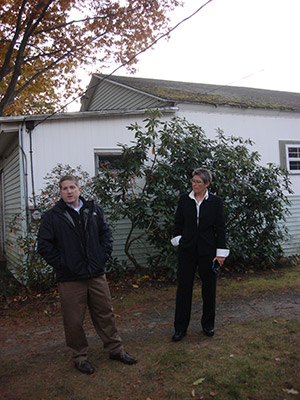 Moss can be seen growing from the roofing shingles of the Wilkinson Park clubhouse behind South Portland City Manager Jim Gailey and Councilor Patti Smith during an Oct. 31 council tour of the property.
Send questions/comments to the editors.
