



SOUTH PORTLAND – The South Portland City Council tended to its garden Monday, moving to pluck away the weeds that have grown up around its summer farmers market by giving initial approval to a wide array of ordinance changes, covering where the market can be located, who can participate, how vendors are licensed and how the entire operation gets approved as a “special exception” to zoning regulations.
But the future of the market remains in doubt. According to market manager Caitlin Jordan, the changes, set for Planning Board review Feb. 12 before returning to the council for a final vote, give the vendors everything they have been clamoring for since the market was founded in 2011, except for one thing – a home.
That’s because city staff has asked the council to not allow the market back on Hinckley Drive due to traffic issues experienced there last summer. The new rules would allow the market to operate on private property, solving an issue that arose last spring when Hannaford offered its Mill Creek parking lot as a possible location. However, Jordan says she emailed the grocery giant two weeks ago about hosting the market this season, and has yet to get a reply. Another email to the Maine Mall, which staged its own farmers market last year, has also gone unanswered, said Jordan.
“It appears that they are not going to be going for a second year,” said City Manager Jim Gailey, of the mall’s nascent endeavor, which reportedly drew light attendance.
Reached Tuesday, Stefanie Millette, marketing manager at the Maine Mall, said four of the 12 vendors from last year’s farmers market at the mall would like to return. She said the mall was looking to do something for those vendors, but it would probably not be in the form of an outdoor farmers market.
If the Knightville market can’t move forward, it also can’t move back. Although the proposed ordinance changes would open up more than 20 zoning districts to the group, Thomas Knight Park, where it spent its first season, has been removed from the list of approved sites.
“The market struggled in its first two years and the third year isn’t looking any better if we’re moved further away from where we’ve been,” said Jordan. “But right now we have no home, so the market might not happen at all.”
Still, Mayor Tom Blake proffered that the council may have its own mind on Hinckley Drive.
“The staff has its recommendation about not using Hinckley Drive again, but that doesn’t mean you couldn’t appeal to the council,” he told Jordan.
“We often listen to city staff, but not always,” Blake said, eliciting a wry grin from Gailey.
Blake also said that the city’s farmers market advisory committee, a citizens’ group created to work with the farmers market association that actually runs the show, “is now defunct.”
“We saw almost too many agencies involved for a small entity,” said Blake. “We really don’t see the need for an advisory committee. If the farmers have issues they can come to the council, or city staff.”
Among language changes made to better align the South Portland market with state definitions, the proposal also creates craft vendor and service vendor licenses, allowing them to comprise up to 25 percent of any market location.
“We don’t want the crafters to overtake the farmers,” said City Attorney Sally Daggett, who helped draft the new ordinance wording. “To market themselves, they really have to be a true farmers market under state law. We don’t want to get the farmers in trouble with the Department of Agriculture.”
According to Gailey, once a site is OK’d by the Planning Board, the market will not need to seek annual approvals. The gymnasium of the former Hamlin School at the corner of Sawyer and Ocean streets would be adopted as a permanent home for the ongoing winter market, “so long as the property is owned by the city.”
Fiber products and malt liquor are proposed for addition to the list of approved farm products, although sale of the latter would require a vendor to obtain a liquor license.
Dagget said proposed license fees are $25 per vendor per location, summer and winter, plus a single $20 processing fee per year. Currently, for any site other than the original Thomas Knight Park location, farmers need to get a temporary vendor’s permit, costing $105. Vendors must still show proof of $400,000 in liability insurance for markets located on public property. Licensing administrator Jessica Hanscombe said she and Jordan have worked together to overcome insurance issues that caused havoc at the start of last year’s summer market, which “came down to, literally, a box on the forms that needed to be checked.”
According to Code Enforcement Officer Pat Doucette, any city resident can grow and sell food on their own property without a permit. The farmers market rules are triggered, she said, whenever “at least two” vendors attempt to sell product at a single location, whether or not they belong to the association headed by Jordan.
“We’re in hopes of, I hate to say it like this, ‘once and for all’ addressing the concerns that we have heard, not only from the farmers market, but also from the residents and adjoining businesses, as well as the dialogue we’ve had amongst ourselves at the City Council level,” said Gailey.
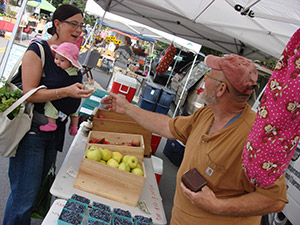 Dick Piper, owner of Piper’s Ranch in Buckfield, makes change for South Portland resident Jenner Greil, with daughter Hazel, at the South Portland Farmers Market last September. The City Council this week addressed concerns regarding the market, but its future remains in doubt.
 Send questions/comments to the editors.
