



GORHAM – After struggling for decades, area farms are closer to the financial precipice than ever before.
A Midwest drought and other factors are driving costs up, while government price controls weight revenue down. Exacerbating those problems is the Sept. 30 expiration of the 2008 federal Farm Bill, which will result in a loss of subsidies that Walter Whitcomb, Maine’s commissioner of Agriculture, Conservation and Forestry, said will prove “disastrous” to the industry.
Last week, Whitcomb went to Washington, D.C., to lobby for various Farm Bill subsidies now in limbo, such Milk Income Loss Contract, which reimburses farmers when the federal minimum price for milk falls below a certain level. He also wanted to “map out the next steps,” he said Monday, to try and get a handle on what might happen when the lame-duck session of Congress convenes following the November elections. The results were not encouraging.
“We spoke to 10 different entities and got 91?2 versions of what might happen in the future,” he said.
“I’m trying to think of some words to describe what’s going on without using expletives,” Warren Knight, owner of Smiling Hill Farm in Westbrook, said Wednesday. “It’s a depressing topic and the Farm Bill is, quite frankly, getting held hostage by things that have nothing to do with agriculture.”
According to Jon Olson, executive secretary of the Maine Farm Bureau, the Farm Bill was allowed to expire by Democrats, who blocked its path to the House floor at least until after the elections for fear Republicans would gut it of food stamp money, which makes up some 80 percent of all subsidy dollars in the bill. Unfortunately, says Olson, Milk Income Loss Contract money and other programs have been waylaid in the process. But even without those funds, which Whitcomb said he doubts will be restored now that they’ve expired, and local dairy farmers already are underwater.
“What with the Midwest drought and all, the price of grain is up three times what it was a few years ago,” said Bill Rust, who moved to Gorham as a sixth-generation dairy farmer 55 years ago. “But has the price of milk come up three times? Of course not. We have no control at all over the price we get.”
That’s because the price for milk is set by a Byzantine mixture of federal price controls tied to the weekly average price of a 40-pound block of cheese on the Chicago Mercantile Exchange. That price is hovering just above $20 per hundredweight (or, 100 pounds of milk) – just above the trigger for federal subsidies. When the price of milk falls below $20 per hundredweight, the MILC program covered 45 percent of the difference. Or at least it did before the Farm Bill expired.
In 2010, the average price allowed for milk was $16.92 per hundredweight, and MILC kicked in an extra 2 cents per 100 pounds. In 2011, the rate paid to area farms by the large, regional processors was $20.64, with no MILC subsidy. But, Whitcomb, who co-owns a 400-head dairy farm in Waldo, says studies show the cost to local farms to produce milk last year, including feed, fuel and labor, was $25.03 per 100 pounds.
In other words, it costs local farmers more to produce their milk than they get for it. Through the Maine Milk Commission, the state can adjust the federal minimum price processors must pay to supplying farms, but it doesn’t dare move the needle too much, for fear the regional processors would cut off local farms completely.
“That’s the threat that’s often been made,” said Whitcomb. “These large regional processors could refuse to buy from Maine farms at all and just truck all of their milk into Maine from out of state.”
“The last couple of years have been very difficult,” said Robert Parsons, who milks about 70 cows on his Gorham farm. “The price we get is all dictated by the government. And granted, some people say the price of milk might go through the roof otherwise, but, for us, things are pretty bad as they are.”
According to state agriculture department spokeswoman Jeanne Curran, Maine has 306 dairy farms ranging in size from 10 cows to 1,700. According to the USDA census of agriculture, that’s down from 776 in 1997, 556 in 2002 and 479 in 2007. Today, said Curran, dairy farms still account for 700,000 acres of farmland in Maine, supporting more than 5,000 jobs directly and indirectly. The dairy industry has an annual impact of $570 million on Maine’s economy, she said.
But, on the 650-acre Rusty Knoll Farm, which Rust handed over to his two sons several years ago, their 130 milking cows support fewer than four employees at any time. That, says Rust, is the trigger for Maine Workers’ Compensation payments, which the farm cannot afford. So, Rust’s sons do virtually everything themselves, working from 3 a.m. to 6 p.m. “with one day off in 21.”
“It’s a tough situation,” said Rust, pointing out that the minimum price paid for his milk has not kept pace with inflation, let alone recently skyrocketing costs for fuel and feed.
“In 1979, my father was getting $15 per hundredweight for our milk,” said Parsons. “Compare that to last year’s price. Now compare that with the jump in off-road diesel in the last 10 years, from 80 cents a gallon to $3.65.
“Right into the 1970s we made money,” said Parsons. “We didn’t get rich, but there was enough profit to be able to reinvest in a new tractor or something every now and again. These last few years, it’s just been a case of trying to do more and more with less and less – just trying to get by and go along.”
How milk prices are set, said Curran, is “extremely complicated,” but it basically boils down to this: When Parsons or the Rusts sell their milk to Agri-Mart, which takes it to the Hood plant in Portland, the price is set not by the farm, based on what it cost to produce the raw milk, but by global commodity traders in Chicago, based on the daily going rate for cheese and butter futures.
It is an “intensely convoluted and frustrating system,” according to Whitcomb.
“The current system is completely out of context with the production issues we now face,” he said. Maine milk prices should have a local, not federal, origin, according to agriculture officials.
The problem, industry watchers note, is that when something happens out west to affect the supply of cheese – say a processing plant loses its cooling system and must flood the market before its product spoils – the federally set price for milk, used up by the Maine Milk Commission, drops accordingly.
But, when the reverse happens – say China makes a large buy, reducing supply – the price per hundredweight is not affected, Parsons said, because farmers inevitably increase their production to eek out whatever extra dollars they can. It’s much like this summer’s lobster glut, only on land.
The result is local dairy farms trapped into selling as much as they can at less than it costs them to produce, with no ability to make demands because they are, in theory, protected by a federal law that sets the minimum they must be paid.
A “very good analogy,” said Olson, is the minimum wage. Although in place to make sure workers get a livable wage, many companies use it as their standard. Rather than compete for the best employees, many simply pay the mandated minimum wage.
“It’s the same way with milk,” he said. “Everybody pays the federal minimum price and no more. So, in a way, it’s a ceiling as well as a floor.”
In response, the Maine Legislature in 2003 passed the Maine Dairy Stabilization Act, which charges milk processors a handling fee that is then paid back out to farmers depending on market conditions.
That’s helped, Olson said, but it still doesn’t get everyone to a break-even point, partly because of the volatility of the market, which has ranged in the last year from $16.58 to $21.93 per hundredweight.
“We get what we get,” said Rust, “and we even have to pay for the trucking when the processor comes to get it.”
“It’s pretty bad, but we just keep slogging along,” said Parsons. “We’ve always had a lot of tough times, but we’ll just keep at it until we can’t pay the bills anymore than then that’s the end. We won’t get out. We’ll take it to the last dying thing, simply because we’ve been at it too long.”
But now, added to the fluidity of the minimum price, which never quite comes up to the cost of production, there is uncertainty over a host of rules in the expired Farm Bill.
“The bill spells out the rules and regulations by which we conduct our business and we don’t know yet what those are going to be,” said Knight. “It’s hard to predict the future when you don’t know what rules the government might put in place.”
Knight, at least, has some control over his own pricing. That’s because he and the five Maine and New Hampshire farms he bottles for sell their milk directly to consumers, bypassing the large processors. Smiling Hill also processes the organic MOO milk brand. Knight said he got into the processing business himself more than 15 years ago because of frustration with the large, industrial-sized processors.
But, that’s not an option for all farms. Even with 70 head, Parsons said, he doesn’t feel he could move milk fast enough to keep up with the herd.
“That means a lot of product can end up getting dumped,” said Knight, “because when a farm tries to work with us, the large processor will cut them off. That’s why we often have to cut back on our own herd to act as a fulcrum, balancing total output until one of our farms can build their sales.”
The trick, says Knight, is to diversify as Maine’s subsistence farms did centuries ago, so that excess milk can be fed to pigs, or made into cheese, while winter months are dedicated to timber and farmcrafts.
Ben Hartwell of Gorham, who chairs the Cumberland County branch of the Maine Farm Bureau, also suggests farmers need to rethink how they manage their herds, possibly moving to the grass-fed method he uses for his beef cattle, making them less dependent on grain and diesel prices.
“The problem is, you have an industry that is locked into methods developed almost 100 years ago, when all of that stuff was dirt cheap,” he said.
But it may not be just the farmers locked into antiquated methods. Whitcomb says that unless a new Farm Bill is passed by Jan. 1, the federal government and the USDA will be forced to revert to administrative rules from the 1940s.
“That will force them to recreate whole, massive government programs that disappeared after World War II,” he said.
Meanwhile, however federal wrangling works out, a larger question persists, as local farmers struggle with to government control of pricing.
“Maine has been involved in efforts to change the national scope of milk pricing for a number of years. We are hopeful that our efforts will soon be of benefit not only to Maine farmers, but also dairy farmers in our region,” said Whitcomb.
“I’m heartened by the locavore movement,” Knight said. “I’m a little scared by the sale of raw milk, but I know the large processors hate us because of what it means to go local. If people really start to do that with dairy, as they have begun to with other things, it could really throw a wrench into what they do.”
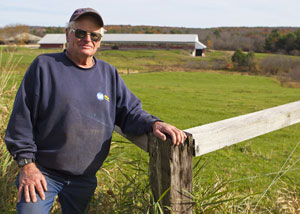 The main cow barn at Rusty Knoll Farm spreads out in a large field behind Gorham dairy farmer, Bill Rust. “We have no control at all over the price we get” for milk, says Rust.
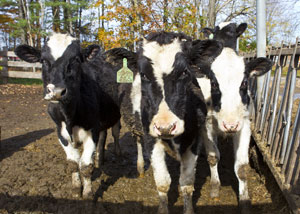 Young heifers on the Parsons farm in Gorham are kept separately from the milking population of cows.
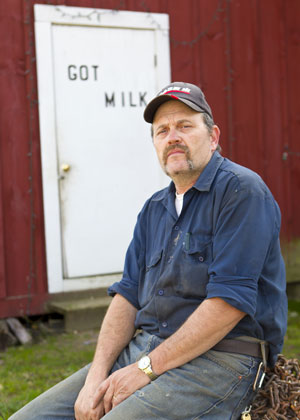 Gorham dairy farmer Robert Parsons at his farm on Buck Street, started by his grandfather, Howard, 65 years ago. “The last couple of years have been very difficult,” he said.
Send questions/comments to the editors.
