



WINDHAM – With the Nov. 6 election bearing down, the town of Windham is stepping up its campaign to educate voters regarding the sewer referendum.
The need for information was made more apparent at a public hearing last week during which many speakers said they knew little about the $37.8 million project, and that their neighbors and friends are similarly ignorant and ill-prepared to answer the ballot question.
The sewer has been discussed for 40 years, but Windham residents have never been asked to vote on the project. That changed last Tuesday when the Town Council voted 4-2 to put the question to Windham voters, the very people who will be paying for the project that would run from North Windham and Windham Center to the Portland Water District’s treatment facility in Westbrook.
The alleged lack of voter education is a serious concern with six weeks to go before Election Day. The Town Council has put the question out to voters looking for direction on how to proceed with the project, which would address the decades-old issues of commercial development potential and pollution from septic systems in North Windham.
So, in an effort to reach as many voters as possible before decision day, in July the town hired the public relations firm of Barton & Gingold for $18,500 to manage the campaign. Randy Seaver, a former journalist, is tasked with providing unbiased information to voters regarding the project.
That task, however, is easier said than done.
“We’re trying to engage people, and the audience is anybody who is in Windham, not just taxpayers or voters, but anybody who is a stakeholder,” Seaver said. “And at some level, the responsibility is on the government to get the information out, but the citizens also have to be willing, and somewhat engaged. So what we’re trying to do is make it as easy as possible for people to get that information.”
The education campaign is being waged on several fronts, Seaver said, all of which ultimately aim to get people to check out www.windhamsewerproject.org. There, people will find dozens of sections devoted to the various aspects of the project, including cost implications and pollution concerns.
Seaver also has developed a distributable paper flyer that aims to get people to look at the website.
“The flyer answers three questions we seem to hear a lot: Why is Windham considering this? How much is it going to cost? And how are we going to pay for it? And, really, it’s meant to drive traffic to the website,” Seaver said.
Seaver and Councilor David Nadeau, one of four councilors who approved the sewer ballot question at last week’s council meeting, were distributing the flyers at the Windham-Cheverus football game last Friday night in Windham. Nadeau said the experience at the front gate of the stadium was eye-opening, with many people grateful for some information while others were adamant in their position either for or against the sewer. Estimating he distributed about 100 flyers, Nadeau says there’s more outreach to be done.
“Yes, I intend to go to different home games, soccer games, football games, and be there to answer questions if they’re asked,” Nadeau said. “I need guidance. If I’m going to try to be a visionary for this town and move this town in a direction, I need guidance from the taxpayer to tell me where to go. I don’t want to make my decision on a handful of people sitting in a room telling me yes or no.”
Nadeau’s efforts could pay dividends if the education campaign is successful. Success, he said, wouldn’t be reflected in a yes or no vote, but in an informed vote where residents know the issues surrounding the sewer question. But judging whether people are informed come Election Day could be a difficult proposition, Nadeau said.
“Whether or not the education effort is successful, I think that’s unmeasurable. But I don’t want to get blamed that there wasn’t an effort made,” he said. “I just don’t want the community saying, ‘We don’t know nothing about this, you’re trying to jam it down our throats.’ I want them to know what they’re looking at.”
Town Manager Tony Plante agrees with Nadeau about determining success.
“We really don’t have a good mechanism for measuring success, but I think a successful effort would lead to people getting the information they need to make a decision, regardless of the outcome,” Plante said.
It’s Seaver’s job to make that education effort reach as many people as possible. Besides the flyer and website, Seaver has several other efforts under way. Starting this week, he’s meeting with groups in town such as the Rotary Club, Chamber of Commerce, Little Sebago Lake Association and Windham Land Trust to show a 15-minute PowerPoint presentation regarding the project.
Seaver’s also using social media with a “Windham Sewer Project” page on Facebook, which he hopes gets posted as a link by the thousands of Facebook users in the town.
Old-fashioned methods are being employed, as well. He hopes to work with Windham High School students, who need 40 community service hours to graduate, to distribute flyers at local shopping centers and athletic games.
“If we can have five or six kids engaged in this, going to shopping centers, greeting people coming out of Shaw’s or Hannaford with a flyer … it keeps costs down. We’re not forcing kids to do this work. It helps the kids understand more about how communities make decisions, how do you get info out, and it teaches people other valuable skills. I would always have loved this when I was in high school,” said Seaver, acknowledging that some in town have criticized the use of students for helping the town disseminate information.
Also, Seaver is planning a community forum Oct. 24, probably at the Windham High School. He’s aiming to get speakers from a wide range of viewpoints to talk about the project in hopes of educating those who want more information just prior to the Nov. 6 vote.
Too late?
Some think the education campaign is doomed to fail because of the time left before Election Day. Patrick Corey, who is an outspoken critic of the project and is calling for a public forum to be held much earlier, is worried that absentee voters won’t hear about the project in time.
“During the last gubernatorial race in this state, 23 percent of the people voted by absentee ballot. Voters can start casting their ballots as early as 45 days before the election, as soon as the state has the ballots in municipal clerk’s hands,” Corey said, saying a forum earlier in October would make better sense. “So, these guys want to have a public education forum on Oct. 24? Imagine the number of people they won’t be communicating with before Oct. 24.”
But Seaver still believes he can get the word out.
“In July and August, nobody’s paying attention to anything. They’re going swimming, hiking, it’s not sitting down and talking about sewer systems,” he said. “But now, we’re getting to a point nationally, state level and even on the local level where people say, hey, in a couple months we’re going to be making a lot of decisions.
“So now people are paying attention. So, absolutely you can do this. We haven’t even had the presidential debates, so if you can choose a new president in a matter of weeks, you can do this.”
Bias
The town is aiming to provide neutral information to voters, and doing so in an unbiased way is imperative, Seaver says, and would violate state law if the education effort morphs into a promotional campaign. Towns, he said, are forbidden to promote public projects under state law.
Seaver takes his role seriously, therefore, and is falling back on his journalism career to avoid the appearance of bias.
“The thing I’m enjoying about this project is it’s bringing me back to my old journalist days,” said Seaver, who was an editor at a weekly paper in Biddeford-Saco. “I am just an objective, paid witness to what’s going on. And I’m just reporting to the community the facts of what is happening.”
But sometimes he falls short in his work. Corey, who knows the sewer project inside and out, noted an error on a crucial element of data on the Windham Sewer Project website regarding the safe drinking water limits regarding nitrates. The website listed the limit at 1 part per million, rather than the 10 parts per million that the federal Environmental Protection Agency reports is the safe limit. The error is significant since readers would believe North Windham nitrates levels, at 3-4 parts per million, are triple the safe drinking water limit.
“I have to take 120 percent responsibility,” Seaver said. “It was simply what I would call in my journalism days – and I used to hate it when it happened then, too – it was a typo. Obviously, I updated it on the website as soon as I heard about it after double-checking it.”
Seaver refutes any nefarious intention behind the error.
“I’ve also heard say this is a way to manipulate information to drive public opinion, but I don’t know how you can say that when we had the hyperlink to the EPA’s own page,” he said. “We’re just trying to be as detailed as possible, and there’s a lot of real detailed information about this project and I don’t profess to be an engineer or scientist, I’m just trying to do my best at assimilating a whole bunch of information, and trying to get that out to the public. But bottom line, I’m glad it got caught and we have corrected the problem. It should not have happened, and the only person to blame is me.”
Corey also takes umbrage with phrases on the website that indicate sewage is “flowing” into the groundwater aquifer, rather than terms used in the past such as leeching or seeping, which indicate a lesser rate. Plus, he takes issue with terms such as “rising levels” of nitrates being found in groundwater when 2009 tests show lower levels than 2003 tests.
“When you go from words like ‘leeching’ to ‘flowing’ isn’t that colorful language? Doesn’t that sound like advocating?” Corey said.
Seaver denies bias, which he said would bring into question the legitimacy of the voting results.
“My job is not to win this campaign, my job is just to get out information,” Seaver said. “And information is information. As somebody who spent more than a decade in journalism, I feel like I have pretty good instincts about bias. To some level, you can’t remove all bias but you have to make the best effort possible. And with this website, I bent over backwards to make it unbiased.”
Before Seaver went live with the website, he sent a link to a sewer opponent in town but didn’t hear back. And he said there’s plenty of information on the website that proves there’s no pro-sewer bent, namely a section that compares and contrasts sewer systems and septic systems.
“Sewer has got its pluses, but we also list out the negatives including cost of installation, traffic impact during construction, long-term costs of wastewater treatment, and that [sewer systems] are more costly over the course of home ownership. That doesn’t sound like a lot of compelling reasons to vote for a sewer, does it? But we have that listed out, because we have the good and the bad,” Seaver said.
Seaver also has to contend with criticism due to his relationship with the town, which is paying the firm up to $18,500 for education efforts until Election Day. Seaver says he feels no duty to steer information in favor of sewer, though several councilors have expressed support for the project saying it would help pollution and improve commercial prospects and provide jobs.
“There was only one time I felt pressure from the council. They said, ‘We want you to be completely unbiased and completely neutral.’ And they said they wanted to be updated every step along the way,” Seaver said. “So, basically they don’t give me a check and send me on my way, they want to know what I’m doing, who I’m talking to, and how I’m talking to them.”
Plante, whom Seaver reports to on a daily basis, said the firm, which was hired 12 years ago to perform public education of a curbside trash and recycling program, is an important player in the sewer referendum.
“We may be expert in many things, but mass communications and effective messaging is an art in its own right, and we appreciate the insight Randy Seaver has been able to bring to that, as well as his outright effort in reaching out to people and groups in the community,” Plante said.
Opposition
Not all are excited about the town’s efforts, however, saying they are last-minute and will only reach a few of the 17,000 residents.
Bob Muir, a former councilor who’s running for council again, said the town has not met with business owners who will be forced to connect, is not able to tell those businesses how much their sewer bill would be and, in general, is being vague with how the project will financially impact both businesses and residential users along the line as well as taxpayers.
“The reason I think the numbers haven’t been put out as much is that I think there are councilors who thought it wouldn’t pass if people knew the real cost,” Muir said. “They’ll tell you they’ve got the betterment fees, the ready-to-serve fees, that’s all out there, but with any project I think you’re going to have a terrific overrun, even with this contingency fund, and that’s part of what they’re not talking about.”
Regarding North Windham businesses, Muir, who’s out door-to-door campaigning, says some business owners don’t even know about the project, proving the town has a long way to go in its efforts to educate. But he says those discussions should have been held long ago since businesses will be impacted greatest.
“It’s amazing to me that [the council] never had some businesses come in and sit down at a council workshop and discuss the implications, because I’ve been out for the last month doing my own survey and I’ll ask them what do you think about the sewer? Most of them don’t know. They haven’t heard of it” Muir said. “And they’re going to get hit, they’re going to get hit hard. And my thing is Lowe’s, Home Depot, Walmart, they can handle it, but when you take a small business, I’m not sure they can raise their prices enough and still stay competitive.”
While the town conducts its education campaign, Corey, who runs a marketing business, is intending to conduct one of his own, and he’ll likely enlist the support of many such as Muir who are critics of the project and the way the town has conducted the process so far.
Corey has formed a ballot question committee, known as the “Committee to Defeat Sewer in Windham, No on Article 2,” which allows him to raise more than $1,500 for signs, flyers and other outreach efforts.
“Is the town advocating or educating? I think they’re advocating, because I think if they were truly interested in educating there’s no time to do that,” Corey said. “I’m a marketing guy, I know you can’t do it that quick.”
Editor’s Note: ?This is the first in an ongoing series examining the Windham sewer proposal facing voters Nov. 6.
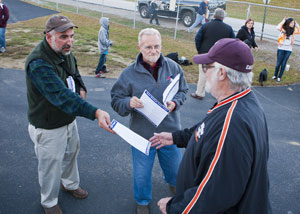 Handing out information about the proposed North Windham sewer project before the football game at Windham High School recently night are, from left, public relations specialist Randy Seaver and Town Councilor David Nadeau.
 Send questions/comments to the editors.
