



WESTBROOK – Milton Gowen was 26 years old on June 6, 1944, when he and thousands of his fellow Allied soldiers stormed the beaches of Normandy, France, in the largest amphibious assault in history.
As he and fellow members of the U.S. Army’s 3rd Armored Division began unloading equipment on the beach that day, under a fusillade of German machine gun fire, he remembered making way for a blaring horn, as Gen. George S. Patton rolled by in a tank.
“He wanted to get ashore, and we were in his way,” Gowen recalled this week.
Now 94, Gowen has been content to live his life after the war quietly, settling in a house he built on Pennell Street in his native Westbrook, and eventually marrying.
But on Tuesday, he got a lot more attention than he was used to, when Maine’s first lady, Ann LePage, paid him a visit to present him with a certificate of thanks for his service, along with a hand-carved eagle cane depicting his accomplishments serving his country in the war.
“What a day this is,” Gowen said as he admired the cane.
LePage was joined by retired Lt. Col. Peter Ogden, director of the state Bureau of Veterans Services. Ogden said in 2006, the bureau began the ambitious project of tracking down all 150,000 known living veterans in Maine. Ogden said the bureau wants to meet each of them personally to thank them for their service.
“We’re just trying to find them all,” Ogden said. “We know they’re out there.”
The eagle cane presentations are Maine’s version of a national campaign started in 2004 to honor veterans with similar, hand-carved presentation canes, according to Andy Rice, a member of the Maine Woodcarvers Association, who was on hand Tuesday to present the cane to Gowen.
“Our goal is to do one for every (Maine) veteran who says they want one,” he said.
Gowen’s new cane has a carved eagle’s head for a handle, along with etched markings on its shaft in color, depicting countries he traveled through during his tour and battles he fought in, including the Normandy invasion and the Battle of the Bulge. There are also markings describing the Nordhausen concentration camp, which the Nazis had abandoned and Gowen’s division discovered, with no survivors, during its patrols.
Today, Gowen is retired, after working for 40 years at S.D. Warren. He has built countless model ships, some from kits, some from scratch, and nine of them have since been exhibited in the Maine Maritime Museum.
As to the war, he displays medals he received in a box hanging from the wall of his living room, but he said he doesn’t think much about the war.
“It’s all gone by,” he said.
LePage made similar cane presentations on Aug. 19 to veterans at the Augusta Armory, and media coverage of that event caught the eye of Gowen’s wife, Edith, 92.
“I saw it in the paper, and I felt he deserved one,” she said.
So Edith Gowen wrote to LePage, asking if her husband could have a cane.
“I said, ‘It would be nice if this could happen,’” LePage said.
And on Tuesday, it did.
Gowen thanked Ogden, Rice, and LePage, calling the cane “beautiful.”
During the presentation, LePage said to Milton Gowen of his wife, “You’ve got a good woman here.”
“You’re telling me,” he replied.
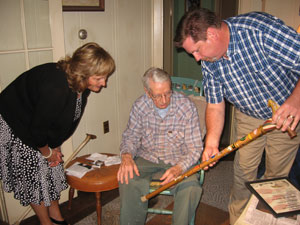 Andy Rice, a member of the Maine Woodcarvers Association, describes the detail on the eagle cane presented Tuesday to Milton Gowen, 95, of Westbrook, in honor of his service during World War II, while Ann LePage looks on.
 Send questions/comments to the editors.
