



PORTLAND – The city had significant decreases in burglaries and robberies in 2011, and officials are crediting patrol strategies and specialty units for the positive trend.
The state’s largest city saw the number of robberies — in which a criminal threatens someone to force them to give up money or property — drop from 125 in 2010 to 86 in 2011.
Additional Photos
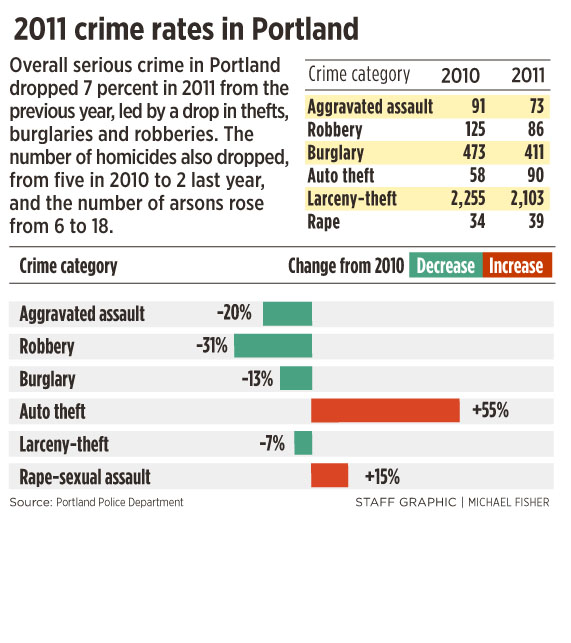
The number of burglaries — in which someone breaks into a home or business — dropped from 473 to 411.
“We know in the city of Portland, what drives crime is substance abuse, primarily drug offenses,” said acting Police Chief Michael Sauschuck.
He said the Maine Drug Enforcement Agency’s Cumberland County task force disrupted a large number of drug operations in Portland, and the city’s Crime Reduction Unit, deployed early last summer, has arrested many suspects who could have gone on to commit new crimes.
SOME CRIMES SAW INCREASE
Overall, serious crime in the city — which also includes homicide, rape, aggravated assault, arson, larceny and car theft — was down 7 percent from 2010. And in 2010, serious crime was down 3 percent from 2009.
There was some bad news in the statistics as well.
The number of rapes increased 15 percent, from 34 to 39. In each case, the rape was by an acquaintance rather than a stranger.
The number of arsons jumped from six to 18. One suspect was responsible for a half-dozen of the fires, set over two nights, and was arrested in the area with a stolen gun, Sauschuck said.
The number of vehicle thefts also spiked, climbing 55 percent to a record 90, compared with 58 in 2010. There were 71 vehicle thefts in 2009, 62 in 2008 and 36 in 2007.
“I think people are stealing cars more than they used to,” said Cmdr. Vern Malloch, head of patrol operations for Portland police. “What hasn’t changed is that the vast majority of cars stolen are recovered, if not locally, then in the Greater Portland area.”
Most of the cars were stolen after the drivers left the keys in them, he said. “It’s more a crime of opportunity,” Malloch said.
SIMILAR TREND IN AREAS NEARBY
The department tracks the number and location of crimes each week as part of its CompStat process, a statistical analysis borrowed from the business world to identify trends and assign resources.
The drop in robberies and burglaries in Portland may be surprising, as prolific robbers and burglars have continued to make news. However, the trend is at least somewhat reflected in neighboring communities.
In South Portland, robberies through November stayed the same, at 11, compared with the same period in 2010, and burglaries dropped from 90 to 76, a 15 percent reduction.
In Westbrook, robberies dropped from 17 in 2010 to 10 last year, though burglaries rose from 100 to 118.
Statewide crime statistics for 2011 will not be available until May.
HOT SPOTS GET EXTRA ATTENTION
Communication and coordination have played an important role in reducing crime, Sauschuck said. The Crime Reduction Unit, made up of a sergeant and six officers, meets daily with detectives and works closely with the MDEA to identify suspects.
A string of burglaries in an area may indicate the presence of a drug dealer’s house, which could lead to an MDEA investigation.
Sgt. Kevin Cashman, head of the nine-person task force responsible for Cumberland County, said that when agents do searches, they often find stolen laptops and other items traded for drugs.
Patrol units continue to emphasize community policing and direct patrol in targeted areas, Sauschuck said, but they can be pulled away by emergencies and other calls.
The Crime Reduction Unit can devote an extended period to stake out an area, just as the MDEA can concentrate on long drug investigations, he said.
Arresting one burglar, even if it’s on a probation violation or a felony motor vehicle offense, can stop a series of crimes, police say.
“Our experience tells us if an individual perpetrates a crime, they’re likely to continue that pattern until they’re apprehended or something else happens to change their direction,” Malloch said.
That may mean “flooding the zone”: concentrating officers in an area that has been hit hard with one type of crime. Heavy traffic enforcement and interviews with pedestrians can uncover leads and drive down related crime, and may lead to a suspect’s arrest on unrelated charges.
PUBLIC CAN HELP REDUCE CRIME
The department will continue to educate the public about simple strategies that reduce the number of crimes. Sauschuck noted that all 17 car burglaries in one week last year were of cars that were left unlocked.
People should lock cars and doors and windows, not leave laptops and GPS units in plain sight, and not hide car keys in easy-to-find places, he said.
The drop in serious crime is a positive trend, Sauschuck said, but may not translate into an increased sense of safety for residents.
Sauschuck said the department plans to use the CompStat model to target nuisance offenses and crimes against public order in the coming year.
“The average citizen is not going to be a victim of crime in their lifetime,” he said, “but when they get out of their car, they may see something that makes them feel less safe.”
Calls reporting drinking in public, aggressive panhandling and other complaints that don’t get logged as serious crimes represent the majority of the 85,000 calls a year, and can foreshadow more serious crimes in an area, Sauschuck said.
Staff Writer David Hench can be contacted at 791-6327 or at:
dhench@pressherald.com
Send questions/comments to the editors.
