



Young sailors from Maine and the greater northeast gathered off East End Beach in Portland for the recent Junior Olympic Sailing Festival Northeast regatta to test their skills against the waves, the wind, and each other. Divided into five skill and sailboat class divisions, the racers battled the occasional bout of unfavorable conditions as they cut back and forth across Casco Bay, generally in the area between Mackworth and Great Diamond islands. The event, hosted jointly by the Portland Yacht Club and SailMaine, was intended both to enhance the skills of budding sailors, while at the same time allowing the most talented amongst them to begin to climb the long hill towards the Olympics.
“(It) went very smoothly overall,” said Sarah Helming, director of programs for SailMaine. “The number of people that came down to support this event is remarkable – we had almost 100 people volunteering in a variety of ways over the last three days. This year’s collaboration with Portland Yacht Club meant there was a division of tasks and responsibilities to make things pretty manageable.”
On the first morning of the event, the competitors – already divided into their respective fleets – slowly wheeled their diminutive craft down to the water’s edge before hoisting their sails and attempting to make headway against still air. Although a few sailors boarded Lasers, the bulk of those participating were either sailing Optimists (the name is shortened to “Optis” by the crews); stubby, single-person boats with flat bows and no headsail, or 420s, larger, two-person craft with more familiar lines and featuring both a headsail and a spinnaker.
Younger sailors, mostly in the middle-school age range, manned the Optis, while the 420s were skippered by junior high or early high school-age racers. While many of the participants are multi-sport athletes during the school year, most said they thought sailing was the most difficult of their hobbies.
“Sailing is much harder than other sports,” said Cady Eldredge, 11, of Scarborough. “In sailing, there are a lot of things you need to know. In other sports, you just need to move your feet, kick or throw the ball. In sailing you need to know about wind speed and direction as well as current.”
In sailing, the most chaotic moments of each race are undoubtedly those just before and after the start, as each tiny ship battles for position, jockeying with multiple boats and throwing the water around into a confused sea state. At the Junior Olympics, the start of a race would be heralded by both the lowering of a flag on a stationary ship – a throwback to when flag signaling was the primary means of ship-to-ship communication (even for naval vessels) back at the turn of the twentieth century – and a horn. Once that sounded, participants threw all caution into the wind and plunged towards the first turn.
“I don’t really get nervous before the races,” said Josie Warfield, 10, of Scarborough. “You’re trying too hard not to hit the other boats to worry. The most important thing to concentrate on is the wind direction.”
But several boats actually had to be towed into the starting area on the first day of the event due to a lack of wind, and it was at this time that the heat of the day was perhaps most noticeable.
“For me, hot days are the worst,” said Eldredge’s sister, Carley. “It’s hard being in a regatta when the temperature is in the 90s. Your body has to be fit to withstand the heat and its very exhausting being on the water for five hours straight. Sometimes you have to deal with the cold. Sometimes the water becomes your worst enemy, splashing on you every few seconds.”
According to Cady Eldredge, there are also days when there is simply too much wind.
“The hardest thing about sailing is when you have high winds,” she said. “(During the races on Wednesday) the wind was so strong that I flipped by boat and broke the fiberglass around the hole where the mast fits in. It was fun though, and I was laughing.”
“The wind was a lot better the second day,” added Hillary Umphrey of Biddeford who raced Optis along with her twin brother Duncan. “It was steadier, but there were some gusts. People were going over, especially when sailing windward. That’s when you get waves coming over the side of the boat. I actually submarined a little when I had a wave come over the bower and the boat flipped up into the water.”
Although both twins are looking forward to advancing to sailing 420s either next year or the following one, Duncan Umphrey is lamenting the loss of autonomy that will come with sailing alongside a partner.
“I like sailing solo because you have more control,” he said. “You have control over your own boat when you don’t have to have to sail with someone else.”
Is there a chance that the Umphreys will choose to sail together? According to Hillary Umphrey, that’s not going to happen.
“We could be partners,” she mused, “but we both have different jibe techniques, and we both like to skipper.”
Do we sense a little healthy competition between these two sailors?
“I don’t know about healthy,” laughed Hillary Umphrey. “But there is a lot of competition.”
Helming hopes that the exhilaration of this year’s competition will draw even more young people to the sport in the coming years.
“Sailing builds great confidence,” she said. “The exhilaration of being in charge of your own boat – driving something without any assistance – can be hugely rewarding for young people. Sailboat racing involves a lot of mental effort. There are a lot of tactics and strategy involved. Physically it can also be tough – sailors are often on the water for 4-6 hours straight. In addition, a typical youth regatta takes place over two to three days. In other words, this is a lot of time for the kids to try and stay focused while being in the wind and the sun.”
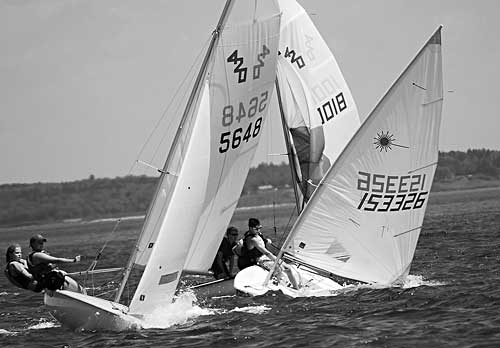 Older sailors piloting the two-man 420 boats lean over the side
Send questions/comments to the editors.
