



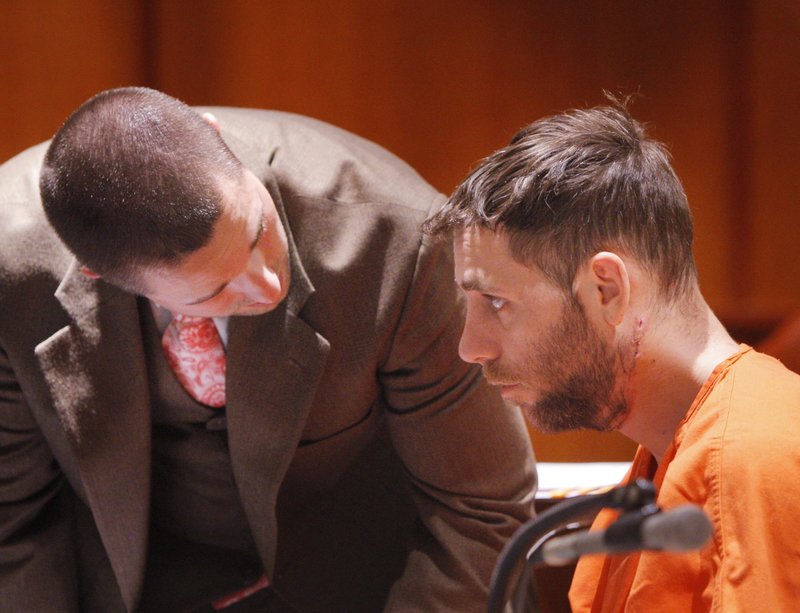
Lawyers for a man who was shot by Portland police in April say they plan to sue the department for use of excessive force, arguing that the officers were not in danger when they wounded Jonathan Mitchell, 29, of Veazie.
Michael Turndorf and Mitchell’s defense lawyer, J.P. DeGrinney, said in an interview Thursday that a slow-motion video created from cruiser-camera recordings shows that officers Robert Miller and David Schertz were not in the path of Mitchell’s car when Miller fired two shots into Mitchell.
Additional Photos
Miller returned to patrol from administrative leave last month.
Police chased Mitchell in response to reports that he had broken into his ex-wife’s apartment in Portland. Mitchell pulled over on Fairfield Street, a dead end, but as officers approached the car, he sped away.
“At the time Officer Miller fired those two shots, neither officer was in danger. (For Miller) to be hit by the car, the car would have had to be moving sideways,” said Turndorf, who plans an excessive-force lawsuit against Miller and the city.
The police department, while declining to comment on specifics of the case, said a slow-motion video is not a basis for judgments about an officer’s actions.
“It certainly doesn’t represent what the officers are facing at that moment and the decisions they have to make in rapidly evolving circumstances,” said the department’s attorney, BethAnne Poliquin. “It would be nice if life went in slow motion, but it doesn’t.”
Mitchell is being held in the Cumberland County Jail on charges of criminal trespass, failure to stop for an officer and reckless conduct with a dangerous weapon. His attorneys said he has serious, permanent injuries.
A bullet that pierced Mitchell’s neck damaged a bone that supports his esophagus and trachea, they said, so he now eats only blended food and sometimes chokes on his saliva. The other bullet hit his shoulder.
Mitchell’s lawyers have copies of the cruiser-camera videos from that night, at least one of which appears to show where Miller and Schertz were when the shots were fired.
“You can see both officers are somewhere between the left rear door and left rear tire,” said DeGrinney. “As far as I can see, nobody can be injured.”
An officer is justified in using deadly force if he or she reasonably believes someone is threatening the officer or someone else with deadly force. All uses of deadly force by police are investigated by the state Attorney General’s Office.
Eric Nevins, president of the Portland Police Benevolent Association, the union representing front-line officers, said he hasn’t seen the video but believes the incident was more dangerous than the lawyers have portrayed it.
“It wasn’t merely the fact of a car fleeing the scene. It was a dead-end cul-de-sac and the car was accelerating very rapidly and spinning and coming back toward the officers,” Nevins said. “It wasn’t just a vehicle trying to drive straight away.”
Paul Gaspar, executive director of the Maine Association of Police, said officers generally favor using cruiser cameras, even though the cameras can’t capture everything that goes on at a scene or goes through an officer’s mind.
Mitchell’s lawyers say they have not been given Miller’s report on the incident. Poliquin said there is a report that Miller prepared for the criminal case against Mitchell, which has been provided to prosecutors, but it would be unusual for an officer to prepare a report on his use of force when he is the subject of an investigation by the AG’s Office.
An assessment that’s required by the department to return an officer to work was completed, allowing Miller to resume his patrol duties last month, Poliquin said.
In the past, officers often remained on administrative leave with pay while the AG’s Office completed its probe. Those probes used to take about 30 days. Because investigators are backed up with numerous cases, a recent deadly-force case took five months to complete.
Staff Writer David Hench can be contacted at 791-6327 or at:
dhench@pressherald.com
Send questions/comments to the editors.
