



WESTBROOk – It is a few minutes into the start of class and John Morgan still has not captured the attention of his students, so he grabs a nearby marble-filled jar and removes a few marbles from it.
That has some impact as the students start to settle down. No marbles in the jar at the end of the week means the class will not have a fun activity on Friday.
Other teachers might have given a startling yell to refocus the students’ eyes onto the teacher. Morgan, though, resorts to some curious methods to engage his students.
He knows he has to embrace unorthodox ideas to succeed with this freshman class. The class itself is unorthodox. Morgan’s students comprise Westbrook High School’s first “School for Success” class, a new program started this year for troubled students within the district.
If that means Morgan has to ruin multiple pairs of dress shoes playing football with his students to keep them engaged, then so be it.
According to high school Principal Marc Gousse, the students were identified in middle school as being at risk of dropping out for a variety of reasons – some could be lacking in support from the home, others may have substance abuse issues and still others might have learning difficulties or even anxiety about coming to school.
The students all have their own struggles to overcome, but, Gousse said, ensuring they persevere and earn diplomas is the common goal. Helping the kids through freshman year is the first step.
“There’s a subset of kids that have a series of challenges where they don’t have services identified. Those are the kids that potentially can fall through the cracks,” Gousse said. “Freshman year is probably the most critical year. It really defines where a kid goes and doesn’t go.”
The 16 School for Success students – all but five of them are males – readily admit attending school was not among their priorities. A few said even their middle school teachers regarded them as lost causes. They were failing school – if they showed up at all.
Ryan Lund, a 15-year-old in the class, described junior high as “prison.” He has attended a dropout prevention committee meeting to support the School for Success program, saying it made a difference for him.
John Wescott, 15, had good attendance in middle school, but only because his parents made him, he said. He was bullied, thought his teachers disliked him and had trouble focusing, he said.
“I can focus better now. I do listen to Mr. Morgan a lot better,” he said.
The students praised Morgan and the structure of the class. They said Morgan keeps a level head and is more understanding of their situations.
Unlike most students, Morgan’s pupils are together in his room for most of the day. They are enrolled in some mainstream classes. Gousse said many of them are interested in vocational studies, but since the vocational center is not an option until junior year, the program helps bridge that gap.
“The real tragedy is, if kids don’t come and have a good freshman year, they can never access the vocational program,” Gousse said, explaining they first need core credits that go toward a diploma. “The goal is to acclimate them into the regular student body. And we’ve done that this year. These kids are not self-contained all day long. Some of them are taking an English class, some are taking a math class (or) a science class.”
But for the most part, they learn from Morgan, who follows the same curricula as the other freshman teachers but leads the class at its own pace. It is quite a shift for the 27-year-old, who was hired as an education technician for the learning center at the start of the year.
However, the school turned to him when the two part-time teachers hired to run School for Success left a month after the school year began.
“They both stepped away of their own volition. We were at a point in the program where it was in jeopardy,” Gousse said.
Morgan previously worked at Sebago Education Alliance, a school for children with serious behavioral and emotional disorders. He has brought that background to School for Success and made things work.
In the first quarter, he said, he worked to establish a classroom culture. The whiteboard constantly reminds the students of those rules: no inappropriate language; no interrupting staff members; and no distractions.
For the rest of the year, he hopes to secure their academic footing and increase expectations, he said.
What happens beyond this year is still in question. Morgan said at least three students have expressed the desire to move mostly, if not completely, into mainstream classes.
Next year’s freshmen will include more students at risk of dropping out, and the administration is struggling to decide whether Morgan should continue teaching this group of kids or move on to teach incoming freshmen.
Gousse hopes to solve that problem by bringing on another School for Success teacher. He said he is making the request in his budget.
Superintendent Dr. Reza Namin said he supports the program and is establishing priorities for the upcoming fiscal year.
“This is a good program that focuses on addressing our students’ needs,” Namin said. “We also have other (staffing) needs, too. We just have to face the fact it’s going to be difficult and we need to identify priorities.”
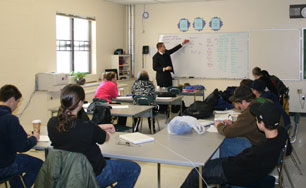 John Morgan leads a math lesson in Westbrook High School’s “School for Success” program.
Send questions/comments to the editors.
