




PORTLAND — More than a decade after being separated from his parents near where the Nile River cuts through southern Sudan, Aruna Kenyi strode through Sunday’s crisp morning air amid freshly fallen snow on Munjoy Hill and took the first step toward a long-overdue reunion.
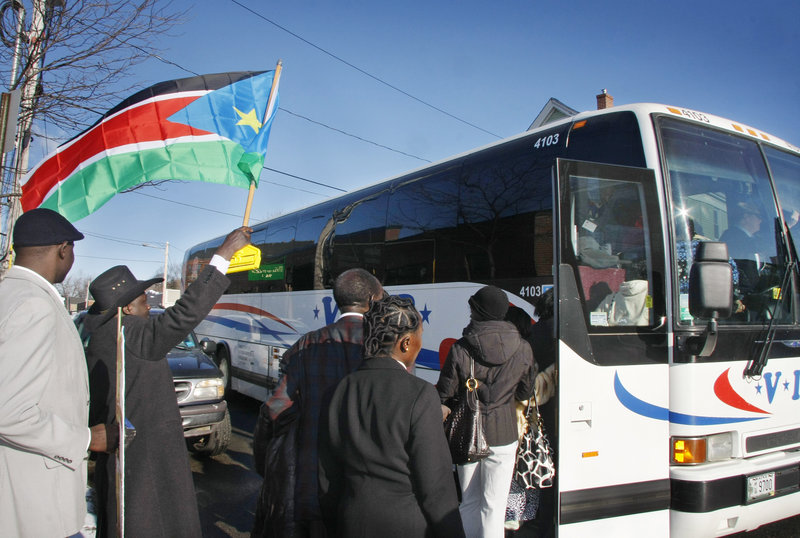
Kenyi, 21, climbed aboard a bus bound for Boston, one of eight polling cities in the United States where refugees of southern Sudan can join the referendum taking place in their African homeland on whether to form a new nation.
Additional Photos

Polling continues through Saturday and is widely expected to split the continent’s largest country into a mainly Muslim and Arab north and a predominantly black and Christian or animist south.
“It really means a lot, not just to me, but to all the Sudanese community in the United States and Sudan in general,” said Kenyi, a 2007 graduate of Portland High School who is studying community health education at the University of Maine in Farmington.
“If this passes, and we have our own state, it will give us a sense to define ourselves, to be able to go back and re-view our country and to be able to call it home again, like it was once before.”
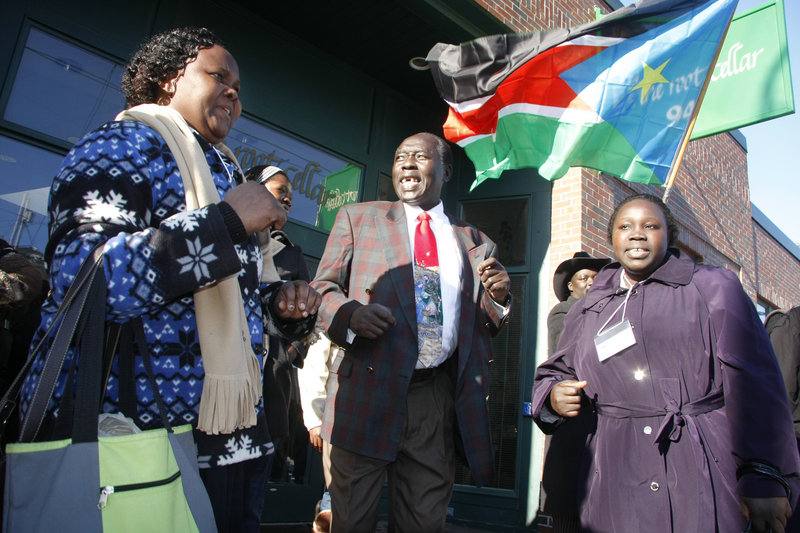
Community organizers sent three more buses to Boston on Sunday morning loaded with voters, young and old, dressed casually like Kenyi in a gray hooded sweatshirt or more formally in suit and neatly-knotted tie like his older brother, Yugu Alfred Yobo. In all, more than 300 members of Portland’s Sudanese community registered for the historic vote.
“These people are all from different tribes, different cultures,” Kenyi said, waving his hand at a crowded community room at The Root Cellar on Washington Avenue. “This election brought all of us together.”
Kenyi and his brother are of the Bari tribe. Edward Laboke and his wife, Sabina Apollo, are of the Acholi tribe.
Laboke, an ed tech at Lincoln Middle School who taught high school for 17 years in Sudan, understands the vote is only the first step on what could be a difficult and challenging path to independence.
“I’m hopeful that we are going to have a prosperous nation where we will get what we have been missing for 40 years,” he said. “The most important thing is peace. When there is peace, there is not so much suffering. Although there could be suffering in terms of poor services, in terms of health and other things, but still, when there is peace, people feel happy.”
Outside the doors of the community center, Apollo joined half a dozen others in a swaying, foot-stomping song-and-dance punctuated by high-pitched yelps of joy. Her husband translated the refrain as: “We are tired of staying in a foreign land. We are ready to go home.”
The singing continued on the bus, reached a fever pitch when Sudanese refugees from other parts of New England came together in Boston, and dissipated only after the group returned to Portland around 5 o’clock, according to community organizer Alfred Jacob.
Results of the referendum will be announced in mid-February, Jacob said, with an official certification — and anticipated transfer of authority to southern Sudan — in July.
Kenyi hopes to be back in Sudan after his spring semester in Farmington. When he was 5, his village of Kansuk was attacked by Arab militiamen and he was separated from his parents for the first time.
He spent his next years moving from village to village, landing in a United Nations refugee camp outside the country in Uganda, where at age 9 he rejoined some of his older brothers.
He hasn’t seen his parents since, and didn’t know if they had survived until he received a photograph his sophomore year at Portland High.
If southern Sudan gains independence, Kenyi plans to return to Africa in June to see his mother and father — who now uses a wheelchair because of war injuries — and start a school-lunch program in Kansuk.
Southern Sudan is roughly the size of Texas, has about 30 miles of paved roads and high rates of illiteracy and malnutrition. It also contains large oil reserves that have brought in $10 billion in revenue over the past five years, with much of it enriching the Arab Islamic rulers in the north.
This week’s vote comes six years after a peace agreement ended a second civil war that started in 1983, slightly over a decade after a first civil war that lasted from 1955 to 1972.
“From 2005, when we first signed the peace agreement, most people doubted this day would come,” Kenyi said. “But it did. And now it’s time to define ourselves and, hopefully, have our own country.
“Yes, it will take a long time to develop and hard work. But hey, a lot of countries went through it. If everybody else can do it, I believe we can do it, too.”
Staff Writer Glenn Jordan can be contacted at 791-6425 or at:
gjordan@pressherald.com
Send questions/comments to the editors.
