



Pike Industries will get one more chance to convince neighboring businesses and residents they can coexist with a quarry.
During the next three months, Pike will work with its neighbors on a compromise regarding its level of activity at its Spring Street quarry – its last opportunity to dodge a rezoning effort that could put the company out of business in Westbrook.
Pike has been fighting a proposal for the past two years to rezone its quarry from industrial to light manufacturing. The new zone, meant for land in and around the Five Star Industrial Park, would restrict Pike’s activity on Spring Street to a level that the company says would render the property economically unviable.
At the same time, several residents and businesses located near Pike’s quarry, a group called Westbrook Works, say Pike’s increased level of blasting during the past couple of years have made their living and working conditions unbearable. Some have said if the blasting resumes, they’ll have to move out of town.
On Monday, the Westbrook City Council was charged with deciding whose case was more compelling. But after a four-hour hearing, councilors said they felt there was still hope for a compromise. They voted unanimously to table the rezoning issue until May, backing a proposal brought forward by Mayor Colleen Hilton at the tail end of the hearing.
“We need to take a step back,” Hilton said Monday. “These competing concerns can be appropriately balanced.”
As negotiations among the businesses and resident are just beginning, Pike will be forced to face off against Westbrook Works and the city in Maine Business Court later this month. Pike has appealed a decision by the Zoning Board that said the company never received the proper permits to operate a quarry.
Though the implications of the new zone and the court case are linked, for now, Pike says it will keep its focus on a finding compromise.
EVOLVING PROPOSAL
The controversy between Pike and its neighbors was initially ignited by the quarrying company’s proposal two years ago to build an asphalt plant at its Spring Street site. Idexx Laboratories was the first company to come forward in opposition of the plan and was soon joined by other area businesses and residents of the nearby Birdland neighborhood, which comprises Finch, Oriole and Cardinal streets.
In response to the uproar, former Mayor Bruce Chuluda came forward with the proposal of the new zone, which was posited as an effort to make sure that area of Westbrook would attract more light industrial, high-tech businesses like Idexx, which presumably would bring more tax revenue and higher-paying jobs to the city than heavy industrial uses.
Since then, Pike has taken the controversial asphalt plant off the table and claims it only wants to operate as it had been before it came forward with that proposal.
But some neighboring businesses say that level of activity is still too disruptive. Officials at Artel Inc. said the blasting disturbs the company’s highly sensitive work, which involves taking precise measurements of liquids. Television stations WPXT and WPME say the blasts disrupt recordings in its studio. Residential neighbors fear the foundations of their homes are being compromised.
At the hearing, however, Jonathan Olson, Pike’s regional manager, said there are ways the company can mitigate the disruptive effects of its blasting while still allowing Pike to reap the benefits of its resources on Spring Street.
Olson said Pike could reduce the intensity of its blasts, enhance the buffers around its property and keep dust particles contained by wetting the rock. He said Pike would continuously monitor its blasts, form a neighborhood group to address any concerns and inform everyone in the area when a blast is about to occur.
“If we have to call 1,000 people, we’ll call 1,000 people,” he said.
Olson said Pike is sensitive to the concerns of the residents who live near the quarry.
“We understand their dilemma,” he said, adding that Pike wants to reach out and work with them.
For Tim Bachelder, who claims to be the quarry’s closest neighbor, that was a long-awaited and welcomed response to hear.
“Up until now it’s been Pike and Idexx,” Bachelder said. As a citizen who’s been involved in the debate since the start, he said he’ll definitely be participating in the negotiations moving forward.
Doug Finck, manager of television stations WPXT and WPME, said Wednesday he was encouraged by Pike’s emphasis on using science and technology to give neighbors the assurance that Pike’s work wouldn’t disrupt their own. In the coming months, Finck said, it will be up to Pike to prove, through talks and test blasts, that they can do what they say.
“As long as I can stand there and say with a straight face, ‘I didn’t feel anything, did you?’ That’s good enough for me,” he said.
‘ONE LAST CHANCE’
Perhaps it was a sign that Pike’s Olson and Dick Daigle, facilities manager for Idexx, came to Monday’s hearing dressed nearly identically in button-down maroon shirts and khaki pants, as they’re now being forced to join the same team.
Throughout the past two years, Olson and Daigle have been the point people for the two sides of the debate, which has long been characterized as a battle between Pike and Idexx, the two largest taxpayers involved.
However, it was clear at Monday’s meeting that many more parties had vested interests in the outcome of the rezoning effort. Nearly three-dozen citizens spoke at the hearing, and they were evenly split on the issue.
People on both sides talked about fairness, fear and the future of the city.
Warren Knight, owner of Smiling Hill Farm, said he believes Westbrook residents opposed to the rezoning are scared of moving away from the city’s working-class roots.
“Deep down they believe Westbrook isn’t good enough,” he said about bringing in more high-tech businesses.
But Patrick Peoples argued that regardless of the high number of jobs those companies might provide, they’re not guaranteed to stay in Westbrook, like the jobs that are tied to the quarry.
“Idexx could be gone tomorrow if it got a good offer from China,” he said.
After the citizens’ portion of the public hearing, the businesses in support of the rezoning were given chances to speak, which was followed by a presentation from Pike. Arguments made during previous debates were reiterated.
Kirby Pilcher, president of Artel, reminded the council that “there are quarries in just about every community around here” and that there will still be plenty of aggregate for Westbrook projects if Pike leaves. He mentioned the size of Pike’s parent company, Ireland-based CRH, and the relative insignificance of this market.
“They don’t really care in my view what happens in Westbrook,” he said.
Pilcher encouraged the council to make a definitive choice regarding the rezoning, which he said represented a fork in the road for the city.
“The issue is Westbrook and where we are going. We can’t just drive down the middle,” he said.
Daigle reminded the council that his company would need the protection of the new zone in order to move forward with the construction of its corporate headquarters, a building that could hold up to 500 more jobs.
“There’s a lot at stake for Idexx,” he said.
In Pike’s presentation, attorney Bill Hagedorn emphasized the unfairness of the new zone, which, he said, was not written with the intention of creating a new vision for that area of the city, but with the goal of pushing Pike out of it.
He pointed to e-mails from 2008 written among Daigle, Idexx’s attorney and city staff around the time the new zone was first proposed. The e-mails included suggestions from Idexx regarding the language of the new zone. In one note, Hagedorn said, the city planner suggested to the city administrator that the zone would need to be written in a way that would downplay the negative effect it would have on Pike.
“The concerns of residents and businesses did not drive this process,” Hagedorn said.
The strong cases from both sides didn’t sway a single councilor to choose one over the other, but instead led the officials to encourage all the parties to find common ground.
“I think it would be remiss for all of us in the room not to give it one last chance,” said City Councilor John O’Hara.
“I think you owe that to the taxpayers of the city,” he said.
Following the council’s vote, Olson and Daigle, together, stepped away from the crowd exiting the council chambers in order to talk privately. Heeding the council’s advice, they came out of their brief conference with the same simple message: They were both ready and willing to work at a solution that will be best for the city of Westbrook.
“It’s really the way this should be resolved,” Daigle said about forging a compromise.
“We look forward to the process,” Olson said.
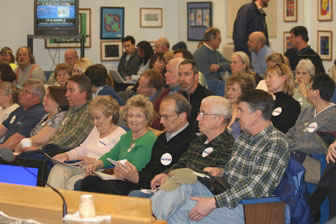 On Monday, the Westbrook City Council held a public hearing to take input on a rezoning effort that could lead to Pike Industries being forced from the city.
Send questions/comments to the editors.
