



On Saturday, July 25, the city of Westbrook will rededicate Rudy Vallee Square, with ceremonies in the square starting at 1 p.m. Vallee’s widow, Eleanor Vallee, will present a Rudy Vallae bust to the city.
A Vallee music concert at Riverbank Park starts at 3 p.m. At 4 p.m., the Westbrook Historical Society, 17 Dunn St., hosts a reception for Eleanor Vallee and guests.
This week American Journal history columnist Andrea Vasquez writes about the life of city’s famous crooner.
One Friday morning in July 1930, a crowd of close to 3,000 pressed into Portland’s Union Station, eagerly awaiting the arrival of radio superstar and recent film actor Rudy Vallee.
Cheering throngs lined the roads from St. John Street to Monument Square – and the squares and streets along the Westbrook portion of Vallee’s auto parade route – hoping to catch a glimpse of the shiny 1930 Packard that held, to date, the city of Westbrook’s most famous celebrity.
The following day at noon, local residents, along with many prominent visitors and film crews from Paramount and several other studios, packed into the area at the intersection of Bridge and Main streets, outside of the Vallees’ Warren Block drug store, for a dedication ceremony: the spot would be called “Rudy Vallee Square.” Three days of citywide celebrations, dances and banquets followed, including a Monday event at which Vallee was presented the key to the city.
Although Vallee (given name Hubert Prior Vallae) was not born in Maine, but in Island Pond, Vt., on July 28, 1901, his family moved to Westbrook when he was only 4 years old so that his father, French Canadian immigrant Charles Vallae, could take charge of the local pharmacy.
The family made their Westbrook home first on Church Street and then on Monroe Avenue, and Vallee and his two siblings, William and Kathleen, completed their education up through high school in local schools.
The young Vallee demonstrated a particular interest in and ability for music from an early age – from snare drums to clarinet, and then onto his beloved saxophone when he was a teenager.
By the time he joined the orchestra at Westbrook High School, he showed distinct skill on sax, and soon took the nickname of “Rudy” after the then-famous saxophonist Rudy Weidoeft.
While in school, Vallee assisted in his family’s business, chipping and hauling ice, selling medicines and working the soda fountain. Mostly due to clashes with his father – which he attributed to their quick tempers in his 1975 memoir – he soon left the pharmacy and got a job at the nearby Star Theater, hand-cranking the movie projector.
Vallee eventually became an usher at the larger Strand Theater in Portland and shortly after, while still a teenager, he began providing musical accompaniment to the theater’s silent films.
At 15, Vallee – already showing the tabloid-type antics of modern-day stars – faked his age and joined the Navy, only to be discharged later when the truth about his birth date was discovered. Retrieved by his father, he returned to school, and to performing.
Upon his high school graduation, by this time in a band that toured all over New England, he began his undergraduate studies at the University of Maine. He soon transferred to Yale, where he majored in philosophy, but he took his University of Maine memories – and the university’s “Stein Song” – with him. He would later make the song an international hit; millions of copies of the sheet music would be sold and the lyrics translated into several foreign languages.
While at Yale, Vallee spent some vacation time performing with the Old Orchard Pier Orchestra, and some time abroad playing at the Savoy Hotel in London.
After Yale, he continued touring with a band called Rudy Vallee and The Connecticut Yankees. Their success led to a steady position in New York’s fashionable Heigh-Ho Club, where Vallee coined the greeting, “Heigh-ho, everyone,” a phrase he shouted out to the audience each night before he performed.
It was at the Heigh-Ho Club that Vallee began to sing, at first out of simple necessity: They needed a singer in order to keep the gig. Those who heard him, however, were struck by the soft, smooth voice that seemed to mimic his band’s jazz instruments.
A whole new style of popular singing was born – the “crooner” – paving the way for later singers such as Frank Sinatra, Perry Como and Bing Crosby.
Vallee soon became the host of the popular “Fleishman’s Hour,” the first-ever radio variety show. Radio success led to numerous fan clubs, and flappers and other female fans began to flock after him when he performed, screaming feverishly and, reportedly, hoping to catch sight of his lips as he sang through a megaphone in larger venues.
Headlines in 1929 named him “America’s new great lover,” following in the footsteps of Valentino and Lindbergh, and marveled at how he had “crooned his way to 20,000 dollars a week.” Another proclaimed him “the man of the moment … dreamed about, brooded over, longed for more than any other man in present-day America.”
That same year, filmmakers decided to capitalize on the young star’s fame and charisma, and cast him in his first film, “Vagabond Lover.” By 1930 and his much-publicized visit to Westbrook, Rudy Vallee was, indeed, a superstar.
Vallee later went on to host several more much-loved radio shows, including “The Royal Gelatin Hour,” giving many well-known performers their starts, including Bing Crosby, Jack Benny, Victor Borge, Milton Berle, Katherine Hepburn and Louis Armstrong, to name a few.
In addition to working with many film and singing sensations, Vallee had the opportunity to meet the Queen of England; several presidents, including Herbert Hoover and Richard Nixon; and Helen Keller. He even had a run-in with the infamous gangster Al Capone.
Vallee also took comedic rolls in 33 films throughout his life, and starred in the Broadway hit, “How to Succeed in Business Without Even Trying,” in the early ’60s.
Vallee was also known for singing in multiple languages, and one of his Italian language songs, “Vieni, Vieni” (1937), can be heard in the background of the restaurant scene from the holiday classic, “It’s a Wonderful Life.”
Vallee also wrote several memoirs, had numerous television roles (including roles in “I Love Lucy,” “CHiPS,” and the part of Lord Marmaduke Fogg on “Batman”) and – in true movie-star style – had three brief marriages to glamorous women before meeting a fourth young beauty who would become his wife of many happy years, Eleanor Norris Vallee.
Rudy Vallee died in Hollywood of surgery complications on July 3, 1986, several weeks before his 85th birthday, but he has not been forgotten by his fans, nor by the people of Westbrook: The rededication of Rudy Vallee Square is planned for July 25.
Andrea Vasquez is a Westbrook resident with a master’s in fine arts from the Stonecoast writers program at the University of Southern Maine. Anyone with suggestions for profiles of historical figures from Westbrook can e-mail her at ampvaquez@hotmail.com.
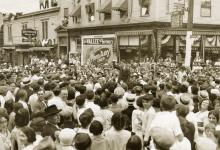 Rudy Valle greets people in Vallee Square in 1930. Vallee Drug Store, operated by his father Charles Vallee, is in the background.
Send questions/comments to the editors.
