



A CLOSER LOOK
Biodiversity Research Institute’s Web site is www.BRILoon.org.
Scientists from the institute are available for classroom presentations in schools. Call 839-7600.
Although the state advises pregnant women not to eat fish from Maine lakes, a leading researcher at an institute in Gorham that’s been studying mercury levels would take that warning much further.
“I wouldn’t eat fish under any circumstance from any Maine lake because of mercury,” Wing Goodale, deputy director and senior scientist at Biodiversity Research Institute, said Tuesday.
The warning comes as communities across Maine observe Earth Week, the yearly event to celebrate the Earth and discuss current environmental issues and solutions.
Biodiversity Research Institute, 19 Flaggy Meadow Road, is a nonprofit organization that conducts research across the United States and parts of Canada. It monitors the impact of mercury in the environment through testing insects, monitoring bird nesting, and analyzing feathers and blood samples from live birds. The institute studies bald eagles and loons, which dine on fish.
The institute has caught, banded and safely released more than 3,000 loons in North America. It studies loons because they are an indicator of the health of lakes.
It also monitors an eagle wearing a $3,000 satellite transmitter, which was installed on an injured bird that was later released into the wild.
“It’s a little backpack,” Goodale said. “We get a position twice a week.”
The institute partners with a variety of state and federal agencies along with several universities and colleges, including the University of Southern Maine.
The institute offers reports to members of Congress and legislative delegations. Last week, Goodale met with U.S. Rep. Chellie Pingree and plans another, more formal meeting with her.
“Our role is to provide policymakers with information,” Goodale said.
On its Web site, the institute offers a bird’s eye view. The institute has cameras monitoring nesting eagles, ospreys, finches and peregrine falcons.
Next week, it will also have a camera observing a loon nest. In March, the Web site had 17 million hits.
“It’s people all over the world” who are logging on, Goodale said.
The institute was founded in Freeport by Dave Evers, who is executive director, in 1998. It later moved to Falmouth, and relocated to Gorham in 2004, where it owns its headquarters, a two-story colonial near the USM campus. The institute is outgrowing its Gorham headquarters. Goodale said a larger site would allow it to develop a visitor center, but the institute would like to remain in the Gorham area where it conducts some research.
Biodiversity Research Institute has 16 staff members now, but Goodale said the number would increase to 35 this summer.
In addition to mercury testing, Biodiversity Research Institute has begun testing for other pollutants like polybrominated diphenyl ethers (PBDE) in flame retardants, in addition to polychlorinated biphenyl (PCBs) once used in transformers, but banned in 1979.
“We’ve geared up to do a broad-based contaminant study in Casco Bay,” Goodale said,
Goodale said mercury winds up in the Maine environment through improperly discarded consumer products like lamps and thermometers, in addition to coal-burning industries and power plants in other regions whose emissions drift into Maine. He said mercury is released when coal is burned.
“We’re the tailpipe of America,” Goodale said.
Because of winds, power plants in the Midwest are a source of mercury found in Maine, but mercury could be blown here from as far away as China.
“It’s local, regional and global,” said Andy Johnson, a laboratory and quality assurance coordinator for air at the Maine Department of Environmental Protection, about sources contributing to mercury in Maine.
Although the Biodiversity Research Institute has been collecting mercury data for 10 years, Goodale said, he hasn’t seen a trend. Goodale said the “million-dollar question” is whether the amount of mercury entering the Maine environment is increasing.
Johnson said the total annual amount of mercury is unknown because only the deposits of mercury from rain and snowfall are measured.
Barry Mower, also of the Maine Department of Environmental Protection, said examination of fish tissues showed no decline of mercury levels in the 20-year period between 1980 and 2000. Mower said modern-day concentrations of mercury are three to five times higher than the pre-Industrial Revolution before the late 1800s, according to lake sediment core samples.
In birds, mercury can cause reduced egg production and impact survival rates for chicks. Goodale said loons with higher mercury levels are lethargic. Birds with high levels are less likely to provide enough food for their young, leaving them in peril.
Biodiversity Research Institute is also researching mercury impacts on otter, mink and bats that eat insects.
Because of mercury, Goodale said, there’s a fish advisory across Maine that pregnant women should not eat fish. “Mercury impairs development of minds,” Goodale said.
The state has warned that mercury builds up in freshwater fish in Maine lakes, ponds and rivers. Predator fish, like pickerel and bass, have the highest concentrations of mercury.
John Boland, fisheries director at the Maine Inland Fisheries and Wildlife Department, Tuesday cited a warning published in the state’s fishing laws and rules.
“Pregnant and nursing women, women who may get pregnant, and children under age 8 should not eat any freshwater fish from Maine’s inland waters. Except, for brook trout and landlocked salmon, one meal per month is safe.
“All other adults and children older than 8 can eat two freshwater fish meals per month. For brook trout and landlocked salmon, the limit is one meal per week.”
Boland said lake trout, bass, pickerel and sometimes perch are more likely to have higher levels of mercury than brook trout and salmon, which have shorter life spans.
For lake trout and bass, “Most folks should limit to a couple of meals a month to be on the safe side,” Boland said.
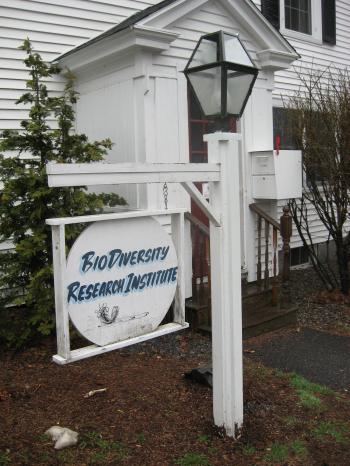 Cutline (Biodiversity Research Institute)- Biodiversity Research Institute in Gorham.
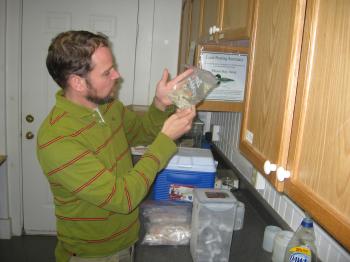 Cutline (Wing Goodale)
Send questions/comments to the editors.
