



As anyone with a backyard pond can attest, the high-pitched chorus of peepers is a sure sign of spring. What is more a surprise is that the sources of these calls are 1-inch long male tree frogs looking for love.
As Lakes Region residents welcome this vocal return of spring, the Maine Audubon Society is enlisting the aid of volunteers to determine just how many of these noisemakers live in the marshes and vernal pools in the state.
In Bridgton, volunteers with Lakes Environmental Association, a regional conservation association, will look as well as listen as they guide frogs and other amphibians across local roads to wetlands so they can mate and lay eggs.
Susan Gallo, a Maine Audubon Society wildlife biologist, coordinates the Maine Amphibian Monitoring Project, which is entering its 12th year of surveys. The program is looking for more “citizen-science” volunteers to conduct two-hour roadside surveys.
This year unfilled routes are mostly in northern and Downeast Maine. Volunteers make 10 stops along their routes, waiting five minutes at each and noting the frog species they hear. Before they start, volunteers listen to frog calls online and take a quiz.
The audible information gathered allows Maine Audubon to assess the size of amphibian populations in the state and is also submitted to the U.S Geological Survey as the agency evaluates habitats and populations throughout the country.
Gallo works with 80 volunteers, who were excited to hear the first peepers of the season. “The volunteers are frog people anyway,” Gallo said. “This year in particular they were so happy to hear the peepers calling. It’s the first real sign of spring.”
According to Gallo, it is also a late sign of spring this year, as the mating calls are being heard about two weeks later than normal.
Once the first peep is heard, it is not long before the full chorus starts. Dennis Hawkes of Windham said he heard just one peeper April 11, three or four the night after that, and many more the following night. “It’s great,” he said. “At night down by the pond it’s incredible how loud it is.”
It is only the males that call, with the purpose of attracting a female to mate. They also produce a high-pitched trill, which is a warning to other males to get out of their territory.
It is quite difficult to spot the frogs. They blend in well with the dead grass and reeds where they perch around ponds and in marshes. They are tan and sport dark lines in the shape of an X on their backs. The females lay eggs in sacs with the consistency of gelatin, which can be seen floating in shallow water.
The peepers aren’t the only frogs beginning to mate this time of year. Wood frogs add to the chorus with calls resembling a duck quacking, though their calls come less constantly than those of the peepers. Later in the spring and into the summer, Maine’s other frogs and salamanders will emerge to mate and lay eggs, including bull frogs, yellow-spotted salamanders and green frogs.
“When we get a night of warm rain, then frogs and salamanders will really start coming to life,” said Gallo.
The mass movements of amphibians are also celebrated by Lakes Environmental Association as it holds its Big Night Salamander Migration Watch. After a training session, volunteers take to local roads on warm rainy nights to help salamanders, frogs and toads cross country roads safely as they seek wet habitats.
Bridie McGreavey, coordinator of the association educational programs, anticipates the Big Night will come as quickly as this weekend, provided temperatures stay above 40 degrees at night and steady rains arrive.
The amphibians have been slower to move in Bridgton and other areas to the north and west of Windham, but McGreavey said she first heard the chirping last Saturday.
Once the rains come, McGreavey said as many as 65 volunteers might help guide amphibians across rural roads so they might reach wetlands.
Peepers are more adaptable and resilient than many amphibian species. Gallo said volunteers hear peepers on 100 percent of the survey routes. They are found in a variety of habitats and are often the first to start breeding and the last to stop.
Wood frogs breed for a short time and only in vernal pools, which are depressions that fill with water during part of the year. Since vernal pools dry out, fish cannot survive there and amphibians can lay eggs without worrying about predations.
For more information about the Maine Amphibian Monitoring Project, or to volunteer, contact Susan Gallo at 781-2330, ext. 216, or e-mail sgallo@maineaudubon.org.
For more information on the Big Night Salamander Migration Watch or other Lakes Environmental Association programs, call 647-8580 or visit www.mainelakes.org.
Coming soon to a road near you in the Lakes Region are multiple species of amphibians looking to cross the road. In Bridgton, Denmark, Naples and Casco, as many as 65 volunteers could be there to give them safe passage.
Each year, Lakes Environmental Association hosts Big Night Salamander Migration Watch. The date is never fixed, volunteers are alerted by e-mail to be ready when the night temperatures climb above 40 degrees and rain falls.
That is the signal for wood frogs, salamanders, toads and other amphibians to seek wetlands for mating and laying eggs.
“I have found when I can see my breath, it is too cold for them to move,” said Bridie McGreavy, who coordinates educational programs for the association.
McGreavy said it could seem unusual for dedicated volunteers to go out in the dark to help amphibians cross the road, but amphibian populations are declining locally and globally due to the loss of habitats, pollution and pesticides. Big Night provides a chance to see species up close and experience what they do to survive and propagate.
The intent of some creatures can be hard to ascertain, according to McGreavy. Salamanders are always headed for wetland, but frogs may just want to absorb some of the radiational heat in the road. While a salamander might be carried across the road by a volunteer, the frogs might just be guided to the closest edge of a road, preferably towards wetlands.
Big Night volunteers are trained in workshops in late March or early April. To learn more about this and other association programs, call 647-8580 or visit www.mainelakes.org.
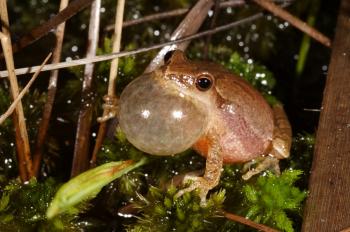 The source of the sound of spring peepers comes from male tree frogs in full throat. The peeps are made to attract mates and protect territory.
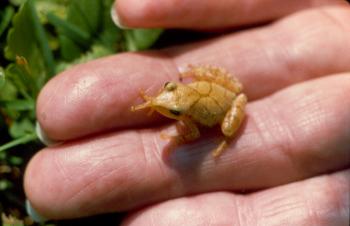 A tree frog, the source of the peeping sound signalling the return of spring to many, is approxiimately 1-inch long and vary hard to see in the reeds and grass inhabits because ot its markings.
Send questions/comments to the editors.
