



While most anglers prefer to put their bait where the fish are – underwater – fly fishermen like to coax the fish to the surface.
Unlike other types of fishing, fly-fishing also requires active use of the rod by the angler to simulate movement, while a traditional rod can be propped up until something gives it a tug.
Fly-fishing uses artificial flies made from feathers, animal fur and thread fashioned around a hook. Chris Banks, a self-employed painting contractor from South Portland, has been tying his own flies for the past ten years instead of buying them.
“The ones we tie work much better,” he said.
David Landergren of Limerick said he’s been tying his own flies for decades. He said he once caught a fish with just a hook and a cigarette butt. He’s also used the pull-tab from an old-fashioned beer can to make one in the 1960’s when he was short on money.
These days he’s using feathers and thread with some tinsel to gain attention. The body of the hook is wrapped and the feathers are bound in a big knot that has been decorated with eyes to resemble a head.
“It makes them more realistic,” said Landergren. He said the fish spot the eyes and think they’ve found their next meal.
Landergren and Banks said they coat the head of the fly with clear fingernail polish. It hardens it and protects the knot from the water.
“I feel weird buying it,” said Landergren of the nail polish. He said outdoor stores sell a special finishing varnish, but nail polish is cheaper and works just as well.
Banks said he borrows it from his wife and daughter.
John Bernard, 68, of Portland, a lifelong member of the Rod and Gun Club in South Windham. He said every little detail of a tied fly, down to the smallest off-color thread, has an impact.
“I think it all makes a difference,” said Bernard. He said he’s seen big differences in fish attraction from two lures that were nearly identical, save a small patch of red decoration.
“You’re trying to trick the fish, that’s all it is,” he said.
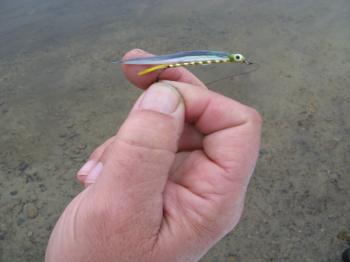 flytie: David Landergren of Limerick holds up one of his homemade artificial flies. The tinsel wrapped around the base of the hook is used to attract attention while the rest of the lure resembles a fly on the surface of the water.
Send questions/comments to the editors.
