



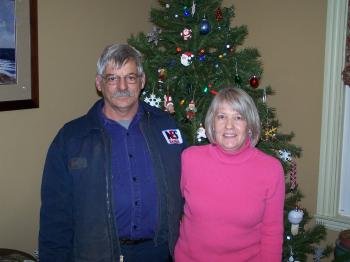
Nelson Wagner died in 2002 after a lifetime of raising strawberries at Dusty Hill Farm on Libby Avenue in Gorham. His widow, Irene, died the following year. They were buried in Eastern Cemetery beneath a strawberry-shaped headstone.
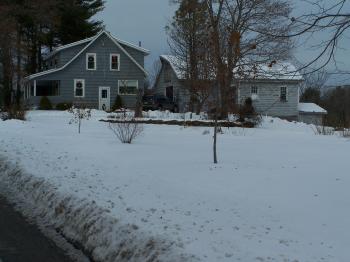
“This was his pride and joy. He was born in this house,” their daughter, Coleen Plummer, said of her father.
Coleen now lives in the house with her husband, Bill. They haven’t grown strawberries at the farm since her father died. The Plummers are selling 20 acres of the farm to a housing developer and keeping the home, barn and 3.5 acres.
Ironically, the farm is being developed under a new ordinance aimed at preserving open space and farms in Gorham, which have been falling victim to increasing demand from housing developers in recent years. The ordinance, adopted in September 2006, allows more clustered house lots in village areas served by public water and sewer.
Town Planner Deborah Fossum said the new ordinance is in line with the town’s comprehensive plan, which encourages high density in the villages to help save farm land.
Gorham is a fast-growing, former agricultural community whose population has increased from 11,856 in 1990 to an estimated 15,402 in 2006, according to U.S. Census figures. At one time it was one of the state’s leading dairy producers. Now, only five dairy farms remain, down from about 40 in the 1950s.
“We’ve had quite a bit of development in our rural areas,” Fossum said Wednesday.
The Wagner farm, she said, had a niche and was relatively small.
“Mainly, development grew up around it,” Fossum said.
With the new open-space ordinance, “We recognize we’ll lose some farms closer to town,” she said.
Coleen Plummer said her parents were proud of their farm near the Gorham Village. “There were no weeds in his fields,” she said.
She said she believes her father would have accepted the sale of the land to Risbara Bros. Construction Company Inc. in Scarborough.
“I think he knew it was going to happen,” she said, “but I’m sure he’d be sad.”
A request to develop the property has been submitted to the town, and it could be on the Planning Board’s February agenda. The town’s new ordinance, passed earlier this year, would allow 49 single-family homes to be built there, up 12 lots from 37 that would have been allowed under previous zoning.
Rocco Risbara, the owner of the construction company developing the property, did not return phone calls seeking comment.
For each of the additional 12 bonus lots, Fossum said, the developer would pay $15,000 into a town account to buy development rights from landowners to preserve land elsewhere in town.
Russ Sprague, a Libby Avenue neighbor and Town Council candidate last month, is disappointed that the farm is being subdivided, although he realized it was inevitable.
“I knew it would happen sometime,” Sprague said Tuesday.
Sprague said the ordinance is a good way to control sprawl. But Sprague, who isn’t opposing the development of the strawberry farm, doesn’t agree with density development in that area. He said it is 1.5 miles from Hannaford in Gorham Village.
Plummer, who has four brothers, is the third generation at the farm. Her brother, Dick Wagner, who lives in Raymond, suggested the housing development be named “Strawberry Fields.”
The other brothers are, Wayne, who lives in Connecticut; Tim, Gorham; and Mike, of Gorham, owner of the Ossipee Trail Garden Center in Gorham.
Their parents bought the farm, which has been in the family 86 years, from Nelson’s mother, Lena, in 1953. Lena Wagner’s father dug a ditch a third of a mile in from Main Street to pipe water to the farm. His implements were a pick and a shovel, along with an ox and plow.
As a youngster, Nelson Wagner, who overcame polio, walked to school. He was raised in the house, which had electricity and a toilet in the cellar. The house was heated with wood and some rooms were closed during the winter months.
According to his daughter, Nelson Wagner grew up helping with the laborious harvesting. A track used in hoisting loose hay into the loft is still in the barn.
When Nelson Wagner brought home his future wife, she quickly lent a hand to his mother, who was in the kitchen cleaning a chicken for cooking. Later, when she hadn’t seen the young woman for a while, she asked, “Where’s the nice girl from Westbrook?”
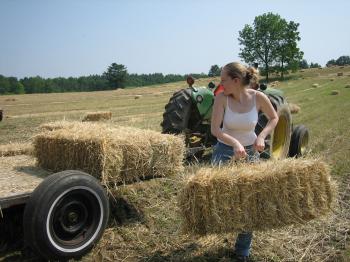
Nelson Wagner also produced hay and straw at the farm. He had kept a herd of 20 beef cattle along with one cow to provide milk for the family. Nelson and his wife both milked by hand, but Coleen said her dad could coax more milk from the cow. He would lean his head on Bessie and sing to the cow, she recalled with a smile.
Wagner had a knack for farming that he mixed with science for maximum production. His daughter said he had a secret formula for strawberry fertilizer. “He was scientific about the whole process,” she said.
He produced food for his family at the farm, and once raised an onion that weighed four pounds. In the house, he built the kitchen cabinets. “He could fix or make anything,” Coleen said.
He ran the farm while working full time at the paper mill in Westbrook. The farm once included a greenhouse and a flock of chickens. He sold eggs.
The Plummers were married at the farm. The Rev. Jack Perkins performed the ceremony on a hill in an alfalfa field.
“We have a lot of good memories,” Coleen said.
Even though they haven’t grown strawberries there since her father died, people still stop to ask, “Where’s the strawberries?”
 (Straw farm 3)
 (strawberry farm couple)
 (haying)
Send questions/comments to the editors.
