



For 10 days in October 60 years ago, Maine suffered its worst forest fire in more than a century. Maine, with its 90 percent forested land, had a good record regarding destructive forest fires. Until the fall of 1947, that is.
After a mild winter with an average snowfall, spring arrived early. March temperatures sometimes reached into the 80s melting snow and creating soggy fields. From April through June there was an overabundance of wet weather. Steady rain, heavy at times, added to the muddy conditions. Planting was delayed, seedlings were slow to take root and grow and those that did were sparse and undersized.
Yet no appreciable rainfall was recorded during July; only a quarter-inch of moisture fell in August. September recorded less than 2 inches of fine rain in Cumberland County, about half of what it should have been. Maine was in the midst of its worst drought in 30 years. Wardens in lookout towers were constantly searching their assigned areas for any signs of smoke.
Following the destructive hurricane of 1938, which left acres of windfall and debris to dry out and rot, the remains on the ground now became tinder dry, making an ideal source for the upcoming conflagration nine years later.
Fall foliage appeared more colorful than in the past. However, fire wardens were becoming increasingly alarmed at the developing conditions as water levels in the lakes and ponds lowered, and streams were reduced to little more than a trickle. By the second week of October, the woods in southern Maine were in a Class 4 state of danger – in other words, “a high state of inflammability.”
Residents were urged to be careful disposing of matches or cigarette butts and cautioned against outside burning to clear land.
Several small woods fires were reported in Cumberland County, southern Oxford and York counties. By the 15th, 10 fires were burning in Maine. Students from Bowdoin College were hired to help dig trenches to serve as fire breaks; other towns used bulldozers to assist their firefighters. The smell of burning wood lingered as the skies became hazy with smoke.
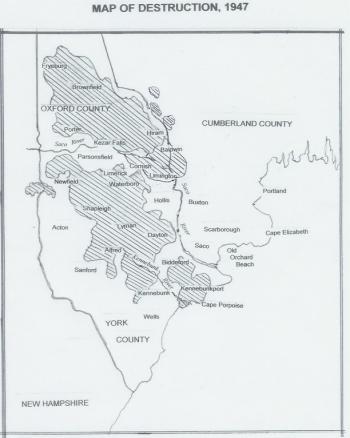
A lookout tower in Waterboro reported sight of smoke and fire in the woods, including Waterboro, Shapleigh, Alfred, Newfield, Lyman and Dayton, which appeared to be heading straight toward the ocean. Biddeford, the Kennebunks and Cape Porpoise were engulfed along its rush south, leaping over Route 1 and the Boston & Maine Railroad tracks in its path.
Northeast of this fire others were sighted in the Fryeburg, Brownfield, Baldwin, Hiram, Porter, Parsonsfield and Kezar Falls areas.
Newspapers in Boston sent reporters and photographers to cover the situation. Farther north in the resort town of Bar Harbor, “Millionaire’s Row” was under siege. Residents escaped their homes retreating to the pier extended in the harbor. The Jackson Laboratory suffered considerable damage to its research facility.
Volunteers responded to calls for assistance. Gov. Hildreth ordered National Guard companies to join the fray. The U.S. Navy sent men and equipment from the base in Portland; the U.S. Coast Guard ship Laurel entered the mouth of the river at Kennebunk to evacuate residents and to run fire hoses ashore.
Fire engines and volunteers from Cape Elizabeth joined those from other towns, strangers all, who worked together to fight a common enemy – fire – whenever and wherever needed. Eighty soldiers accompanied by medics were sent from Fort Williams to assist, as were Coast Guardsmen and equipment from stations at Cape Elizabeth, South Portland and Biddeford Pool.
All of this extra manpower needed to be fed. The Red Cross arrived, as did the Salvation Army to offer their assistance. Homeowners, business owners and others joined forces to provide the nourishment. Sandwiches, hot and cold drinks, huge pots and kettles of hot food were devoured by the hot, hungry and tired.
One family, distant relatives of this writer living in the village of Kezar Falls shared their story: The lady of the house, Mrs. Gertie Pierce, did all the cooking and preparation while her husband Eddie and young son Maynard delivered sustenance to the hard-working men on the fire line. Gertie stated, “Every time I looked out my kitchen window, I could see the mountain burning!” so she kept cooking and preparing additional food.
Although Cape Elizabeth escaped relatively unscathed as far as fire damage was concerned, the three months of steady rain followed by another three months of severe drought affected local crops of vegetables and fruit. Hay and fodder for the animals was also in short supply.
The estimated tally of economic damages exceeded $30 million. Dairy farms lost livestock and farm implements as well as 280 barns. Ruined homes numbered 1,182. Another 1,193 other buildings including churches, town offices and businesses disappeared in the space of 10 days in October 1947. Nine communities were totally destroyed, four others severely damaged. Loss of life numbered 15.
For many years thereafter whenever our family visited the Pierce family in Kezar Falls we were very conscious of the dead, blackened tree stumps standing like sentinels guarding the wasted acreage. The only indication that a dwelling formerly occupied a site was the tall brick chimney with its gaping fireplace left standing amid the rubble.
 History Matters – Fire of ’47: 10 days, 15 deaths, $30 million in damages
Send questions/comments to the editors.
