



Music masters
Last week, just by luck, I turned on the TV to Channel 10 for the New York Philharmonic concert, led by Lorin Maazel. They were then playing Dvorak’s B-minor Cello Concerto.
The featured cellist was thrilling to hear and watch, as he played frequent solo arias emotionally, often closing his eyes, moving his head, etc. I thought how accomplished he was, comparing him in my mind to the famous cellist, Yo-Yo Ma.
I hadn’t heard the Dvorak symphony the orchestra played first, nor the first movement of the Cello Concerto, or any announcement of who the cellist was, until I read Anthony Tommasini’s review of the Dvorak program in the Sept. 21 New York Times. It was indeed Yo-Yo Ma himself playing cello.
Tommasini wrote, “Anytime Yo-Yo Ma plays the Dvorak Cello Concerto, the occasion becomes a significant musical event. So it was Tuesday, when he performed this enduring work during the opening concert of the New York Philharmonic’s season at Avery Fisher Hall.”
Yo-Yo Ma was born in Paris Oct. 7, 1955. His parents were Chinese. He was enrolled in a class for cello lessons at the age of 4. His first recital was at age 6. He went to New York City in 1962 and studied at the Juilliard School with Leonard Ross. He graduated in liberal arts from Harvard College in the class of 1976.
So our family had a slight connection with him, I say proudly, as our son Daniel was a 1976 graduate of Harvard, too.
Yo-Yo Ma has been performing the Dvorak concerto prominently for at least 30 years. His technical command remains incomparable. The variety of colorings, shadings and nuances, as always, was wondrous.
Yo-Yo Ma is world renowned, playing in many countries, with the best-known orchestras.
With this program the conductor, Lorin Maasel, began his sixth season as music director of the New York Philharmonic, his next to last. It was a pleasure to watch him conduct, too. Tommasini said of him, “He has kept the orchestra in terrific condition, The playing of all three Dvorak works was exemplary. Following tradition, the concert began with Mr. Maazel conducting the national anthem in his trademark stately manner.”
Now, the composer, whom I read about in Grove’s Dictionary of Music and the Encyclopedia Brittanica:
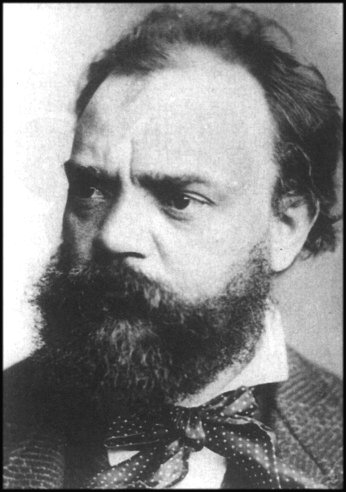
Antonin Dvorak, the first Czech composer to achieve worldwide recognition, was born at Nelahozeves, a small village on the Vitava, north of Prague, on Sept. 8, 1841. He developed an impressive series of works which quickly came to rank in popularity with those of his great German contemporaries.
His father was a humble innkeeper and butcher, and Dvorak was undoubtedly influenced by the amateur music-making which he heard and contributed to in the inn. He soon became an accomplished violinist. In 1857 a perceptive local teacher, A. Lishmann, recognizing his unusual talent, persuaded his father to send him to the Organ School in Prague. After a two-year course, Dvorak, worked as an orchestral viola player, organist, and teacher in order to keep himself while engaged on his first serious composition.
In November 1873, at a time when a few successful concerts of his works had begun to make his name well known in Prague, he married Anna Cermakova, and thus began an unusually happy family life. In 1875 he was awarded a state grant by the Austrian government, and this brought him into contact with Brahms, with whom he formed a close and fruitful friendship. Brahms not only gave him valuable technical advice, but also found him an influential publisher in Fritz Simrock, and it was with his firm’s publication of the Moravian duets (1875) for soprano and contralto, and the Slavonic dances (1878) for piano duet that Dvorak first attracted world-wide attention to himself and his country’s music. The admiration of the leading critics, instrumentalists and conductors of the day continued to spread his fame abroad, which naturally led to even greater triumphs in his own country.
In 1884 he made the first of 10 visits to England, where the success of his works, especially his choral works, was a source of constant pride to him. In 1890 he enjoyed a great personal triumph in Moscow with two concerts arranged for him by his friend Tchaikovsky. The following year he was made an honorary doctor of music at Cambridge University. In 1892 he accepted the post of director of the National Conservatory of Music in New York, but, much as he found to interest and stimulate him there, he soon came to miss his own country and he finally returned to Bohemia in April 1895. The final years of his life saw the composition of two string quartets, five symphonic poems and his last three operas. He died in Prague on May 1, 1904, from a stroke of apoplexy.
Actually, I was glad to be watching that Cello Concerto on TV, instead of being there in the Avery Fisher Hall at Lincoln Center. For the camera focused frequently on Yo-Yo Ma, showing us his facial expressions, his body movements, etc. I felt as if I were in the first row, ground floor, with my binoculars helping me catch his wonderful performance.
Recall woes
At the top of Page 1 of a Sept. 22 Boston Globe was a picture of a beaded bracelet in color. The story was about a cancer charity group called The Friends of Mel, which has recalled about 200,000 of the bracelets because of lead content. “Local anticancer group blames Chinese supplier,” said a headline.
Well, what next? The cancer charity had raised more than $1 million for Massachusetts General Hospital by selling the memorial bracelet, and recalled about 200,000 of them Sept. 21 after receiving a report that a 9-month old boy became ill after ingesting lead when he put one in his mouth.
Tests confirmed that the bracelets contained high levels of lead. A spokesman blamed a supplier based in China that had promised in writing that none of the materials it provided contained the toxic element. A spokesman said, “The organization feels that they were lied to and were given a bad product.”
The cost of the recall to the foundation had not been determined yet.
Berry appealing
Today’s recipe is from “Good Grange Cooking,” from the Maine State Grange, 1992. We are still able to get fresh blueberries here in Maine, so here is a good recipe.
BLUEBERRY PUDDING
2 cups blueberries
Lemon juice
3/4 cup sugar
3 tablespoons butter
1/2 cup milk
1 cup flour
1 teaspoon baking powder
1 cup sugar
1 tablespoon cornstarch
1/4 teaspoon salt
1 cup boiling water.
Spread blueberries in bottom of pan. Sprinkle with lemon juice. Cream 3/4 cup sugar with 3 tablespoons of butter. Add 1/2 cup milk alternately with flour, sifted with baking powder and salt (spread over berries).
Combine 1 cup sugar with cornstarch; sprinkle over mixture. Pour boiling water over all. Bake for 1 hour at 375 degrees.
Best served with whipped cream or ice cream.
Submitted by Arlene Layr, Weymouth Grange.
 Ramblings
Send questions/comments to the editors.
