



Frances Redstone laughs with her grandson Christopher King, who has just come to visit after a golf game. Carol King – Frances’ daughter – sits at her mother’s bedside.
Redstone’s blue eyes are bright, even merry, as she surveys the visitors in her room. She clearly enjoys the attention.
“This is the most beautiful place,” said Redstone. “Of course, I would rather go home. But the nurses are so wonderful. I can’t imagine not being here.”
Here is Gosnell Memorial Hospice House, a new 18-bed facility that provides end-of-life care for terminally ill patients too sick to live at home. The hospice house aims to create a home-like environment while still meeting a patient’s end-of-life needs.
Redstone, 80, is dying of melanoma, a pernicious form of skin cancer that started as a pimple on her foot and spread to her liver, lungs and brain.
Redstone’s stay at the hospice house shows how the facility and its resources meet a critical need for in-patient care for adults in the final weeks of life.
Redstone’s physician referred her to the hospice house, when it became clear that her cancer was too debilitating for her family and a home health nurse to manage.
Frannie, as she is affectionately called by staff, arrived at the home in the beginning of August. “I wasn’t sure how I would feel about coming here,” she said. “But when I stepped through the doors, it felt like I was in heaven.”
The care at the hospice house is a contrast to Redstone’s hospital stays each time her condition worsened. “It wasn’t personal there,” Redstone said. “It was bright and loud.”
Hospitals are geared to diagnose and treat patients, then send them home. They are not set up to provide end-of-life care in a comfortable setting.
Redstone first stayed at the hospice house for a week. She improved so much she went home. But her condition worsened, causing her to lose the ability to walk or think clearly.
The home health nurse said it was time to return to the hospice house. Redstone knew she was coming back to die.
“She always has been a strong, determined individual,” King said. “She never really lets anything get her down.”
When Redstone was wheeled into her room, the staff was there to welcome her. “It was like they were saying, ‘We’re glad you’re home,'” Redstone said.
Frannie’s angels
Medical staff at the hospice can control pain as Redstone’s disease advances. Workers watch her like a hawk to make sure she is safe, and sensors on her bed let them know when she tries to stand without assistance.
“She calls all the nurses and the entire staff Frannie’s angels, they have been so good to her,” said King. “They allowed her minister to come in with members of the church.”
Redstone’s pastor from the First United Methodist Church in South Portland arrived recently with several congregants. They used one of the large conference rooms to hold a special service for Redstone. It meant the world to her.
King’s family also feels a burden has been lifted. She says they worry less about the day-to-day problems and can focus on spending time with Redstone before she dies.
“They’ve made her feel so comfortable,” King said.
Redstone’s great grandchildren have also come by. The spacious patient rooms are bright with natural light. They’re not like an institution. They look like small apartments, with enough room for family members and to fit a wheelchair.
King is at her mom’s bedside every day. Watching her mother’s condition worsen takes its toll. She is exhausted and vigilant at the same time.
“I have days when I’m tired,” King said. “I lay down beside her in bed and take a nap when she naps.”
The cancer causes Redstone to fall into deep sleeps, though she tries to stay awake for her family. “I tell her, ‘Don’t worry, mom. Just go to sleep,’ ” King said.
Kirsten King is the hospice house social worker and no relation to Carol King. Her job is to offer support to hospice patients and their loved ones.
She told Carol about bereavement support groups she can attend. She makes herself available when Carol needs to talk. She sits and talks with Redstone and her family.
Redstone knows her time is near.
She picked out her casket, asking her son to bring a brochure to the hospice house. She wrote her obituary. She gave away her important belongings.
Redstone even chose the navy blue dress she wants to have on for her funeral and burial. She told her daughter to make sure she is dressed in blue nylons.
She wants to be warm in the afterlife.
“She says her feet always get cold,” Carol said smiling. “She told me, ‘Just remember to make them put my knee lengths on at the funeral home. And make sure they are the navy blue ones that match the dress.’ “
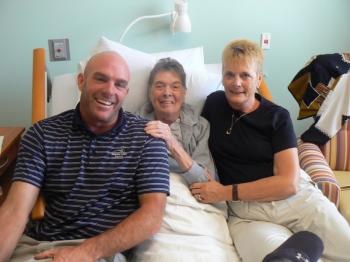 Frannie Redstone, who is dying of melanoma, sits in her bed at Gosnell Memorial Hospice House with her grandson Christopher and daughter Carol.
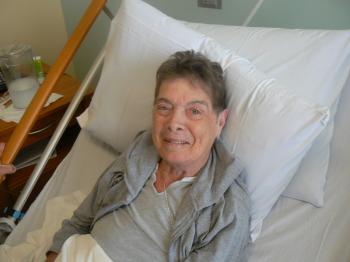 Frannie Redstone’s pain is controlled as her cancer advances by the hospice house staff, who watch her closely. Sensors alert them if she tries to stand without assitance. ister to come in with members of the church.
Send questions/comments to the editors.
